The short answer
A B2B martech stack for 2027 keeps three layers you own: the CRM as system of record, consent and first-party data, and a governed analytics layer. AI agents take over the manual work between tools, such as list building, campaign QA and reporting. Cut overlapping point tools and make every vendor easy to leave.
Key takeaways
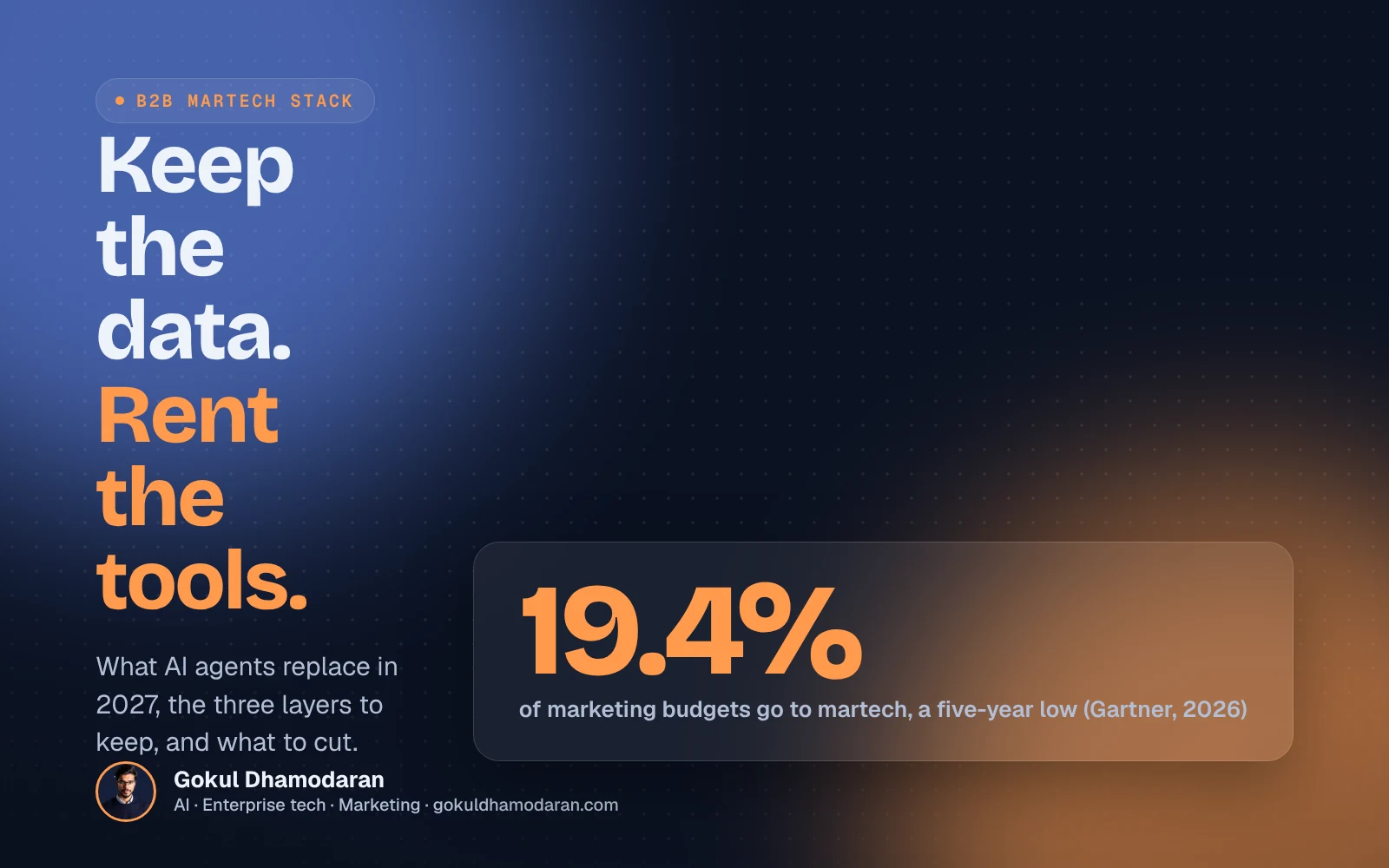
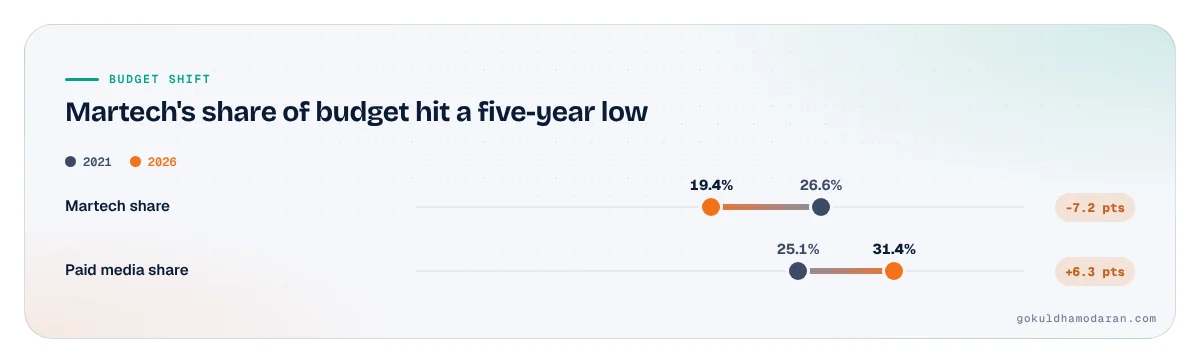
- Martech fell to 19.4% of marketing budgets in 2026, from 26.6% in 2021 (Gartner CMO Spend Survey).
- Keep three layers: the CRM as system of record, consent and first-party data, and governed metrics.
- Agents replace the manual work between tools: lists, routing, campaign QA, ops tickets and reporting.
- Mailchimp sold for $3.68B after a ~$12B purchase in 2021. Plan for any tool's owner to change.
- Run a 30-day review: inventory, keep-cut-automate tags, one agent workflow, an export test.
On November 19, 2026, Bending Spoons agreed to buy Mailchimp from Intuit for $3.68 billion in cash. Intuit had agreed to pay about $12 billion for it in September 2021. If your newsletter, nurture flows or event emails run on Mailchimp, the company that owns your tool will change in early 2027, and you had no vote.
That is the quiet lesson for anyone planning a B2B martech stack for 2027. Tools come and go, and so do their owners. The parts you must own are your customer record, your consent and first-party data, and the numbers your leadership trusts. This guide shows what AI agents now replace, what to keep, what to cut, and how the stack changes by company stage.
What is a B2B martech stack?
A B2B martech stack is the set of software a business-to-business marketing team uses to find accounts, reach buyers, capture leads, pass them to sales and measure revenue. It usually spans a CRM, a marketing automation platform, data and enrichment tools, ad and intent platforms, a website and content system, and an analytics layer. In 2027 it also needs an agent layer that does routine work across those tools.
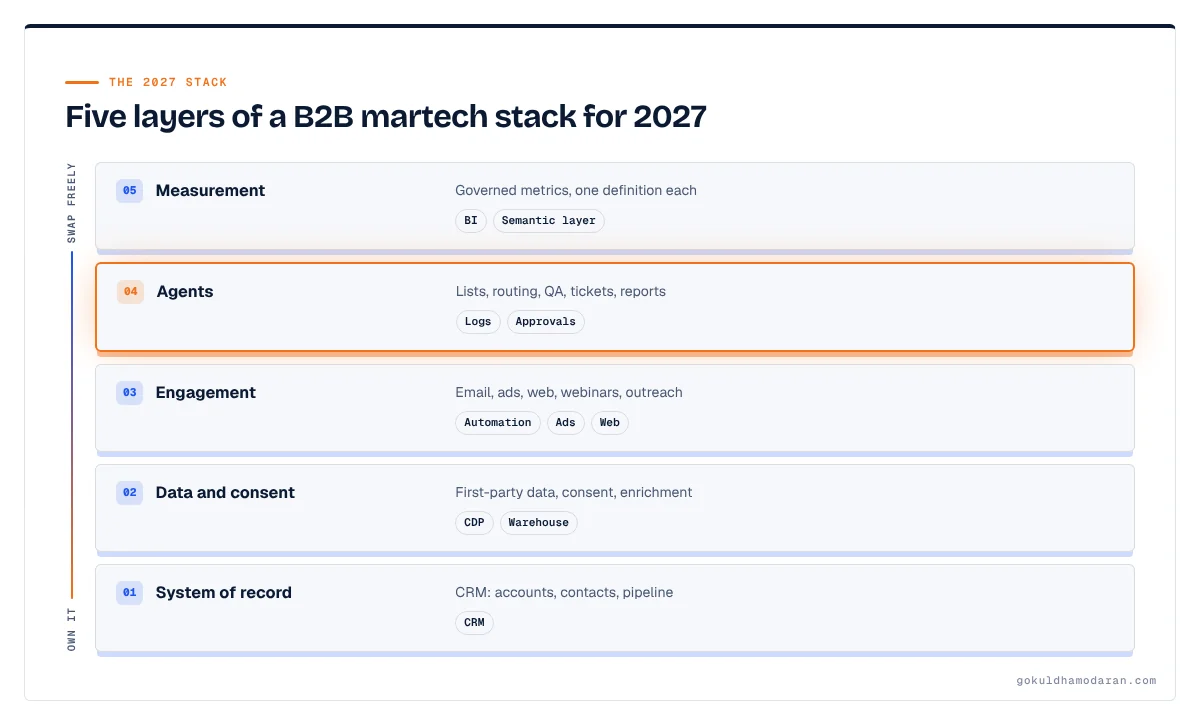
I think about it in five layers, from the bottom up. The layers matter more than the logos, because logos change. Get the bottom two right and you can swap almost anything above them without losing your history.
- System of record: the CRM that holds accounts, contacts, opportunities and revenue.
- Data and consent: first-party data, consent records, enrichment and the warehouse or CDP that joins them.
- Engagement: email, ads, website, webinars, chat and sales outreach.
- Agents: AI that builds lists, checks campaigns, files tickets and drafts reports across the other layers.
- Measurement: a governed analytics layer with one definition for every metric.
Five layers of a B2B martech stack for 2027
- 05MeasurementGoverned metrics, one definition eachBISemantic layer
- 04AgentsLists, routing, QA, tickets, reportsLogsApprovals
- 03EngagementEmail, ads, web, webinars, outreachAutomationAdsWeb
- 02Data and consentFirst-party data, consent, enrichmentCDPWarehouse
- 01System of recordCRM: accounts, contacts, pipelineCRM
gokuldhamodaran.com
What changed in the martech stack in 2026
Four dated facts explain why a 2027 plan looks different from a 2024 plan. Each one points the same way: fewer tools, more automation, and more value in the data you control.
- Nov 19, 2026: Bending Spoons signed a definitive agreement to buy Mailchimp for an enterprise value of $3.68 billion, all cash, with closing expected in early 2027 (Bending Spoons release, filed with the SEC). Intuit had agreed to pay about $12 billion in 2021 (Intuit release, Sept. 13, 2021).
- May 2026: Gartner’s 2026 CMO Spend Survey of 401 CMOs put martech at 19.4% of the marketing budget, down from 26.6% in 2021, a five-year low (Chief Marketer, June 24, 2026).
- Same survey: CMOs put 15.3% of the budget into AI, and 56% raised the share of martech spend on consumption-based pricing in the past year (Gartner, May 11, 2026).
- May 5, 2026: Scott Brinker’s 2026 Marketing Technology Landscape counted 15,505 products, up just 0.79% from 15,384. Additions fell 40% to 1,488 and removals rose to 1,367 (chiefmartec).
Brinker’s own summary: “After 15 years of relentless expansion, we may have finally hit peak martech — or at least a plateau.” He also counts more than 29,000 MCP servers listed across registries in about 18 months. That number matters more than the plateau. Tools are now judged by how well agents can work with them, not by how many screens marketers log into.
Martech's share of budget hit a five-year low
20212026
- Martech share26.6%19.4%-7.2 pts
- Paid media share25.1%31.4%+6.3 pts
gokuldhamodaran.com
What do AI agents replace in a B2B martech stack?
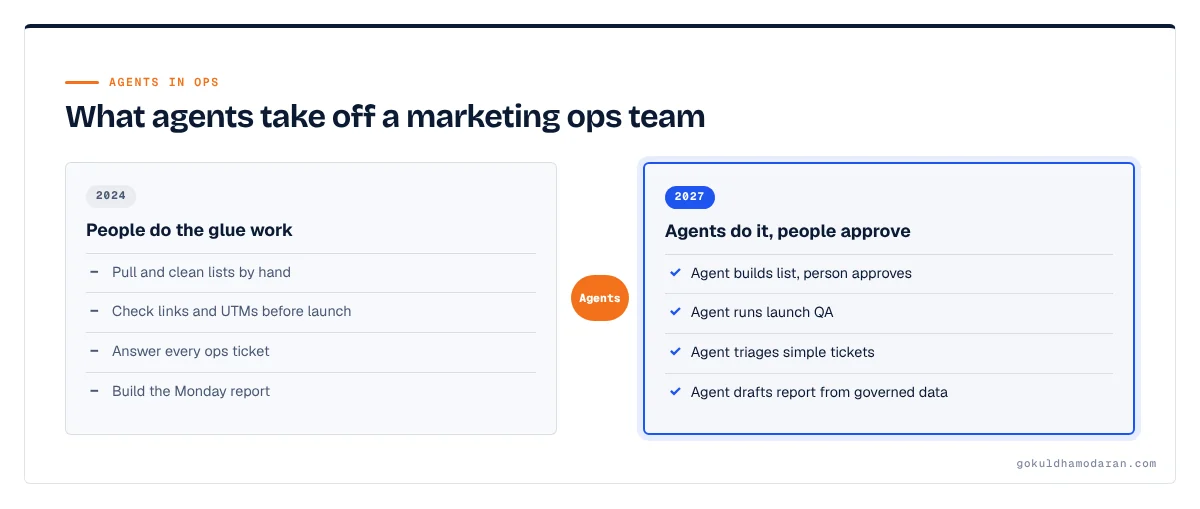
AI agents in a B2B martech stack replace the manual work between tools, not the tools that hold your data. The best targets are high-volume, rules-based tasks where a person already checks the output: building and enriching lists, routing leads, checking campaigns before launch, filing ops tickets and assembling the weekly report. The CRM, consent records and metric definitions stay put.
Here is where I would hand work to agents first, in order of payback.
- List building and enrichment. An agent pulls accounts that match your ICP, fills missing fields from your enrichment source and flags duplicates. A person approves the list before it syncs to the CRM.
- Lead routing and follow-up. An agent reads the form fill, checks the account owner and drafts the first reply. Rules decide who gets the lead. The agent only does the busywork.
- Campaign QA. Before launch, an agent checks links, UTM tags, audience size, suppression lists and consent flags. This is the step most teams skip under deadline pressure.
- Ops tickets. “Add a field”, “fix this list”, “why did this email go to churned customers?” An agent can triage, answer the simple ones and route the rest.
- Reporting assembly. An agent pulls the week’s numbers into one summary with notes on what moved. It reads from your governed metrics, never from a spreadsheet someone edited.
- First drafts. Briefs, ad variants and email copy, checked by a person against your brand and claims rules.
Notice what is missing. Agents do not replace your judgment on which accounts matter, and they do not become your source of truth. When an agent writes to the CRM, it should leave a log a person can read. I covered why agent projects stall in why agentic AI projects fail; the same rule applies in marketing ops: one owner, one workflow, one metric.
What agents take off a marketing ops team
People do the glue work
- Pull and clean lists by hand
- Check links and UTMs before launch
- Answer every ops ticket
- Build the Monday report
Agents do it, people approve
- Agent builds list, person approves
- Agent runs launch QA
- Agent triages simple tickets
- Agent drafts report from governed data
gokuldhamodaran.com
What should you keep in your martech stack?
Keep three things in your martech stack no matter how much AI you add: the CRM as the system of record, your consent and first-party data, and a governed analytics layer. These are the parts that carry your history and your trust. Everything above them can be swapped, consolidated or handed to an agent with far less risk.
1. The CRM as the system of record
Every account, contact, opportunity and closed deal should live in one CRM. Agents, ad platforms and outreach tools read from it and write back to it. When I ran account-based marketing for SAP-focused enterprise solutions, the stack ran on HubSpot, Demandbase, ZoomInfo and Apollo. The lesson that stuck: the program is only as good as the account record underneath it. If the CRM and the intent tool disagree on who owns an account, the campaign fails before it starts. My account-based marketing program guide goes deeper on that setup.
2. Consent and first-party data
Consent records, preference settings, form fills, product usage and event attendance are yours. Third-party lists are rented. Keep consent in a place you can export, audit and pass to every tool, including agents. An agent that emails someone who opted out is a legal problem, not a productivity win.
3. A governed analytics layer
A governed analytics layer is one place where each metric has one definition: what counts as an MQL, a sourced opportunity or pipeline. I build AI analytics tools that answer business questions in plain English and show the query behind every number. The reason is simple. Leaders stop trusting AI answers the first time two reports disagree. If you let agents report on top of ungoverned data, they will produce confident numbers that nobody can trace.
What should you cut?
Cut tools that duplicate a feature your CRM or automation platform already has, tools nobody has logged into for 90 days, and point solutions whose only job is now done by an agent. Gartner’s numbers explain the pressure: martech fell from 26.6% to 19.4% of the marketing budget between 2021 and 2026 while paid media rose to 31.4%.
- Overlapping point tools. Two enrichment sources, two webinar tools, three form builders. Pick one each.
- Shelfware seats. Licenses bought for a launch and never used again. Check last-login data before renewal.
- Thin AI wrappers. A tool that only adds a prompt box to another product. The content marketing category had the largest outflow on Brinker’s 2026 map, with 176 products removed.
- Manual glue. Zapier chains nobody owns and CSV exports someone runs every Monday. Replace them with one integration or one agent with a named owner.
Watch the new cost model too. Gartner notes that half of consumption-pricing adopters keep renegotiating contracts to avoid usage spikes. Agents run on usage, so an agent that loops can run up a bill overnight. Set a monthly cap in the contract and an alert in the tool.
How should a B2B martech stack change by company stage?
A B2B martech stack should grow with the size of the go-to-market team, not with the number of vendor demos. Early teams need one CRM with built-in automation. Growth teams add enrichment, intent and an analytics layer. Enterprise teams add a warehouse or CDP, formal consent management and an agent platform with audit logs. The core three stay the same at every stage.
| Layer | Early (under 50 people) | Growth (50 to 500) | Enterprise (500+) |
|---|---|---|---|
| System of record | CRM with built-in email | CRM plus automation platform | CRM integrated with ERP and billing |
| Data and consent | Consent in the CRM | One enrichment source, intent data | Warehouse or CDP, consent platform |
| Agents | Built-in AI features | Agents for lists, QA, reporting | Agent platform with logs and approvals |
| Measurement | CRM reports, web analytics | One BI tool, shared metric definitions | Governed semantic layer |
| Biggest risk | Buying tools before process | Overlap and shelfware | Data that disagrees across regions |
The martech stack by company stage
Early
Growth
Enterprise
gokuldhamodaran.com
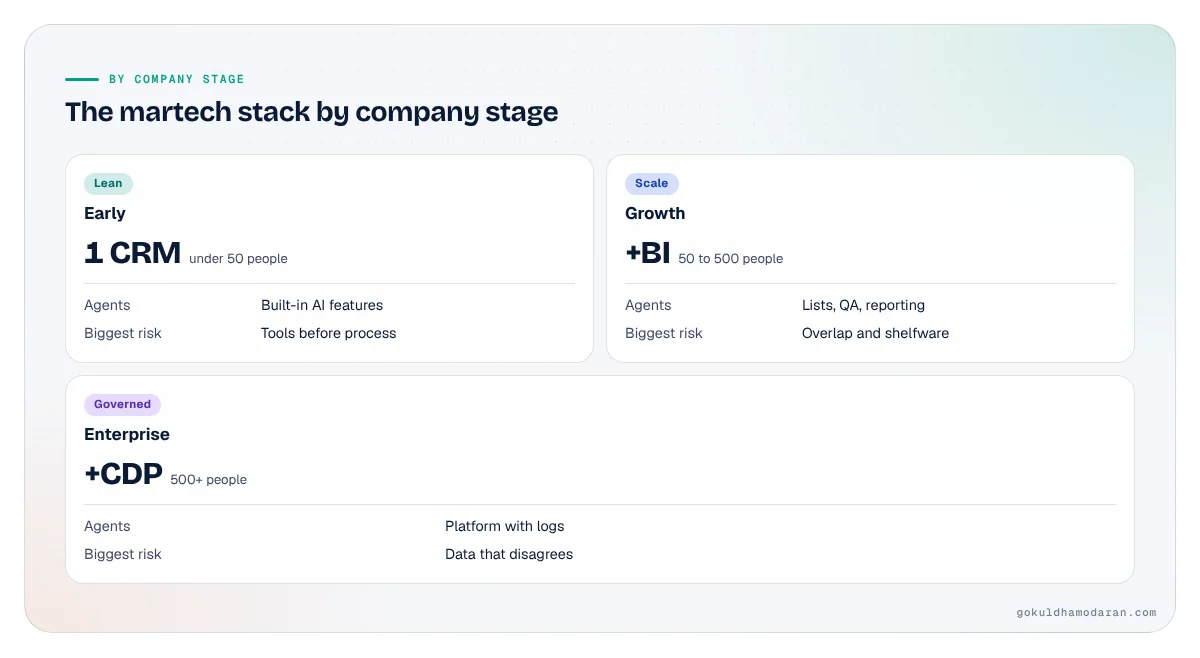
One caution for early teams: do not buy an intent tool before you have a named list of target accounts and a sales team that will act on the signal. For growth teams, the move that pays most is shared metric definitions. For enterprise teams, it is a clean link between the CRM and the ERP, so pipeline and booked revenue match.
How do you reduce vendor risk in your martech stack?
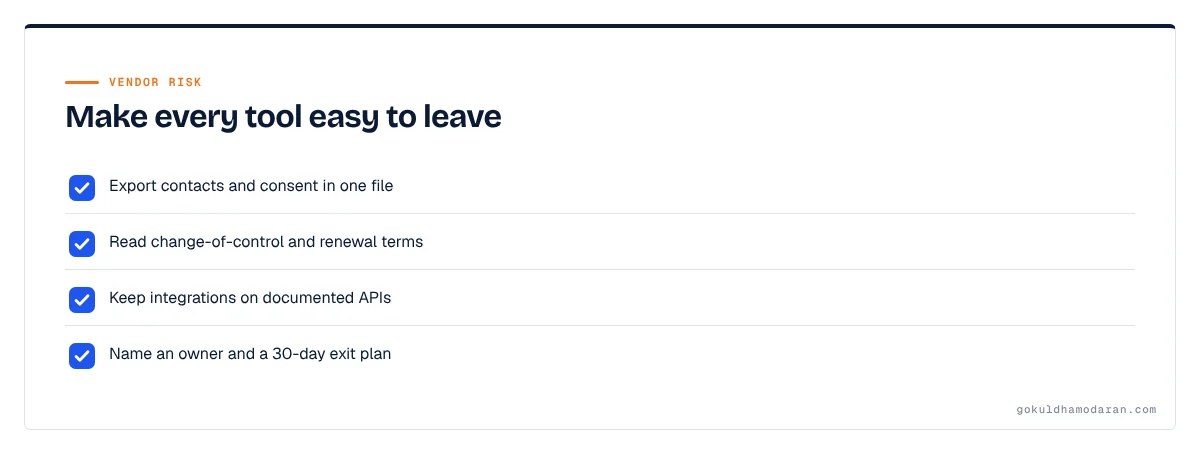
You reduce vendor risk in a martech stack by making every tool easy to leave. Keep your data exportable in a standard format, read the change-of-control and price-increase terms in each contract, keep integrations on documented APIs, and name an owner for each tool with a 30-day exit plan. The Mailchimp sale is the reminder: owners change while your contract runs.
Bending Spoons says it will invest in Mailchimp after closing, and Intuit says it is focused on a smooth transition for customers. Nobody can tell you today what pricing or product changes follow. That is the point. Plan for any tool’s owner to change, then check these four things this quarter:
- Export test. Can you export contacts, consent history and engagement data today, in one file, without a support ticket?
- Contract terms. What happens to price and terms on a change of control or at renewal? Ask your legal team to check the details.
- Integration path. Do your connections use documented APIs, or a workaround that breaks on the next update?
- Owner and exit plan. Who owns the tool, and what would you move to in 30 days?
Make every tool easy to leave
- Export contacts and consent in one file
- Read change-of-control and renewal terms
- Keep integrations on documented APIs
- Name an owner and a 30-day exit plan
gokuldhamodaran.com
How is a B2C martech stack different?
A B2C martech stack is built for volume and speed, while a B2B martech stack is built around accounts and long buying cycles. Consumer brands put a CDP, ecommerce platform and mobile messaging at the center and measure purchases and repeat rate. B2B teams put the CRM at the center and measure pipeline across a buying group.
- Unit: B2C tracks a person; B2B tracks an account and the people in its buying group.
- Center: B2C runs on a CDP and commerce data; B2B runs on the CRM.
- Cycle: B2C measures in days; B2B measures in quarters.
- Agents: B2C agents personalize offers at scale; B2B agents prepare accounts and hand off to sellers.
The core rule holds for both: own the customer record, the consent and the metrics.
A 30-day review for your 2027 stack
You can review the whole stack in a month without a consultant. Do it before budget season, so the cut list funds the agent work.
- Week 1: Inventory. List every tool, its owner, annual cost, renewal date and last login. Map each one to a layer.
- Week 2: Keep, cut or automate. Tag each tool. Confirm the CRM, consent records and metric definitions are in good shape.
- Week 3: Pick one agent workflow. Choose one task from the list above, name an owner and set a baseline metric.
- Week 4: Risk check and plan. Run the export test on your top five tools and write the renewal calendar for 2027.
My read: the winning stack for 2027 is not the biggest or the newest. It is the one where you own the record, the consent and the numbers, and where agents do the busywork in between. If you are weighing whether AI will replace your software outright, read will AI replace SaaS next. For choosing the system of record, see best enterprise CRM software for large companies.
 The glueMost stack problems live in the wiring
Frequently asked questions
What tools should be in a B2B martech stack?
Start with a CRM as the system of record and a marketing automation platform for email and nurture. Add one enrichment source, intent data if sales will act on it, a website and content system, and a BI tool with shared metric definitions. In 2027, add agents for routine work such as list building, campaign QA and weekly reporting.
How much should a B2B company spend on martech?
There is no single right number, but Gartner's 2026 CMO Spend Survey of 401 CMOs found martech averaged 19.4% of the marketing budget, down from 26.6% in 2021. Paid media averaged 31.4% and labor 24.5%. Use the benchmark to question renewals, then fund the tools that support your system of record and measurement first.
Will AI agents replace marketing automation platforms?
Not in 2027. Agents replace the manual steps between tools, not the platforms that hold contacts, consent and send history. Expect agents to build lists, check campaigns and assemble reports on top of your automation platform and CRM. The platforms that win will be the ones agents can work with through documented APIs and connectors.
What does the Mailchimp sale mean for B2B marketers?
Bending Spoons agreed on Nov 19, 2026 to buy Mailchimp for $3.68 billion, with closing expected in early 2027. Nobody has announced pricing or product changes. The practical lesson is to test that you can export contacts and consent history, check change-of-control terms with your legal team, and keep a 30-day exit plan.
How often should you audit your martech stack?
Review it once a year before budget season, and check any tool 90 days before its renewal date. A full review takes about a month: inventory every tool with owner, cost and last login, tag each one keep, cut or automate, pick one agent workflow, and run an export test on your top five tools.
Sources
- Bending Spoons: definitive agreement to acquire Mailchimp (Nov 19, 2026, SEC Form 6-K exhibit)
- Intuit to Acquire Mailchimp (Sept. 13, 2021, SEC Form 8-K exhibit)
- Gartner 2026 CMO Spend Survey press release (May 11, 2026)
- Chief Marketer: Gartner CMO Spend Survey, consumption-based martech and paid media (June 24, 2026)
- chiefmartec: 2026 Marketing Technology Landscape Supergraphic (May 5, 2026)
- chiefmartec: State of Martech 2026 report (May 6, 2026)

Gokul Dhamodaran
I turn what is happening at the AI frontier into what it means for enterprise systems, and I build AI products myself (Euliv Analytics, Vantage). I write Leading Indicator every Friday: the AI and enterprise tech moves that matter, and what they mean for you.
Views are my own and do not represent any employer or client. Graphics are original; sources are linked.