The short answer
Personal branding on LinkedIn for tech leaders works best as a system, not a burst of motivation: one positioning line people can repeat, three named series readers learn to expect, a 90-minute weekly rhythm, and a monthly check on conversations started with the right roles. Followers are a lagging number; conversations are the leading one.
Key takeaways
- Treat your LinkedIn presence like a product you ship weekly: a promise, features, a release rhythm and a feedback loop.
- Write one positioning line that passes the swap test, then leave it alone for a quarter.
- Run three named series: field notes, the translator and the position.
- 90 minutes a week is enough: capture, draft, publish, comment, log.
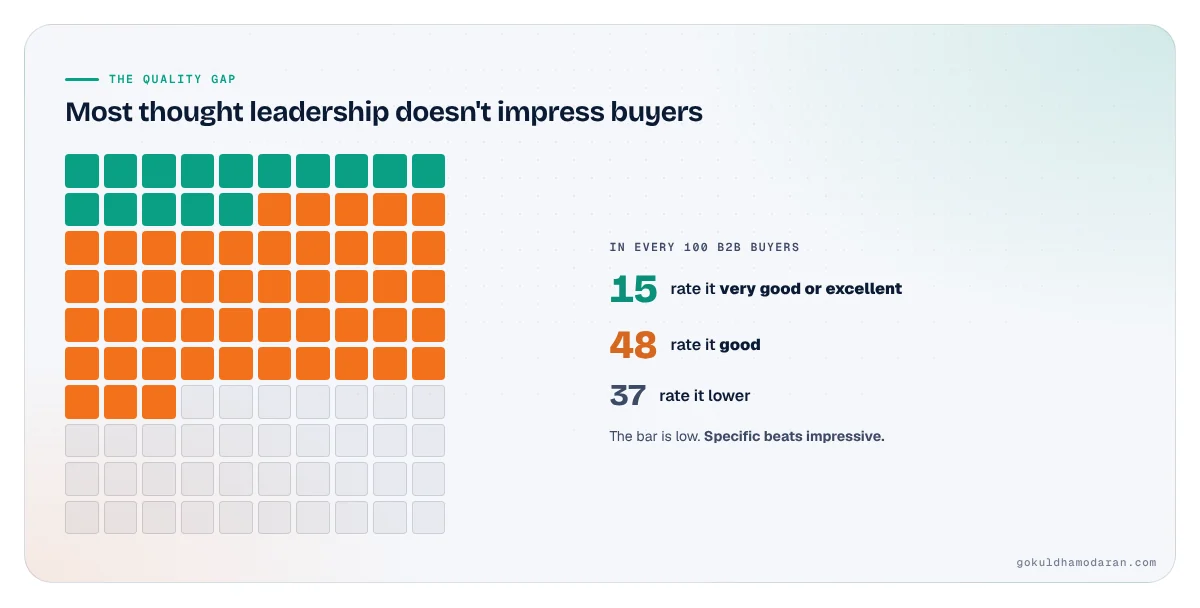
- Measure right-role conversations, not followers. Only 15% of buyers rate the thought leadership they read as very good or excellent.
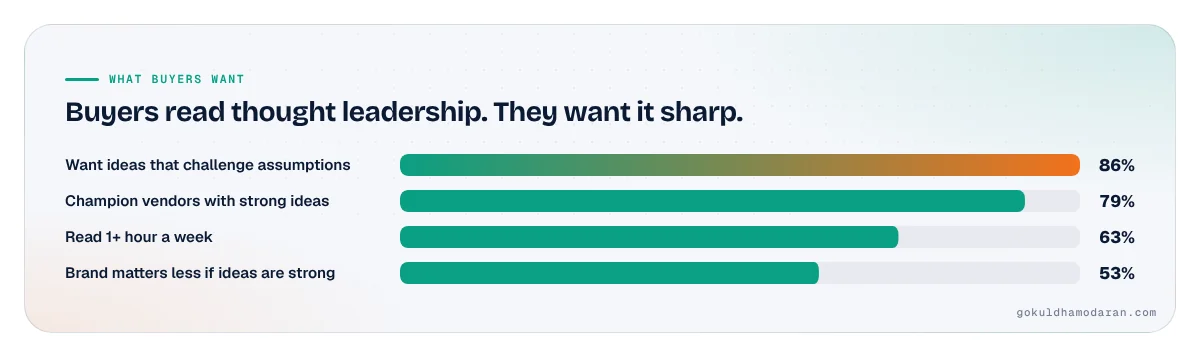
Edelman and LinkedIn asked nearly 2,000 management-level professionals what makes them trust a supplier’s ideas. 86% of hidden buyers said they favor perspectives that challenge their assumptions. A year earlier, the same research series found that only 15% of buyers rate the thought leadership they read as very good or excellent.
That gap is the opening for personal branding on LinkedIn for tech leaders. Readers want sharp, specific B2B thought leadership, and most of what they get is bland. CTOs, CIOs and IT leaders sit on exactly the material buyers, peers and candidates want: real trade-offs from real systems. What most of them lack is not talent or time. It’s a system. This guide gives you one in four parts, sized for a leader’s calendar, with the signals that tell you it is working.
What is personal branding on LinkedIn for tech leaders?
Personal branding on LinkedIn for tech leaders is the repeatable practice of publishing one clear point of view, in a few recognizable formats, on a steady rhythm, so the right people know what you think and start conversations with you. It is not a follower count, a viral post or a polished headshot. It is a reputation for useful judgment that people can find, forward and come back to.
A LinkedIn personal brand works differently for a technologist than for a sales leader or a founder. Your edge is that you have seen what happens after the vendor demo: the migration that slipped, the approval step nobody mapped, the agent that worked in the pilot and broke on real data. Peers can’t get that from a product page. That is why B2B thought leadership from a practitioner reads differently from marketing, and why the bar is to explain, not to promote.
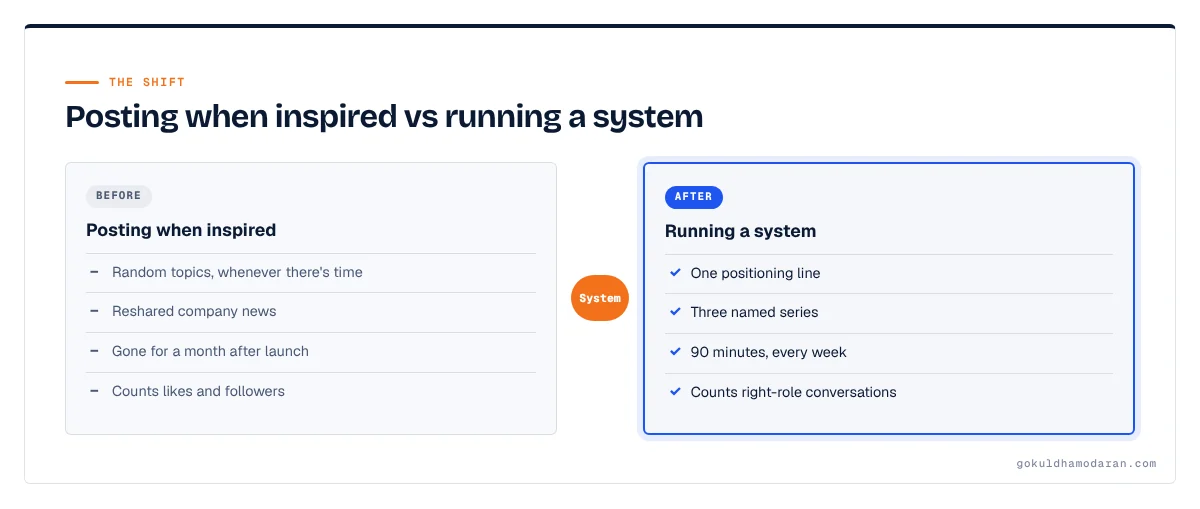
My read: treat it like a product, not a mood. A product has a clear promise, a few features people learn to expect, a release rhythm and a way to tell whether it is landing. A LinkedIn personal brand needs the same four things.
Posting when inspired vs running a system
Posting when inspired
- Random topics, whenever there's time
- Reshared company news
- Gone for a month after launch
- Counts likes and followers
Running a system
- One positioning line
- Three named series
- 90 minutes, every week
- Counts right-role conversations
gokuldhamodaran.com
Why should a CTO or CIO bother with LinkedIn?
Because a LinkedIn personal brand reaches the people who shape your decisions, your vendors’ decisions and your hiring and they trust people over brands. In LinkedIn’s August 2025 research with Censuswide, 43% of professionals said their network is their top source for work advice, ahead of search engines and AI tools. In the same release, 77% of B2B marketing leaders said audiences rely on their network, not just company channels, to vet brands.
The time is there too. The 2025 Edelman-LinkedIn B2B Thought Leadership Impact Report found that 63% of hidden buyers and 64% of target buyers spend more than an hour a week consuming B2B thought leadership. These are the people who sit in the buying group but rarely take the sales call: the architect, the security lead, the finance partner.
For a tech leader, that attention pays off in three practical ways:
- Hiring. Strong engineers want to know how a leader thinks before they take the interview. A steady record of your decisions is a better pitch than a job post.
- Influence inside the company. A clear public point of view on, say, AI agents in finance makes your internal memo easier to fund, because people have already seen the reasoning.
- Peer access. The CIO two companies over is far more likely to take your call if they’ve been reading your notes on the same migration.
The Compounding Brand System: four parts
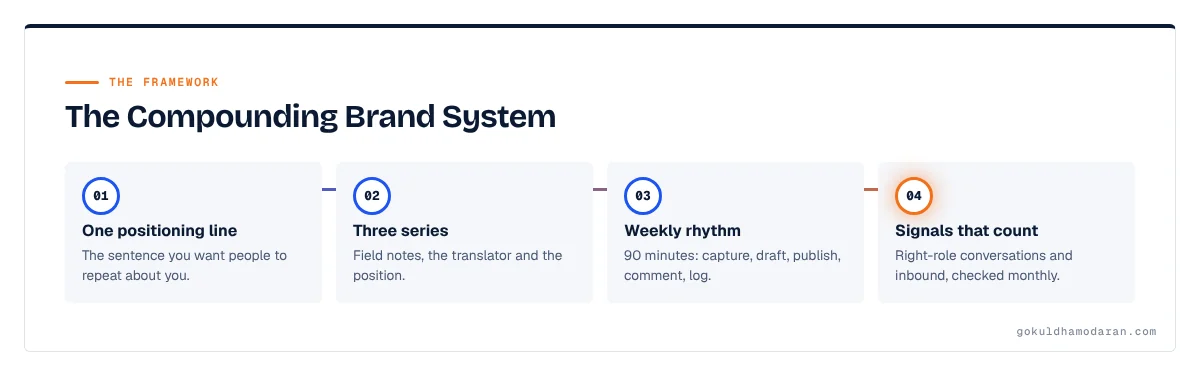
Most advice on executive branding is a list of tips: update your headline, post more, comment often. The tips aren’t wrong. They just don’t add up to anything. The Compounding Brand System gives each habit a job so every post builds on the last one.
- One positioning line. The single sentence you want people to repeat about you.
- Three recurring series. Named formats your readers learn to expect, so you never start from a blank page.
- A weekly rhythm. About 90 minutes a week, blocked like any other meeting.
- Signals that count. A monthly check on conversations and inbound from the right roles, not likes.
I run my own presence this way. My website publishes on Monday, Wednesday and Friday, each day with its own series, and my LinkedIn newsletter, Leading Indicator, goes out every Friday with the same segments in the same order. The structure is what makes it sustainable. The rest of this guide shows how to build each part for yourself.
The Compounding Brand System
- 01One positioning lineThe sentence you want people to repeat about you.
- 02Three seriesField notes, the translator and the position.
- 03Weekly rhythm90 minutes: capture, draft, publish, comment, log.
- 04Signals that countRight-role conversations and inbound, checked monthly.
gokuldhamodaran.com
How do you write a positioning line?
Write one sentence that names the shift you explain, the people you explain it for and the vantage point only you have. A useful pattern is: “I explain [the change] for [the people who must act on it], from [where I sit].” If a peer couldn’t repeat it after one read, it’s too long.
Here’s mine: I turn what’s happening at the AI frontier into what it means for enterprise systems, and I build AI products myself. Every article and post I publish has to fit inside that line. If an idea doesn’t, it waits.
Three tests keep a positioning line honest:
- The swap test. Replace your name with a competitor’s. If the line still works, it’s too generic. “Driving digital transformation” fails. “Making SAP data usable for AI agents without breaking audit” passes.
- The calendar test. Could you write 50 posts inside it without repeating yourself? Too narrow, and you’ll run dry by spring.
- The proof test. Does your actual work back it up? You should be able to point to systems you run, decisions you made or things you built.
Put the line in your LinkedIn headline, in the first sentence of your About section and in your featured post. Then stop editing it for at least a quarter. Good executive branding is boring in exactly this way. Consistency is what makes people remember it.
What should tech leaders post on LinkedIn?
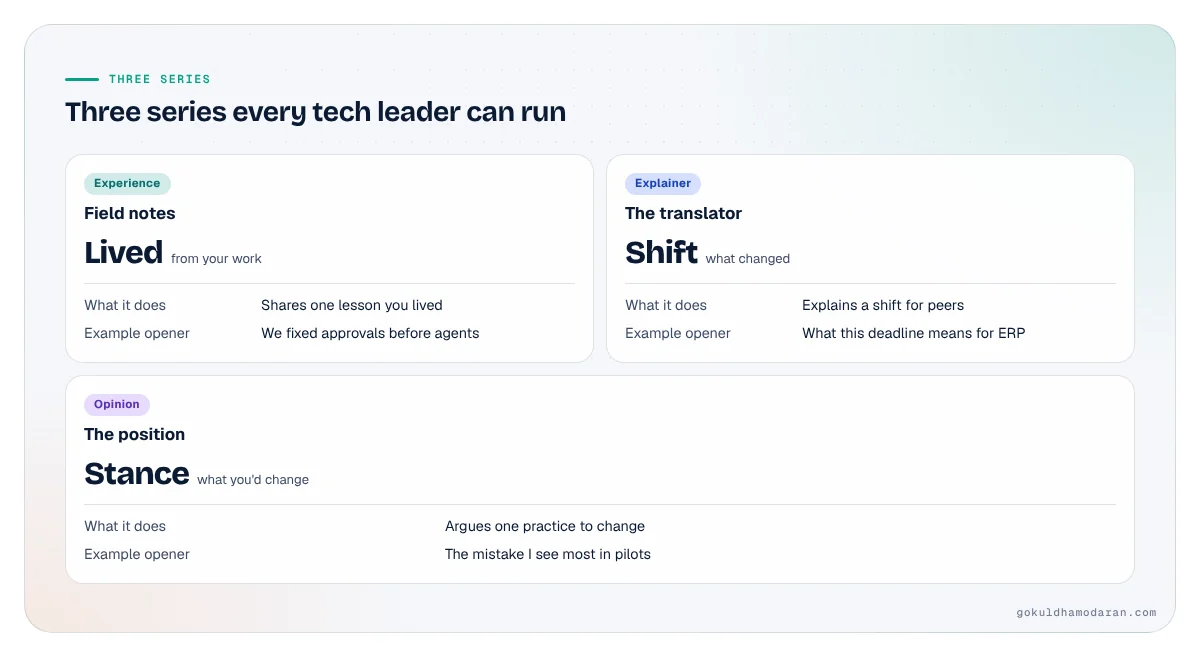
Post three recurring series, each with a fixed name and a fixed job: one that shares what you learned from your own systems, one that explains an outside shift for your peers, and one that takes a clear position on a common practice. Series beat one-off posts because readers learn what to expect, and you never face a blank page.
Here’s a set that fits most CTOs, CIOs and IT leaders:
- Field notes (from your own work). One decision, trade-off or lesson from running real systems, with no confidential details. “We moved approvals out of email before we added an agent. Here’s why that order mattered.”
- The translator (from the outside world). One change in the market, explained for your peers: what changed, what it means for an enterprise stack and what to do this quarter. A model release, a vendor deadline, a new rule.
- The position (your opinion). One practice you’d change, argued with reasons. “The mistake I see most in AI pilots is…” This is the series that gets people talking, so it’s also the one to run past your own judgment twice.
This is how my LinkedIn newsletter is built. Every edition uses the same segment tags in the same order, such as THE BIG ONE, ONE NUMBER and THE ERP DESK, while the headline under each tag is new every week. The tag tells readers where they are. The headline gives them a reason to keep going. Your series names do the same job in a feed.
Three series every tech leader can run
Field notes
The translator
The position
gokuldhamodaran.com
Each series should earn its place on the swap test too. If your field notes could have been written by any CIO, add the number, the system or the constraint that makes them yours. Edelman’s 2025 data backs this: in final vendor decisions, 85% of buyers weigh a demonstrated understanding of their specific challenges. Specific beats impressive.
How often should executives post on LinkedIn?
Once or twice a week is enough for most executives, if it happens every week. Rhythm matters more than volume: a leader who posts one strong series piece every Wednesday for a year will be better known for an idea than one who posts daily for a month and then disappears. Block the time like a meeting, or it won’t happen.
Here is a 90-minute weekly rhythm that fits a leader’s calendar:
- Capture (Monday, 15 minutes). Write down three moments from last week: a decision, a surprise, a question someone asked you. These are raw material, not posts.
- Draft (Tuesday, 30 minutes). Turn one moment into one series post. Lead with the specific, give the lesson, end with a question a peer can answer in one sentence.
- Publish and stay (Wednesday, 20 minutes). Post, then stay for the first hour and reply to every serious comment. The replies are where the conversations start.
- Comment (Thursday, 15 minutes). Leave five useful comments on posts by people in the roles you want to reach. A good comment is a short post of its own.
- Log (Friday, 10 minutes). Note the conversations that started and who started them. This is your measurement, covered below.
What one week looks like
Picture a CIO in the middle of a finance system upgrade. On Monday she notes three moments: the vendor pushed back a cutover date, a controller asked whether an AI assistant could draft journal entries, and her team found that half the approval rules lived in people’s heads.
On Tuesday she picks the third one for her field notes series. The draft opens with the specific scene (“Our upgrade stalled on approval rules nobody had written down”), keeps every internal detail out, and explains why that matters before any automation, and ends with “Where do your undocumented rules live?”
On Wednesday she posts and answers every serious comment, including a few from finance leaders at peer companies. On Thursday she comments on posts by three CFOs and two enterprise architects. On Friday she logs two real conversations. The controller’s AI question goes into next week’s position post. Nothing about that week needed a ghostwriter, a content team or a viral hook.
Once a month, go long: one edition or one article that pulls your best series posts into one argument. A LinkedIn newsletter or long article is where readers decide whether you are worth following, and it gives search engines and AI assistants something to cite.
Using AI to draft B2B thought leadership is fine, with one rule: the idea, the example and the opinion must be yours. AI can tighten a sentence. It can’t supply the trade-off you lived through, and readers can tell.
How do you measure a LinkedIn personal brand?
Measure the conversations it starts, not the reactions it collects. Each month, count the direct messages and comment threads from people in your target roles, the inbound requests (introductions, panels, podcasts, candidates who mention your posts) and the times a peer forwards your thinking internally. If those numbers rise for a quarter, your LinkedIn personal brand is working, whatever your follower count says.
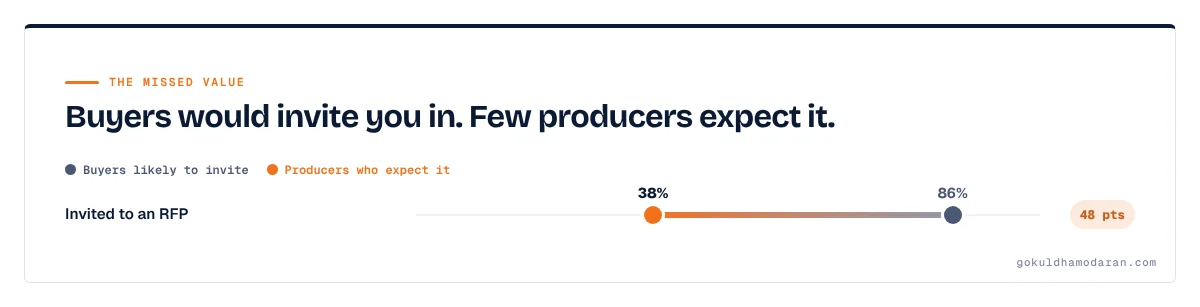
Most organizations skip this step entirely, which is why so much B2B thought leadership can’t prove its value. In Edelman’s 2024 research, only 29% of thought leadership producers could link leads or business wins to specific efforts, 42% measured success by web and social traffic and 19% had no process at all. The same research shows how much value gets missed: 86% of buyers said they’d be likely to invite thought leadership producers to an RFP, while only 38% of producers expected that.
Buyers would invite you in. Few producers expect it.
Buyers likely to inviteProducers who expect it
- Invited to an RFP86%38%48 pts
gokuldhamodaran.com
Keep the scorecard small enough to fill in on a Friday:
- Right-role conversations. DMs and real comment threads from your target titles.
- Inbound. Invitations, introductions and candidate mentions.
- Echo. Times someone quoted your line back to you, inside or outside the company.
- Consistency. Weeks in the quarter you shipped at least one series post.
I learned to value this kind of measurement on the marketing side. I supported an SEO and content program that contributed to a 140% increase in digital impressions, and the lasting lesson was that the program mattered more than any single piece. Impressions told us people saw the work. Conversations tell you they trusted it.
What can a tech leader safely share?
Share your reasoning, your patterns and your public facts, never your employer’s private details. The safe zone is how you think about a problem, what you’d do differently and what any leader could learn from it. The no-go zone is anything a competitor, a customer or your legal team would recognize as internal.
- Safe: decision frameworks, lessons from systems described in general terms, opinions on public news, books and tools you use, questions you’re working through.
- Check first: anything about a live vendor selection, a current incident or a named partner. Ask your communications team before you post, not after.
- Never: customer names, deal details, internal metrics, security architecture, or anything shared with you in confidence.
Add one line to your profile that your views are your own, and read every post once as your general counsel would. If it would embarrass a company you could work for, rewrite it. Done this way, executive branding is an asset to your employer, not a risk they have to manage.
Five mistakes that stall a LinkedIn personal brand
- Posting the press release. Resharing company news with “Proud of the team” adds nothing. Add the one thing you learned building it.
- Chasing the viral post. A post that spikes once teaches people nothing about you, and executive branding built on spikes resets every month. A series that shows up every week does.
- Changing the topic every week. If the feed covers AI, leadership, travel and a book review, nobody can say what you stand for.
- Broadcasting without replying. The comments are the point. A leader who never replies looks like a brand account.
- Measuring followers. Followers are a lagging, noisy number. Conversations with the right roles are the leading one.
Most thought leadership doesn't impress buyers
In every 100 B2B buyers
- 15rate it very good or excellent
- 48rate it good
- 37rate it lower
The bar is low. Specific beats impressive.
gokuldhamodaran.com
Your first 90 days
Start your LinkedIn personal brand small and stay consistent. In the first month, write your positioning line, update your headline and About section, and name your three series. In the second, ship one series post every week and comment five times a week. In the third, publish your first long-form piece and fill in the scorecard. At day 90, keep what started conversations and drop what didn’t.
The free workbook walks through each step with fill-in pages: the positioning line, the three series, the weekly rhythm and the monthly scorecard. If you want to see the system running, my Leading Indicator newsletter is the live version, and pieces like AI agents in ERP and small language models for enterprise show the translator series in long form. If you also run marketing for a technical product, the same thinking about the right roles drives an account-based marketing program.
Personal branding on LinkedIn for tech leaders comes down to one decision: treat your point of view like a product you ship every week. Signal, not noise.
Frequently asked questions
Should a tech leader use a ghostwriter or AI to write LinkedIn posts?
Help with editing is fine, and AI can tighten a draft. The idea, the example and the opinion have to be yours, because that is what readers are trusting. A good test: if a peer asked you about the post over coffee, could you defend every line without notes? If not, rewrite it in your own words before it goes out.
How long does it take to build a LinkedIn personal brand?
Plan on one quarter before judging it. In the first month you set the positioning line and series; by the end of the third you should see more right-role conversations and the first inbound requests. Weekly consistency matters more than any single post, so a leader who ships every week for 90 days learns more than one who posts daily for two weeks.
Is a LinkedIn newsletter worth it for an executive?
Yes, once you have a weekly posting habit. A LinkedIn newsletter turns your best thinking into a fixed format readers subscribe to, and long-form pieces give search engines and AI assistants something to cite. Start monthly, keep the same segments in the same order every time, and only move to weekly if you can sustain it.
What if my company is cautious about executives posting?
Agree the rules up front with your communications and legal teams: what is safe, what needs a check and what is off-limits. Share reasoning and patterns, never customer names, deals, internal metrics or security details, and add a line that your views are your own. Framed that way, your LinkedIn personal brand becomes an asset the company can support.
Personal profile or company page: which matters more?
Both have a job, but people trust people. LinkedIn's 2025 research found 77% of B2B marketing leaders say audiences rely on their networks, not just company channels, to vet brands. The company page carries news and jobs; the leader's profile carries judgment, which is what buyers and candidates are trying to read. That is the core of executive branding.
Sources
- Demand Gen Report: Marketers need to gear content to hidden B2B buyers, Edelman-LinkedIn (Jul 8, 2025)
- Edelman: 2025 B2B Thought Leadership Report
- Edelman: Reaching Beyond the Ready, 2024 B2B thought leadership study (Feb 28, 2024)
- LinkedIn: Networks, not AI or search, are the #1 trusted source amid information overload (Aug 26, 2025)

Gokul Dhamodaran
I turn what is happening at the AI frontier into what it means for enterprise systems, and I build AI products myself (Euliv Analytics, Vantage). I write Leading Indicator every Friday: the AI and enterprise tech moves that matter, and what they mean for you.
Views are my own and do not represent any employer or client. Graphics are original; sources are linked.