The short answer
Will AI replace SaaS? Not the part that holds your data, rules and approvals. AI assistants are taking over the front door: the screen people type into. The system of record stays, but seat-based pricing and dashboard-heavy apps come under pressure. Plan renewals around who owns the user and who owns the decision.
Key takeaways
- SaaS isn't dying. The front door is moving to AI assistants like ChatGPT and Copilot.
- The system of record stays: data, business rules, permissions, approvals and audit.
- Gartner says up to $234 billion of app spend is exposed to agents through 2030.
- Seat counts stop tracking value once agents do the clicking. Rewrite the pricing clause.
- Before 2027 renewals: map doors vs records, reprice seats, demand open agent access, keep exits.
On October 28, 2026, ServiceNow released a plugin that lets people work in ServiceNow without opening ServiceNow. An IT agent can find similar incidents, check change risk and update records from inside ChatGPT. The next day, ServiceNow’s stock fell 26.9%, and the old question came back louder: will AI replace SaaS?
I build AI tools myself, including analytics that answer business questions in plain English and show the query behind every number. The chat window was never the hard part. The hard part was the layer underneath it that decides what a right answer is. That layer is where this whole debate turns, and it is where your 2027 renewals should start.
Will AI replace SaaS? The short answer
Will AI replace SaaS? Not the systems that hold your records, rules and approvals. AI assistants are replacing the front door: the screen people log into, click through and pay a seat for. The software behind that door still has to store the data, enforce the permissions and keep the audit trail. What breaks is the link between how many people use an app and what you pay for it.
Think of an enterprise stack as four layers. On top sits the assistant, where people ask for things in plain English. Below it, agents plan and take actions. Below that, the system of record applies the business rules. At the bottom sits the data. The fight in 2026 is over the top layer. The money you spend sits mostly in the third.
The AI front door and the system of record
- 04Front doorWhere people ask in plain EnglishChatGPTCopilotClaude
- 03AgentsPlan the work and take actionsMCPAPIs
- 02System of recordRules, permissions, approvals, auditITSMERPCRM
- 01DataAssets, orders, people, history
gokuldhamodaran.com
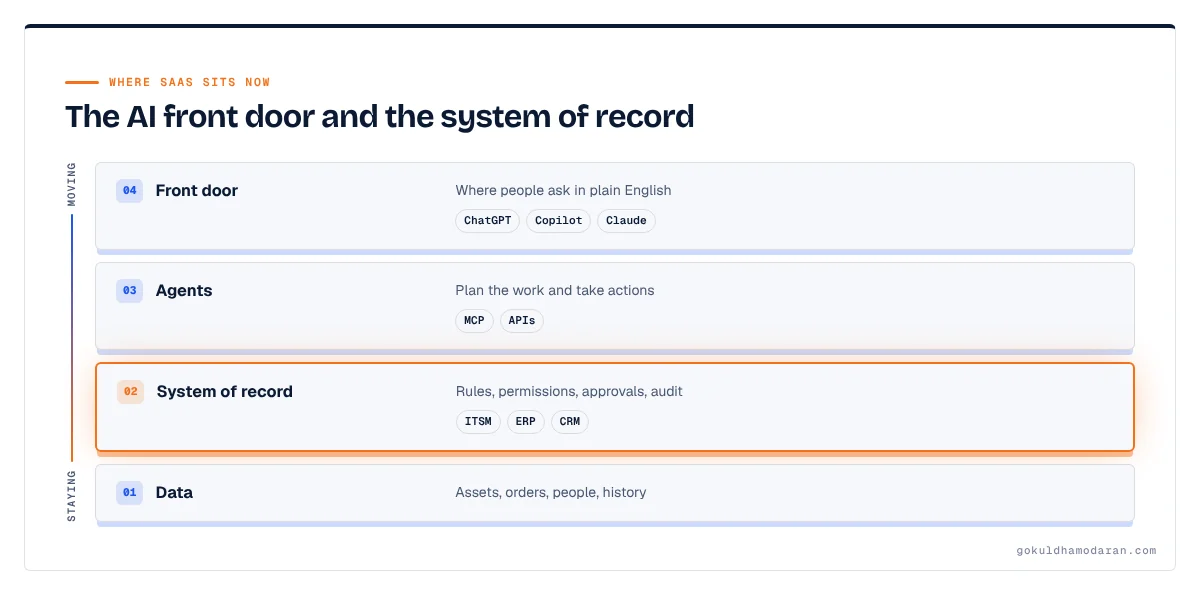
ServiceNow’s own wording makes the split clear. The October 28 press release says ServiceNow “remains the system that executes and governs” actions taken from ChatGPT, applying its business rules, permissions and approvals. In plain terms: the user may live in ChatGPT, but the decision still lands in ServiceNow.
What did ServiceNow and OpenAI actually ship?
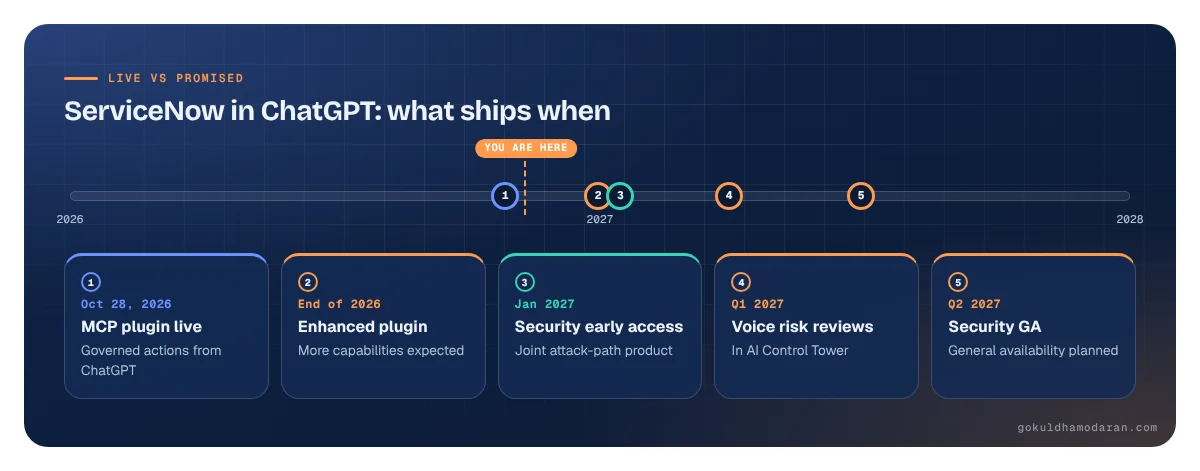
Separate what is live from what is promised. Only one piece is available today. The rest is preview or roadmap, and the dates matter for anyone signing a multi-year deal.
- Available now: a ServiceNow MCP plugin in the OpenAI marketplace, with enhanced capabilities expected by the end of 2026.
- Preview: interactive plugin extensions, such as an on-call engineer reviewing linked alerts and updating an incident inside ChatGPT.
- Q1 2027: voice-driven AI risk assessment in ServiceNow’s AI Control Tower, built on OpenAI voice models.
- January to Q2 2027: a joint security product, early access in January and general availability planned for Q2.
- 2027: Codex inside ServiceNow’s AI Workflow Factory, so developers build apps with ServiceNow’s business context.
ServiceNow in ChatGPT: what ships when
- 1MCP plugin liveGoverned actions from ChatGPT
- 2Enhanced pluginMore capabilities expected
- 3Security early accessJoint attack-path product
- 4Voice risk reviewsIn AI Control Tower
- 5Security GAGeneral availability planned
gokuldhamodaran.com
Now the market reaction. ServiceNow reported Q3 subscription revenue of $3.988 billion, up 21%, in its October 28 earnings release. It guided current remaining performance obligations (signed revenue due in the next 12 months) to grow 18.5% in Q4, down from 20.5% in Q3. It also raised its 2026 AI contract value target to $1.7 billion, from $1 billion at the start of the year.
The drop was not only about AI. Trefis notes that ServiceNow fell more than three times as far as the worst of its five closest peers that day, so most of the move was company-specific: a small earnings miss, slower backlog growth and renewals pulled into Q3. The AI fear was real, but it was the amplifier, not the whole story.
The same day, Fortune reported that Serval, a startup pitching AI agents as a replacement for ServiceNow, raised $150 million at a $3 billion valuation, led by Sequoia. Put the two stories side by side and you get the real question. It is not whether SaaS dies. It is who owns the front door.
What moves to the front door, and what stays in the record?
Here is the split I would put in front of an architecture board. Anything that exists mainly so a person can see, click or fill in a form is front-door work, and assistants are absorbing it. Anything that decides whether an action is allowed, records that it happened and proves it later is system-of-record work, and it stays.
What moves to the assistant, what stays in the record
The front door
- Screens and forms
- Navigation and training
- First drafts and lookups
- Who holds the user
The system of record
- Data model and history
- Business rules and approvals
- Permissions
- Audit trail
gokuldhamodaran.com
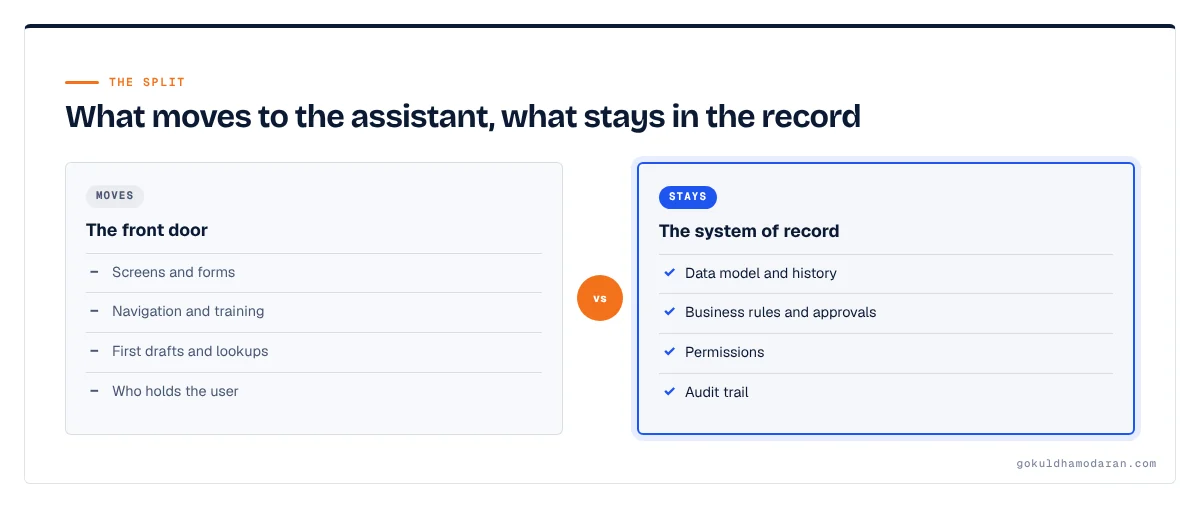
What moves to the front door:
- The interface. Search, forms, ticket views and status pages become questions typed into one assistant.
- Navigation and training. Nobody needs to learn which menu holds the change request.
- First drafts. Summaries, similar-incident lookups and draft responses get done before a human looks.
- Who holds the user. The assistant vendor sees every request, across every app behind it.
What stays in the system of record:
- The data model. Assets, contracts, employees, orders and their history.
- Business rules and approvals. Who can change what, and who signs off.
- Permissions. The assistant should never hold more access than the user or agent it acts for.
- Audit. The record that survives a regulator, an auditor or a bad week.
Here is one request, end to end. A plant manager asks an assistant whether the replacement pump for line 3 has been approved and when it ships. The assistant reads the question. An agent looks up the purchase order in the ERP and the change ticket in service management. Each system checks that this manager may see those records. The agent finds the approval is still waiting on a budget owner, sends a reminder through the approval flow, and replies in two sentences with a link to the record.
Notice what happened. The manager never opened two apps or learned two menus. But every fact came from a system of record, every check ran there, and the reminder went through the approval flow that already existed. Take those systems away and the assistant has nothing true to say. That is why the front door can move while the record stays put.
It also shows where the risk sits. If the agent had used a shared service account with broad access, the manager could have seen records they were never meant to see. The front door is only as safe as the permissions enforced behind it.
This is the same pattern we saw in AI agents in ERP: the agent proposes, the ERP disposes. The record keeps authority even when the work starts somewhere else.
Why is seat-based pricing under pressure?
Seat-based pricing is under pressure because agents do work that used to need a logged-in person. If five agents handle what 50 people once clicked through, a per-seat bill either shrinks for the vendor or stops matching value for the buyer. Neither side can keep the old math for long.
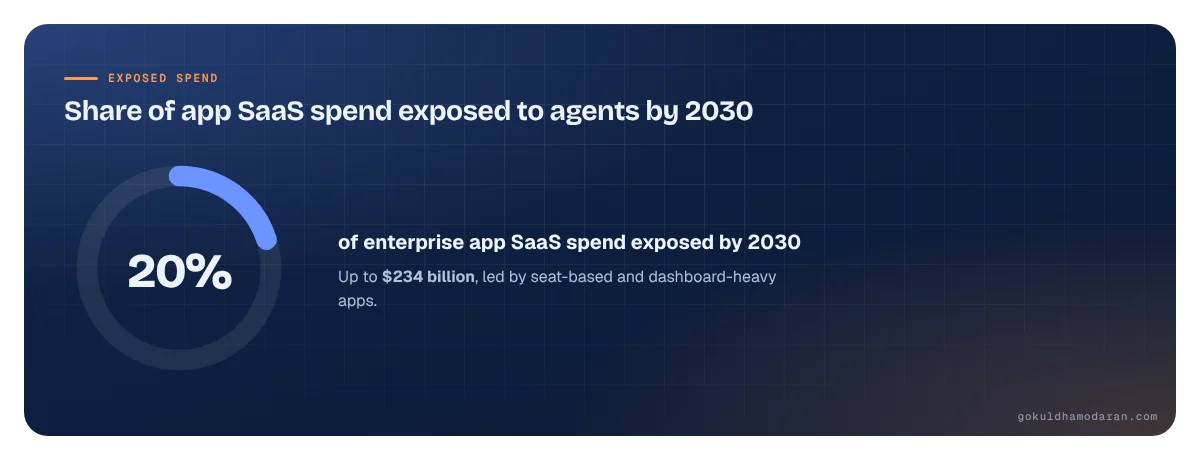
Gartner said on July 1, 2026 that up to $234 billion of enterprise application spending is exposed to what it calls agentic arbitrage between now and 2030, about 20% of enterprise application SaaS spending by then. It named dashboard-heavy and seat-based vendors as most at risk. Its analyst put the buyer shift in one line: “Enterprise buyers will deemphasize buying more new tools or dashboards.”
Share of app SaaS spend exposed to agents by 2030
of enterprise app SaaS spend exposed by 2030
Up to $234 billion, led by seat-based and dashboard-heavy apps.
gokuldhamodaran.com
Vendors are already testing new models in public. Salesforce ran three Agentforce pricing models at once by early 2026, SaaStr reported: $2 per conversation, Flex Credits at $0.10 per action, and per-user licenses from $125 a month. Fortune notes ServiceNow’s Flow product at $2 per conversation. When the leaders price three ways at once, buyers have room to negotiate.
My read: the vendor that wins your renewal will be the one that prices the outcome you care about, not the seat you no longer need.
Who will own the front door?
Three kinds of players want it, and most enterprises will end up with more than one. Compare them by capability and status, not by brand.
- General assistants. ChatGPT, Microsoft Copilot, Claude and Gemini sit where people already work. Their pull is breadth: one place to ask about anything. Their gap is depth in any one system, which is why they need plugins and MCP connections from the vendors behind them.
- The SaaS vendors’ own assistants. ServiceNow, Salesforce, SAP and Workday all ship assistants inside their products. Their strength is deep context and native permissions. Their risk is that users would rather ask one assistant than six.
- AI-native challengers. Startups like Serval pitch agents that replace the workflow tool itself. Fortune reports Serval’s customers build automations, test them in a separate environment with access controls and audit logs, then publish them to an agent employees use. That is a system-of-record claim, not only a front-door one, so judge it on audit and approvals, not on the demo.
ServiceNow’s move tells you how incumbents plan to play it. If you can’t keep the user, keep the decision, and make sure every assistant has to come through you to act. For buyers, that’s good news. It means the record vendors now have a reason to offer open, governed access to any assistant you choose.
My read: don’t pick a single front door in 2027. Pick the rules every front door must follow.
Is each app a front door or a system of record?
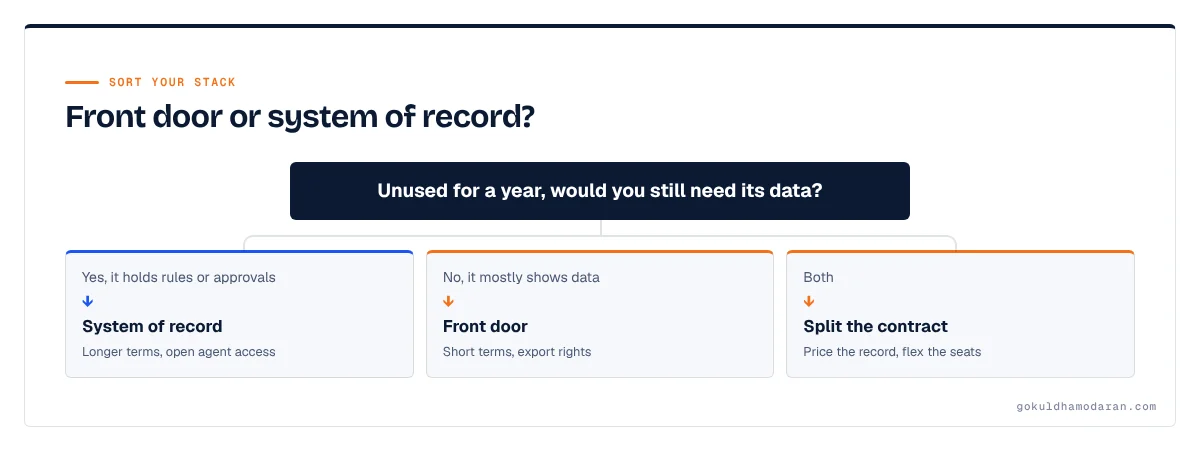
Most portfolios mix both, and the right contract depends on which one an app really is. Ask one question per app: if nobody opened this screen for a year, would the business still need what it stores and enforces? If yes, it is a system of record. If no, it is a front door with data you can move.
Front door or system of record?
Unused for a year, would you still need its data?
- Yes, it holds rules or approvalsSystem of recordLonger terms, open agent access
- No, it mostly shows dataFront doorShort terms, export rights
- BothSplit the contractPrice the record, flex the seats
gokuldhamodaran.com
Expect surprises. Some tools you think of as core are mostly reporting layers over data held elsewhere. Some tools that feel minor hold the only approval history for a regulated process. Sort them now, before a vendor sorts them for you in a renewal deck.
4 moves to make before your 2027 renewals
These are contract and architecture moves, not tool picks. They work whether your front door ends up being ChatGPT, Microsoft Copilot, Claude, Gemini or a vendor’s own assistant.
- Map doors versus records. Tag every app over a set spend line as front door, system of record or both. Put the renewal date next to each one. Front-door apps up for renewal in 2027 are your first negotiations.
- Reprice the seat. Ask for the right to convert seats to usage or outcome pricing mid-term, a cap on any consumption meter, and a clear rule for how agent activity is billed. Don’t sign a three-year seat count that assumes 2025 headcount math.
- Demand open agent access. Write in API and MCP access for the assistant of your choice, not only the vendor’s. Require that permissions and approvals are enforced in the system of record for every agent action, and that agent activity logs are exportable.
- Keep exits on the door. Sign shorter terms on front-door apps and keep data export rights in a usable format. Save long commitments for the records you will run for a decade.
 The record still runsThe decision still lands in the system of record
One practical way to start: pick a single high-volume workflow, such as password resets or purchase-order status, and run it through an assistant for 30 days. Count how many seats were really needed and how many actions an agent took. That number is your negotiating position.
Keep the test honest. Measure three things: how many requests the assistant closed without a human, how many actions it took in the system of record, and how many it got wrong or had to hand back. Write down who approved each kind of action before the test starts. A pilot that skips the approval map will look great until the first audit.
If you are building agents yourself, the agentic development lifecycle covers how to test and govern them before they touch a record. And the small language models guide shows where a cheaper model can sit behind the front door.
Questions to ask every vendor this quarter
Bring these to your next account review. Vague answers tell you where the vendor’s roadmap really is.
- Which assistants can act in your product today, and which are preview or roadmap?
- When an agent acts through ChatGPT or Copilot, where are permissions checked and where is the action logged?
- How will you bill agent actions, and can we cap that spend?
- Can we move seats to usage pricing during the term?
- If we leave, what data and agent history can we export, and in what format?
What this does not mean
It doesn’t mean ripping out your service management, ERP or CRM in 2027. Those systems still carry the rules, approvals and history your auditors depend on, and ServiceNow alone runs more than 100 billion workflows a year, per its release. Replacing a system of record is a multi-year migration, not a plugin.
It also doesn’t mean buying every AI add-on on the price list. Gartner’s own advice to buyers is to judge tools by the outcome they deliver, not the features they add. An add-on that raises the bill without moving a business number is the new shelfware.
What it does mean: the user is moving, and the contract should move with them. Signal, not noise. If you want one of these each week, the Leading Indicator newsletter tracks the moves that matter for enterprise stacks.
Frequently asked questions
Will AI agents replace ServiceNow or Salesforce?
Not in the near term for the records they hold. Agents can take over the interface, so people work in ChatGPT, Copilot or a startup's assistant instead of the vendor's screens. The rules, approvals and audit history still need a system of record. What changes is pricing and who owns the user, which is why ServiceNow now ships a ChatGPT plugin.
What is a system of record in the AI era?
A system of record is the application that holds the trusted version of a business fact and enforces the rules around it: who can change it, who approves, and what was logged. In the AI era it becomes the place every agent action must pass through, even when the request starts in an AI assistant.
What is the SaaSpocalypse?
SaaSpocalypse is the market's nickname for the fear that AI agents will make subscription software obsolete. It flared with software sell-offs in 2026, including ServiceNow's 26.9% one-day fall on October 29. Most analysts see a repricing of seat-based models and interfaces rather than the end of enterprise software.
How should we negotiate SaaS renewals with AI agents in mind?
Tag each app as a front door or a system of record first. For front doors, push for shorter terms and data export rights. For all apps, ask for the right to move seats to usage pricing mid-term, a cap on consumption meters, open API and MCP access for your chosen assistant, and exportable logs of every agent action. Check final terms with your legal and procurement teams.
Sources
- ServiceNow: ServiceNow and OpenAI accelerate enterprise AI (Oct 28, 2026)
- ServiceNow Q3 2026 financial results, Form 8-K (Oct 28, 2026)
- Trefis: What is behind the move in ServiceNow stock? (Oct 30, 2026)
- Fortune: Serval raises $150M at a $3B valuation (Oct 29, 2026)
- Gartner: $234 billion in enterprise application software spend at risk from agentic AI (Jul 1, 2026)
- SaaStr: Salesforce now has 3 pricing models for Agentforce (Feb 17, 2026)

Gokul Dhamodaran
I turn what is happening at the AI frontier into what it means for enterprise systems, and I build AI products myself (Euliv Analytics, Vantage). I write Leading Indicator every Friday: the AI and enterprise tech moves that matter, and what they mean for you.
Views are my own and do not represent any employer or client. Graphics are original; sources are linked.