The short answer
Why agentic AI projects fail comes down to the work around the model, not the model. Most agents die because nobody owns the outcome, they run on shared service accounts, they lack business context, their token costs were never budgeted, and they were tested like a demo. Fix those five before launch.
Key takeaways
- Gartner expects over 40% of agentic AI projects to be canceled by the end of 2027: cost, unclear value and weak risk controls.
- The model is rarely the problem. The work around the model is.
- Five patterns: no owner, borrowed keys, no business context, unbudgeted tokens, demo-grade tests.
- Gartner's 2027 trends (Oct 20, 2026) read like the repair manual: agent identity, AI context platforms, coding agent harnesses.
- Run a one-page pre-launch check on every agent this quarter. Kill or fix the ones that fail it.
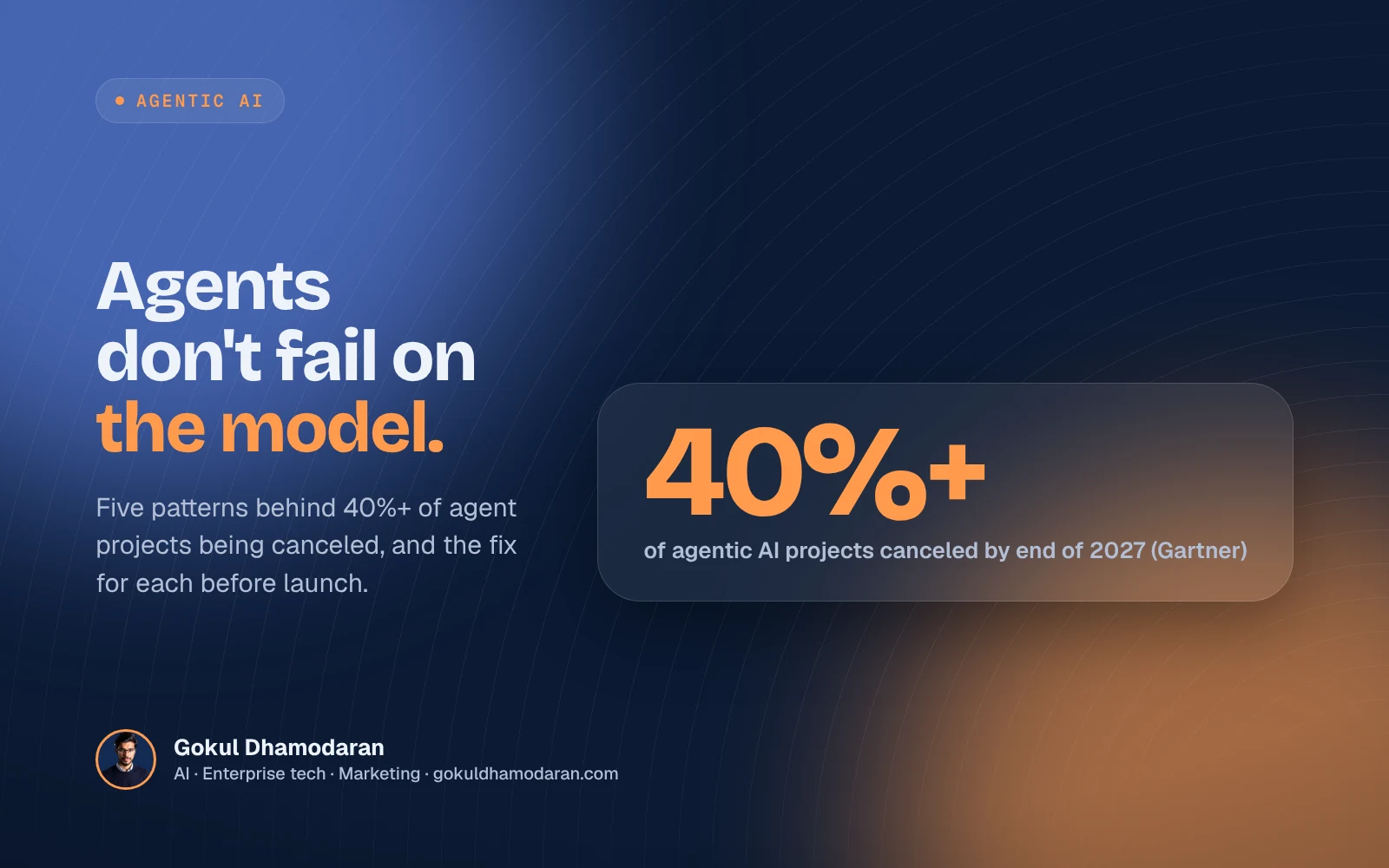
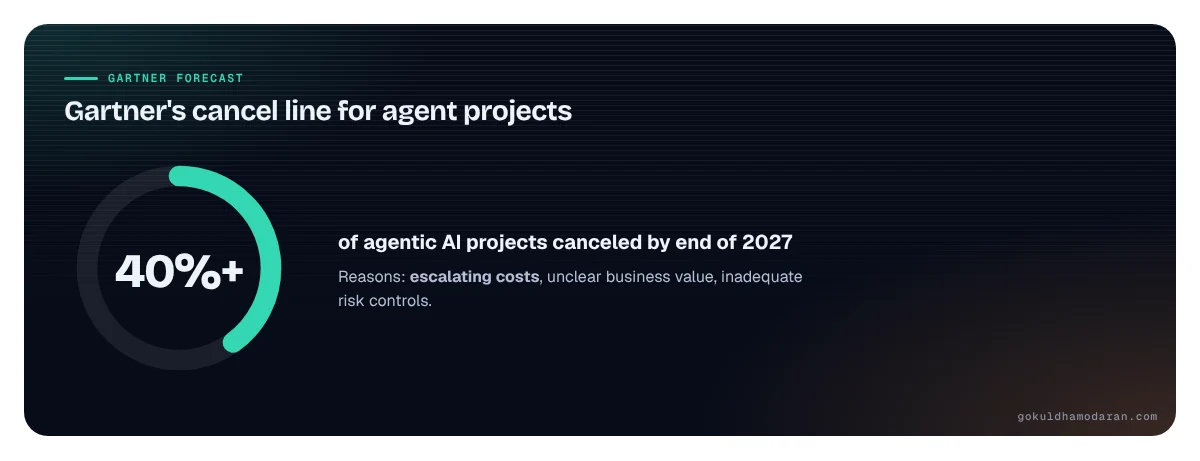
In June 2025, Gartner predicted that over 40% of agentic AI projects will be canceled by the end of 2027. It named three reasons: escalating costs, unclear business value and inadequate risk controls. On Oct 20, 2026, Gartner published its top technology trends for 2027, and three of them read like the repair manual for that forecast: AI agent identity, AI context platforms and the AI coding agent harness.
So the question for 2027 budgets isn’t whether agents work. It’s why agentic AI projects fail when the model works fine in the demo. I build AI agents myself, and the model call is never the hard part. The hard part is deciding what the agent may touch, what it should know and how I’ll prove it got the answer right.
Why agentic AI projects fail, in plain English
An agentic AI project is software that plans steps and takes actions on its own, inside your systems, on someone’s behalf. It fails when the organization treats it like a chatbot pilot instead of a new kind of worker. Workers need a manager, their own login, training on how the business runs, a budget and a performance review. Most agent projects skip all five. The demo still works, because demos don’t need any of them. Production does.
That is the pattern behind most AI agent failure stories: the model is the cheapest, most mature part of the stack, and the surrounding work is unfunded. Gartner’s own analyst, Anushree Verma, put it plainly in the 2025 forecast: “Most agentic AI projects right now are early-stage experiments or proof of concepts”.
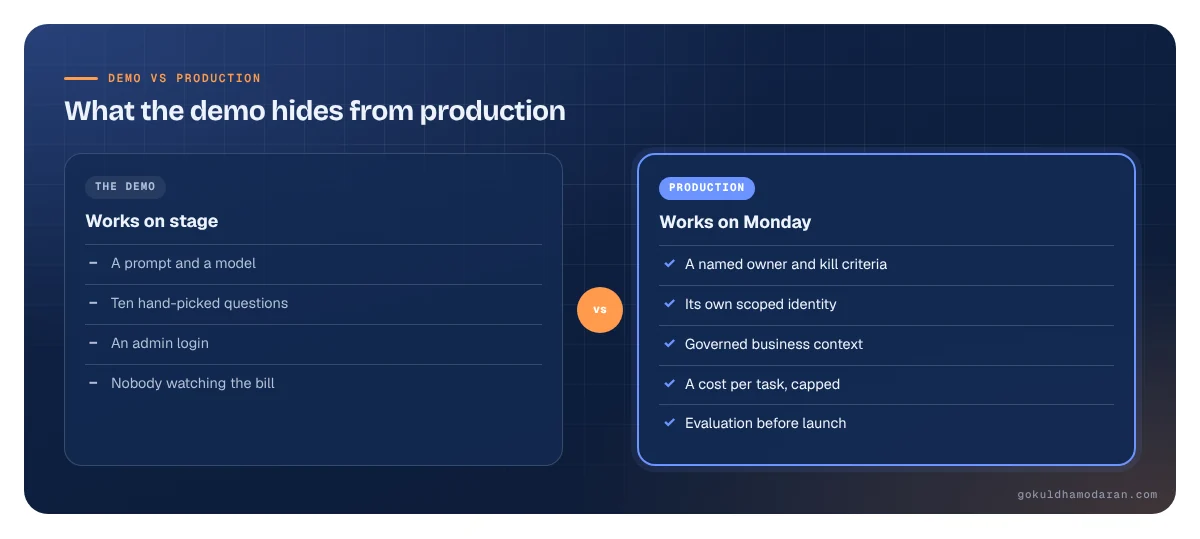
What the demo hides from production
Works on stage
- A prompt and a model
- Ten hand-picked questions
- An admin login
- Nobody watching the bill
Works on Monday
- A named owner and kill criteria
- Its own scoped identity
- Governed business context
- A cost per task, capped
- Evaluation before launch
gokuldhamodaran.com
What did Gartner say, and what changed in October 2026?
Gartner’s agentic AI forecast came with a poll of January 2025 webinar attendees. According to coverage of the release, 19% said their organization had made significant investments in agentic AI, 42% conservative ones, 8% none, and 31% were waiting or unsure. Gartner also estimated that only about 130 of the thousands of vendors selling agentic AI offer the real thing. It calls the rest agent washing.
The upside in the same release is large. Gartner expects at least 15% of day-to-day work decisions to be made autonomously by agentic AI by 2028, up from 0% in 2024. It expects 33% of enterprise software applications to include agentic AI by 2028, up from less than 1% in 2024. So the cancellations aren’t a verdict on agents. They’re a verdict on how companies run agent projects.
Gartner's cancel line for agent projects
of agentic AI projects canceled by end of 2027
Reasons: escalating costs, unclear business value, inadequate risk controls.
gokuldhamodaran.com
Then came the Gartner top strategic technology trends for 2027, announced Oct 20, 2026. Three of the ten speak straight to agent projects, as Network World’s summary lays out:
- AI agent identity. Tie each agent’s actions to its model, prompts and credentials, and replace static credentials with dynamic, policy-controlled access. Gartner predicts that by 2028, 25% of enterprise security breaches will trace back to AI agent abuse.
- AI context platforms. Unify scattered company knowledge so agents act in line with business goals. Gartner says organizations that prioritize semantics in AI-ready data could raise agentic AI accuracy by up to 80% and cut costs by up to 60% by 2027.
- AI coding agent harness. A closed loop with verification gates around autonomous coding. Gartner expects coding agents to generate 20% of all public commits by late 2026.
My read: Gartner’s 2025 forecast told you agents would fail. Its 2027 list tells you where. The rest of this guide maps both onto five patterns that explain why agentic AI projects fail in real enterprise stacks, with the fix for each.
Pattern 1 · Who owns the agent? Usually nobody
An AI agent needs one named business owner: a person who owns the process it works in, the metric it moves and the decision to kill it. In most failed projects, IT owns the build, a vendor owns the model, a business team owns the “use case”, and nobody owns the outcome. When the first wrong answer reaches a customer, every team points at another.
Ownership is also why “unclear business value” tops so many post-mortems. A pilot without an owner gets measured on activity: tasks run, tickets touched, hours “saved”. Nobody signs up to a number the CFO would recognize. When budgets tighten, those pilots are the first to go. That’s how agentic AI projects get canceled without ever failing a test.
The fix. Before a line of code, write a one-page agent charter:
- Owner. One name from the business, not IT. They approve launch and own the metric.
- Job. The single process step the agent does, with its start and end.
- Metric. One number that already exists in a report: cycle time, cost per case, error rate.
- Kill criteria. The result by a set date that ends the project. Write it down now, while nobody is attached.
If you’ve read my guide to the agentic development lifecycle, this is the “agent product owner” role. It’s the cheapest fix on this list, and the one most often skipped.
Pattern 2 · Agents borrow someone else’s keys
The fastest way to get an agent working is to give it an existing login. That’s also the fastest way to get it shut down by security. A Cloud Security Alliance survey released March 24, 2026 (228 IT and security professionals, funded by Aembit) found that 43% of organizations rely on shared service accounts for AI agents, and 31% let agents operate under human user identities. 74% said agents often receive more access than they need. 68% can’t clearly tell agent activity from human activity.
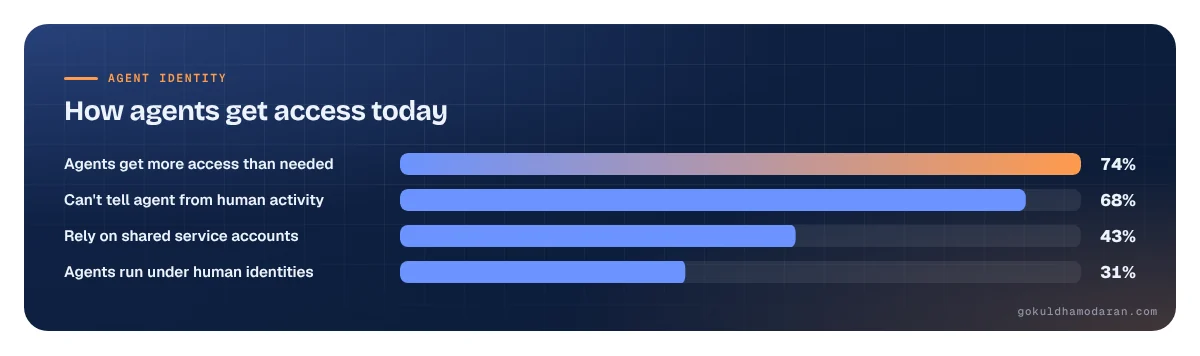
Now picture the audit. An agent changes a vendor’s bank details in your ERP. The log says a service account did it, the same one three other integrations use. Nobody can say which prompt, which model version or which request caused it. That’s not a hypothetical risk; it’s why security teams block agents from reaching the systems where value lives. Forrester’s June 2026 state of agentic AI names weak nonhuman identity management as one of the reasons enterprises stall in pilot mode.
The same survey shows why nobody fixes it: ownership of agent identity is split between security (28%), engineering (21%), IT (19%) and IAM teams (9%).
The fix. Treat agent identity as a launch gate, as Gartner’s 2027 trend says:
- Every agent gets its own identity, never a shared service account or a person’s login.
- Credentials are short-lived and scoped to the one job in the charter.
- Every action logs the agent, the model version, the request and the human it acted for.
- High-risk actions (payments, master data, approvals) stop for a human, enforced in the system of record.
I covered how this plays out inside ERP in AI agents in ERP. The short version: the record decides, the agent requests.
Pattern 3 · The agent doesn’t know your business
Ask an agent for active customers and it will find a table with that name. It won’t know that finance counts a customer as active after 90 days, sales after 180, and the board deck uses a third rule. The agent’s answer is fluent, fast and wrong. People stop trusting it after the second time.
This is what Gartner’s AI context platform trend is about. Its 2027 trends warn: “Without a dedicated context layer, organizations face severe operational risks.” The context layer holds the definitions, policies, approved sources and process rules an agent needs to act like someone who has worked at your company for a year.
From the bench: when I build analytics that answer business questions in plain English, every number shows the query behind it. That rule exists because of this exact failure. If a person can’t see which definition the agent used, they can’t trust the answer, and they’re right not to.
The fix.
- List the 20 business terms the agent will touch, and write one approved definition for each.
- Point the agent at governed sources only: the metric layer, the policy library, the system of record. Not a shared drive.
- Make the agent cite the definition and source it used in every answer or action log.
- Give each definition an owner, so changes reach the agent the same week.
Pattern 4 · The token bill nobody budgeted
Agents don’t answer once. They plan, call tools, read results, check their work and try again. Each loop costs tokens. In a June 2026 GovInfoSecurity report, Nutanix’s Debo Dutta said a single exchange that once used about 2,000 tokens can now use 20,000 or more. A pilot with 50 users hides that. A rollout to 5,000 does not.
Agents burn tokens in loops
tokens for one exchange, up from about 2,000
Agents plan, call tools and retry. Budget the cost per task, not the license.
gokuldhamodaran.com

The same report cites Bain’s 2026 survey of 951 companies: nearly 40% of those that measured AI cost savings landed below 10%, short of targets of 11% to 20%. That’s “escalating costs” from Gartner’s list, in plain numbers. The bill grows while the savings stall, and the project ends up on a cost-cutting slide.
The fix. Budget the agent like a unit of work, not a software license:
- Cost per completed task. Measure it in the pilot, including retries and failed runs, and compare it with the human cost of the same task.
- Caps. A hard spend limit per agent, per day, with an alert at 80%.
- Routing. Send routine steps to a smaller, cheaper model and save the frontier model for the hard step. My piece on small language models for enterprise covers when that works.
- Context, not volume. A good context layer cuts tokens too, because the agent stops searching for what it should already know.
Pattern 5 · Demo-grade evaluation
A demo is ten hand-picked questions in front of a friendly audience. Production is ten thousand questions nobody picked. Most agents that get canceled were never tested in between.
The LangChain State of Agent Engineering report (1,340 responses, surveyed Nov 18 to Dec 2, 2025) found quality was the top barrier to production, cited by 32%. Only 52.4% run offline evaluations, while 89% have some form of observability. Teams are watching agents more than they are testing them. And per Bain’s survey, only 7% of companies run fully autonomous agents in production; 38% still require human approval.
The fix. Make the evaluation the specification:
- Golden set. 100 to 300 real past cases with the right answer, written by the business owner’s team.
- Pass bar. The accuracy and error rate that justify launch, agreed before you test.
- Red team. A session where people try to make the agent leak data, skip an approval or invent a fact.
- Shadow run. Two to four weeks where the agent works alongside people and nothing it does is final.
- Trace everything. Every production run keeps its steps, tools and sources, so a wrong answer can be explained.
This is what Gartner means by a harness for coding agents, and it applies to every agent: a closed loop where the work is checked before it lands.
 Mission controlEvery switch has an owner. Agents need the same.
How do you know an agent is ready to launch?
An agent is ready to launch when it passes a one-page check across all five patterns: a named owner and kill criteria, its own scoped identity, governed business context, a cost per task under budget and a passed evaluation with a shadow run. If any line fails, the agent isn’t ready, however good the demo looked. This is the check I’d run on every agent in the portfolio before 2027 planning closes.
8 lines every agent must pass
- A named business owner
- Kill criteria with a date
- Its own scoped identity
- Human gate on high-risk actions
- Approved definitions it cites
- Cost per task under a cap
- Golden set passed
- Shadow run completed
gokuldhamodaran.com
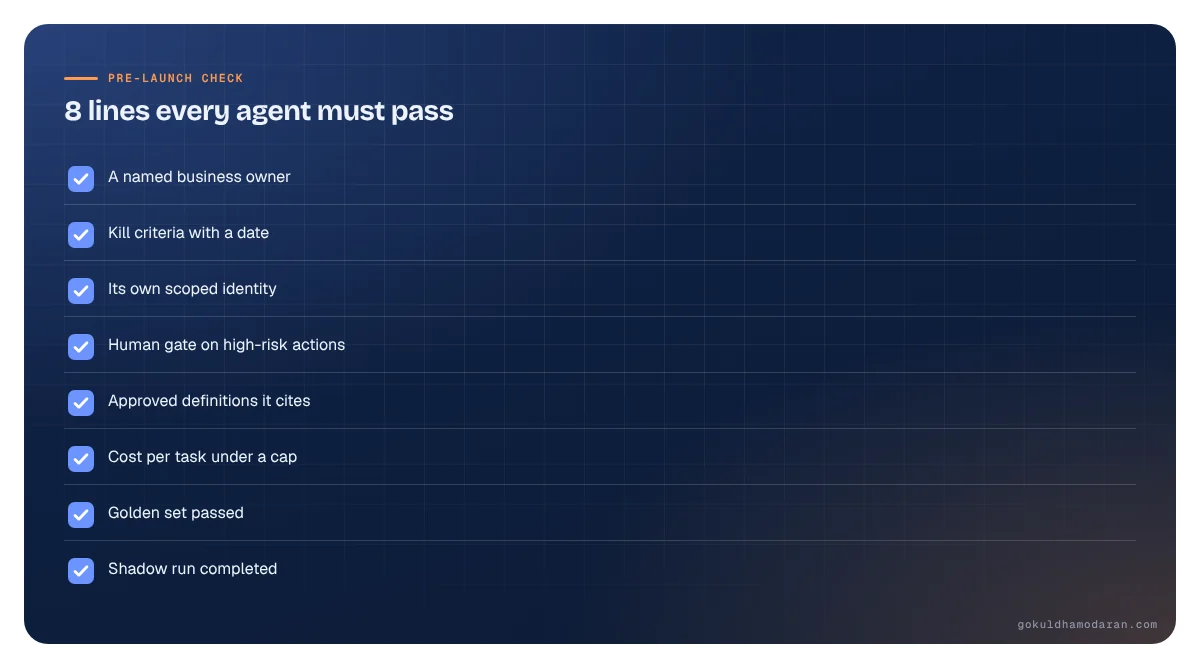
Score each agent: one point per line, eight lines. Seven or eight, launch. Five or six, fix the gaps this quarter. Four or fewer, pause it, and move its budget to an agent that scores higher. Cutting a weak project now is cheaper than having Gartner’s forecast cut it for you in 2027.
What should leaders do this quarter?
Leaders should treat the next 90 days as an agent portfolio review, not a new pilot sprint. Most enterprises already have more agents than they can govern. Forrester’s June 2026 research says more than half of enterprises report agentic sprawl, even after adopting the NIST AI Risk Management Framework. The fastest gains come from fixing or retiring what’s already running.
- Week 1–2. List every agent, pilot and vendor “agent” in use. Give each a named owner or a stop date.
- Week 3–6. Score each one on the eight-line check. Move every agent off shared service accounts and human logins.
- Week 7–10. Write the 20 definitions for your top two agents. Build their golden sets.
- Week 11–13. Set cost caps, run shadow tests, and decide: launch, fix or kill.
Watch your vendors in the same review. Agent features are landing inside the SaaS you already pay for, as I wrote in Will AI replace SaaS? Ask each vendor the same five questions: who owns it, whose identity it uses, what context it reads, what it costs per task and how it was evaluated.
Here is why agentic AI projects fail, in one line: companies fund the model and forget the job. The forecast isn’t a reason to slow down. It’s a list of what to build first. Signal, not noise.
If this was useful, the Leading Indicator newsletter tracks these moves every Friday.
Frequently asked questions
What percentage of agentic AI projects fail?
Gartner predicted in June 2025 that over 40% of agentic AI projects will be canceled by the end of 2027, citing escalating costs, unclear business value and inadequate risk controls. That is a forecast of cancellations, not a measured failure rate. Surveys in 2026 also show only a small share of companies run fully autonomous agents in production; Bain put it at 7%.
What is the most common reason AI agents fail in production?
Quality is the most cited barrier. In LangChain's State of Agent Engineering survey, 32% named it the top blocker to production. Underneath quality sit fixable causes: no approved business definitions, no golden set of real cases to test against, and no shadow run before launch. Agents are usually tested like demos, then trusted like employees.
What is agent washing?
Agent washing is Gartner's term for rebranding chatbots, RPA bots or AI assistants as agentic AI without real agent capability. Gartner estimated that only about 130 of the thousands of vendors claiming agentic AI offer genuine agents. Ask vendors to show the agent planning steps, calling tools and acting with its own scoped identity on your data.
What is AI agent identity and why does it matter?
AI agent identity means each agent has its own login, with scoped, short-lived credentials, and every action is tied to the agent, its model and its prompt. It matters because a Cloud Security Alliance survey found 43% of organizations rely on shared service accounts for agents. Gartner lists AI agent identity as a top trend for 2027.
How do you stop agentic AI costs from spiraling?
Budget the cost per completed task, not the license. Measure it in the pilot with retries included, set a hard daily cap per agent, route routine steps to a smaller model, and give the agent governed context so it stops searching. Compare the result with what a person costs for the same task before you scale.
Sources
- Gartner: Over 40% of agentic AI projects will be canceled by end of 2027 (Jun 25, 2025)
- New Electronics: Over 40% of agentic AI projects could be cancelled by 2027 (Gartner poll details)
- Gartner: Top strategic technology trends for 2027 (Oct 20, 2026)
- Network World: Gartner's top tech trends for 2027
- Cloud Security Alliance: Identity and access gaps in the age of autonomous AI (Mar 24, 2026)
- GovInfoSecurity: AI spending keeps outrunning budgets (Jun 12, 2026)
- LangChain: State of Agent Engineering
- Forrester: The state of agentic AI in 2026 (Jun 3, 2026)

Gokul Dhamodaran
I turn what is happening at the AI frontier into what it means for enterprise systems, and I build AI products myself (Euliv Analytics, Vantage). I write Leading Indicator every Friday: the AI and enterprise tech moves that matter, and what they mean for you.
Views are my own and do not represent any employer or client. Graphics are original; sources are linked.