The short answer
AI agents in ERP are generally available today for narrow finance and contract tasks, such as reconciliation and contract review, mostly with a person approving each action. Broad autonomy across whole processes is still roadmap. Pilot first in reconciliation and close, accounts receivable, and supplier documents, and demand status, controls and audit logs in writing.
Key takeaways
- Most ERP agents in production today handle exceptions inside one process, with a person approving.
- "Generally available" means you can buy it, not that peers run it. Ask for production counts.
- Agents take reconciliation, receivables and supplier documents first.
- Use the Three-Gate Test: status in your edition, controls you set, and a log you can replay.
- Run a 90-day pilot in suggest-only mode before the agent acts alone.
On October 6, 2026, SAP said its Joule assistants and agents were generally available that month. Oracle says it has more than 1,000 prebuilt agents. Microsoft ships an agent that reconciles your ledger. Read the press releases and AI agents in ERP look finished. Read the fine print and most of them are still a preview, a demo, or a pilot with a person checking every step.
That gap is the whole story for 2027. This guide sorts what is in production from what is still a demo across the big suites, names the three processes agents take first, and gives you a pilot plan you can start in January. No rankings. Just status, scope and proof.
What are AI agents in ERP, in plain English?
AI agents in ERP are software that reads your business data, decides on a next step and takes it inside the ERP system, within limits you set. A chatbot answers a question. An agent does the work: it matches a payment, drafts a supplier email or posts a journal entry, then asks a person when it is not sure.
The useful test is simple. If the software only suggests, it is an assistant. If it can act on a record, it is an agent. Most products marketed as agents today sit in between. They act on the easy cases and hand everything else to a human queue. That is not a flaw. It is the design you want in finance and supply chain, where one wrong posting has an audit trail. Good ERP automation keeps a human approval step for exactly those cases.
Gartner has a name for the opposite: agent washing, or rebranding chatbots and old automation as agents. In its June 2025 forecast, Gartner estimated that only about 130 of the thousands of agentic AI vendors are real. Keep that number in mind when a slide promises autonomy.
What is actually in production versus still a demo?
As of November 2026, a handful of finance and contract agents are generally available or in “production-ready preview” across the major suites. Broad, multi-step autonomy across a whole process is still mostly roadmap. The safe reading: agents handle exceptions inside one process, with human approval for anything that moves money.
What ERP suites ship now vs. still demo
| Attribute | Cloud firstSAP | EmbeddedOracle | PreviewMicrosoft | ContractsWorkday |
|---|---|---|---|---|
| Headline status | GAsince Oct 2026, cloud | Liveledger agent | Previewproduction-ready | GAcontract agents |
| Shipping now | Joule finance agents, cloud | Ledger agent in production | Reconciliation agent | Contract review agents |
| Preview or early | Private cloud ERP: early adopter | Collections apps due in 2026 | Recommends on one exception type | Document accounting agent |
| Demo or roadmap | Full autonomous suite | Consolidation, planning: demoed | Supplier agent: status varies | Broad finance autonomy |
SAP
Oracle
Microsoft
Workday
Status as reported by each source. Not a ranking.
gokuldhamodaran.com
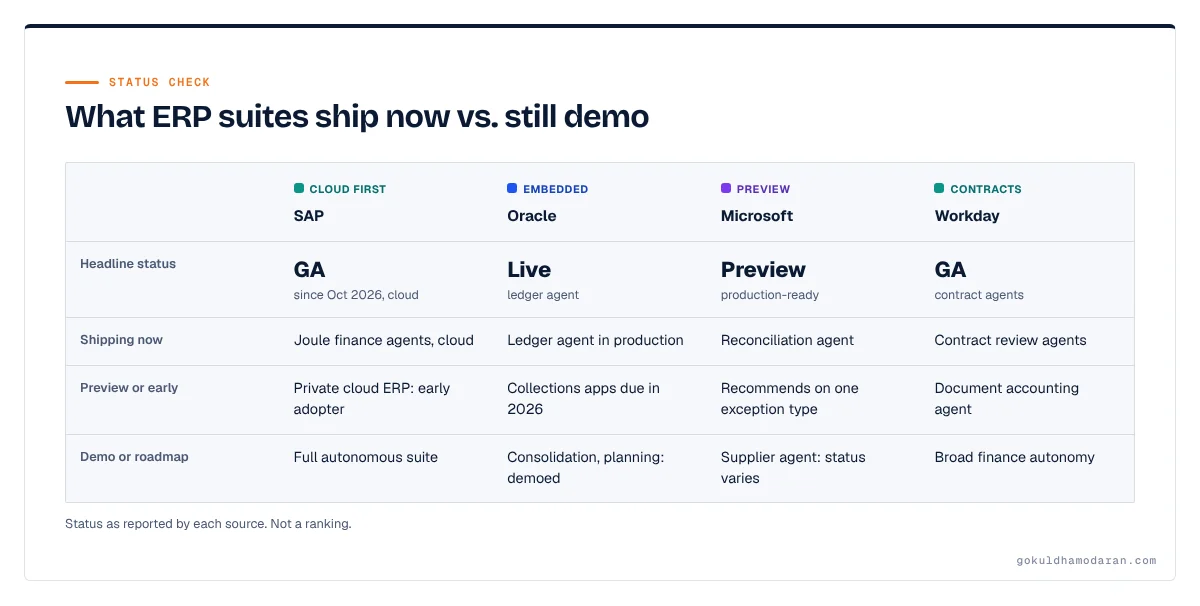
Here is what each suite has said in public, with dates. This is status, not a ranking. Where a source says generally available, I say so; where it says preview or demo, I say that.
- SAP. At Sapphire in May 2026, SAP described more than 50 domain assistants that coordinate more than 200 specialized agents, with initial general availability for some finance agents that quarter, according to Constellation Research. In October, SAP said the assistants, agents, Joule Studio and Joule Work became generally available as SAP-managed products. For private cloud ERP, they run through an early adopter program, with general availability planned by year-end, CIO reported.
- Oracle. Oracle cites 1,000+ prebuilt agents and says it has no plan to charge for agents embedded in Fusion. Forrester’s May 2026 review describes the ledger agent as in production, consolidation and planning apps as demoed live, and collections apps as expected this year.
- Microsoft. The Account Reconciliation Agent in Dynamics 365 Finance is labeled a production-ready preview in Microsoft’s documentation, last updated September 2026. Today it recommends actions for one exception type: voucher amount mismatches.
- Workday. In May 2025, Workday made its contract intelligence and contract negotiation agents generally available, and set early 2026 as the target for document-driven accounting and supplier contract agents.
Notice what is missing from almost every announcement: production counts. Forrester named the missing deployment counts, activation rates and outcome metrics as the main gap in Oracle’s story. The same gap shows up across the market. SAP’s own figure, Joule Work live with 110,000 SAP employees, is an internal rollout, not a customer one. That is useful proof that SAP Joule agents run at scale inside SAP. It is not proof they run inside your company.
My read: generally available tells you that you can buy it. It does not tell you that companies like yours run it. Ask every vendor for both.
Why the gap between demo and production is so wide
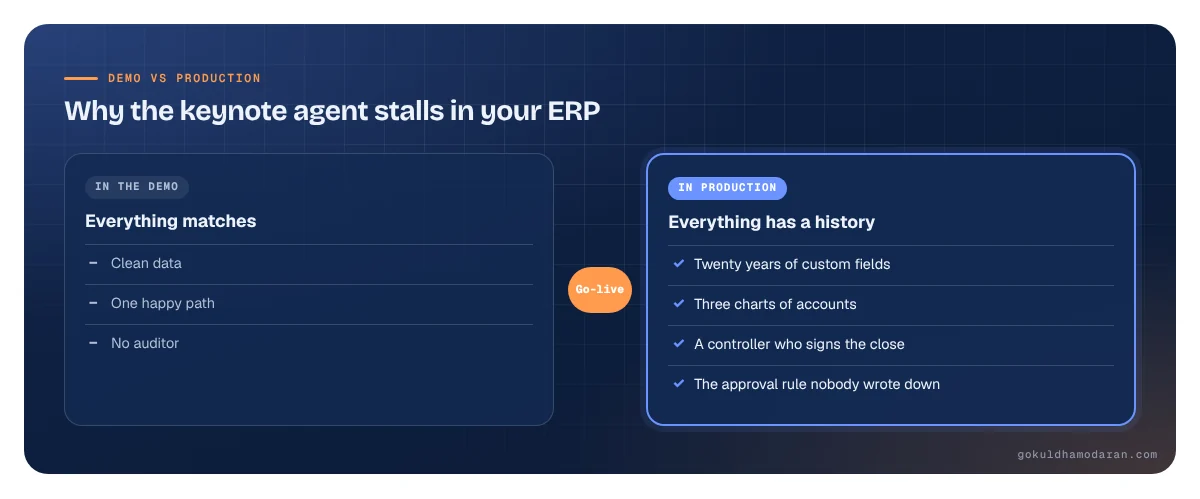
A demo runs on clean data, one happy path and no auditor. Production runs on twenty years of custom fields, three charts of accounts and a controller who signs the close. Agentic AI in ERP fails at the seams: the missing purchase order, the vendor with two names, the approval rule nobody wrote down.
Why the keynote agent stalls in your ERP
Everything matches
- Clean data
- One happy path
- No auditor
Everything has a history
- Twenty years of custom fields
- Three charts of accounts
- A controller who signs the close
- The approval rule nobody wrote down
gokuldhamodaran.com
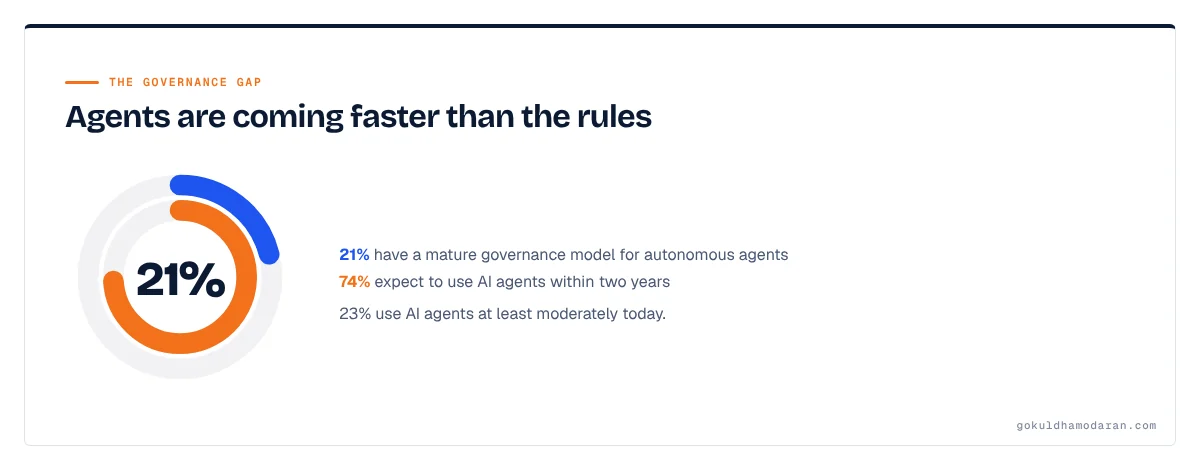
The survey data says the same. Deloitte’s April 2026 report, based on 3,235 business and IT leaders in 24 countries, found that 74% expect to use AI agents at least moderately within two years. Only 21% have a mature governance model for autonomous agents. The Register’s summary adds that 23% use agents at least moderately today.
Agents are coming faster than the rules
- 21% have a mature governance model for autonomous agents
- 74% expect to use AI agents within two years
23% use AI agents at least moderately today.
gokuldhamodaran.com
Finance teams feel it first. In a March 2026 Gartner survey of 204 finance leaders, 63% said AI implementation was slower than expected in 2025, according to Gartner. And Gartner’s broader forecast is blunt: over 40% of agentic AI projects will be canceled by the end of 2027, due to rising costs, unclear value or weak risk controls.
Agent projects that won't make it
of agentic AI projects canceled by the end of 2027
Gartner's reasons: rising costs, unclear value or weak risk controls.
gokuldhamodaran.com

I build AI agents myself, and the hard part is rarely the model. It is deciding what the agent may do without asking, and proving afterward what it did. That is a process design problem, not an AI problem. It is also where ERP teams already have an edge, because ERP is built on roles, approvals and logs.
Which ERP processes will AI agents take first?
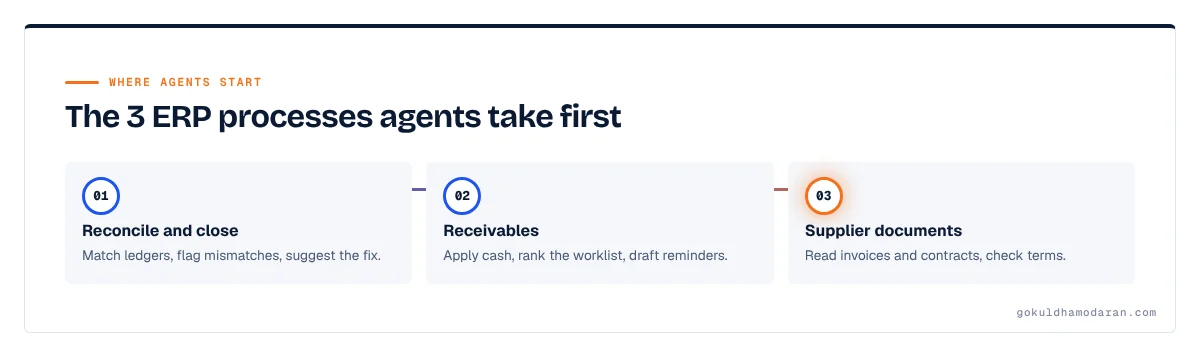
Agents in ERP will take three processes first: reconciliation and the financial close, accounts receivable and collections, and supplier documents in procure-to-pay. All three are high volume, rule-heavy, and already split into easy matches and exceptions. That split is exactly where an agent with human approval earns its keep.
The 3 ERP processes agents take first
- 01Reconcile and closeMatch ledgers, flag mismatches, suggest the fix.
- 02ReceivablesApply cash, rank the worklist, draft reminders.
- 03Supplier documentsRead invoices and contracts, check terms.
gokuldhamodaran.com
1. Reconciliation and the financial close
Reconciliation is the clearest early win for ERP automation with agents. The work is matching: subledger to general ledger, bank to book, intercompany to intercompany. Most items match on rules. The rest become exceptions that a person investigates.
That is why the first shipping agents live in the financial close. Microsoft’s reconciliation agent recommends a fix for a mismatch, and the user accepts it, picks another action or undoes it later. Oracle’s ledger agent is the one Forrester describes in production. SAP lists financial closing among its finance assistants. The pattern is the same in all three: the agent proposes, the accountant disposes. Human approval is the product, not a workaround.
What to measure: days to complete the financial close, open reconciliation items at day three, and the share of agent suggestions accepted without change. That last number is your trust score.
2. Accounts receivable and collections
Cash application and collections are the second wave. An agent reads remittance advice, matches payments to invoices, flags short pays and drafts the dunning email in the right tone for the right customer. SAP includes an accounts receivable assistant in its finance suite. Oracle expects its collections workspace this year.
The risk is customer-facing. A wrong reminder to a key account is a relationship problem, not just an accounting one. Start ERP automation with internal steps (matching, prioritizing the worklist) before you let an agent send anything. Customer emails should need human approval for the whole pilot.
What to measure: days sales outstanding, unapplied cash, and the hours your team spends on the worklist each week.
3. Supplier documents in procure-to-pay
The third wave is the paperwork between you and suppliers: invoices that don’t match the purchase order, contract terms nobody checked and supplier emails about late deliveries. Workday’s document-driven accounting and supplier contract agents target this work. Microsoft lists a supplier communications agent for supply chain. SAP’s spend assistants cover sourcing, supplier management and invoices.
This is where agents read unstructured text and turn it into a structured action. That is a real strength of today’s models. It is also where hallucination risk is highest, so every extracted field needs a source link back to the document, and every posting needs human approval until the match rate proves itself.
What to measure: first-pass match rate on invoices, cycle time from invoice to approval, and missed early-payment discounts.
How do you tell a real ERP agent from agent washing?
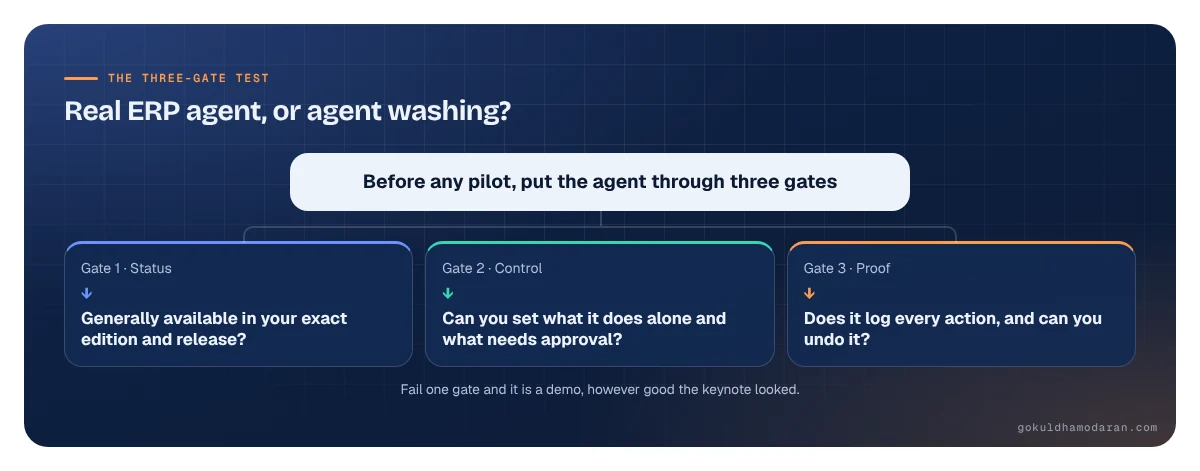
Use the Three-Gate Test before any pilot. Gate one is status: is the agent generally available in your exact edition and release? Gate two is control: can you set what it may do alone and what needs approval? Gate three is proof: does it log every action and can you undo it? Fail one gate and it is a demo, however good the keynote looked.
Real ERP agent, or agent washing?
Before any pilot, put the agent through three gates
- Gate 1 · StatusGenerally available in your exact edition and release?
- Gate 2 · ControlCan you set what it does alone and what needs approval?
- Gate 3 · ProofDoes it log every action, and can you undo it?
Fail one gate and it is a demo, however good the keynote looked.
gokuldhamodaran.com
- Status. Ask for the status in writing for your edition: public cloud, private cloud or on-premise. SAP’s October update is a good example of why. The same agents were generally available for some editions and early adopter only for private cloud ERP.
- Control. Ask to see the settings screen, not the demo. You want thresholds (for example, auto-post under a dollar amount), role-based permissions and a named human approver for everything above them. Forrester’s advice for Oracle buyers applies to every suite: require audit trails, thresholds and human override paths before you pilot.
- Proof. Ask what the agent writes to the log, who can read it and how an auditor would replay one decision. Microsoft’s reconciliation agent labels each of its actions as a fix suggested by the agent and lets a user undo it. That is the bar.
Then ask two commercial questions. Which agents are included in what you already pay for, and what happens to pricing at renewal? Oracle says embedded agents carry no extra charge today. Forrester flags renewal pricing as the open question. Get the answer in the contract, not the keynote.
How should agentic AI in ERP change your 2027 roadmap?
Agentic AI in ERP should change the order of your roadmap more than its size. Clean master data, written approval rules and a modern core now pay off twice: once for the upgrade and again for every agent you add. Teams still on old systems should plan agents as a reason to finish the core, not a reason to delay it.
If you still run SAP ECC, the timing matters. Most new SAP Joule agents target S/4HANA and SAP’s cloud suite, so your agent plan and your migration plan are now the same plan. Customers who stay on ECC longer should expect fewer SAP Joule agents, later. I covered the deadline and the three paths in SAP ECC end of maintenance 2027.
Three things belong on every 2027 ERP roadmap:
- A data owner for each pilot process. Agents act on master data. Bad vendor or customer records turn into bad actions at machine speed.
- An agent identity policy. Microsoft’s reconciliation agent needs its own identity with its own roles. Treat every agent like a new employee: named owner, least access, reviewed quarterly.
- A budget line for change management. Gartner’s cancellation forecast names unclear value as a top reason projects die. The people who do the work today must define what good looks like, or the pilot will never get past them.
A 90-day pilot plan for AI agents in ERP
A good first pilot of AI agents in ERP is small, boring and measurable. Pick one process, one entity and one agent that has passed the Three-Gate Test. Run it in suggest-only mode first, then let it act on low-risk cases. Here is the plan I would follow.
- Weeks 1–2: Baseline. Pick one process from the three above. Measure today’s numbers: volume, cycle time, exception rate and hours spent. No baseline, no business case.
- Weeks 3–4: Rules on paper. Write down what the agent may do alone, what needs approval and what it must never touch. Get the controller and internal audit to sign it.
- Weeks 5–8: Suggest-only. Turn the agent on in recommend mode. Every suggestion goes to a person. Track the acceptance rate, and log every rejected suggestion with a reason.
- Weeks 9–12: Act on the easy cases. Where acceptance runs high, let the agent act below a set threshold. Review a sample of its actions every week. Compare against the baseline.
- Day 90: Decide. Scale to the next entity, fix and rerun, or stop. Stopping is a valid result. It costs far less than a year-long pilot that never ends.
The free workbook below turns this plan into pages you can fill in with your finance and IT leads in the room.
The mistakes that stall agent pilots
The mistake I see most is starting with the most impressive process instead of the most measurable one. A demo of an agent negotiating with suppliers wins the steering committee. A reconciliation agent that cuts close by a day wins the budget.
Other patterns to avoid:
- Piloting a roadmap item. If it is not generally available in your edition, you are testing the vendor’s product for them.
- No human approval step. Autonomy is earned with an acceptance rate, not granted on day one.
- Measuring activity. Gartner’s Marco Steecker put it well: CFOs “must not mistake activity for impact.” Count hours saved and errors avoided, not prompts sent.
- Skipping the financial close. It is the most measured process in the company. Use it to prove ERP automation works before you try anything customer-facing.
- Building custom first. Use the agents your suite ships before you build your own. Custom agents make sense once you know where the shipped ones stop.
One more, from the adoption side. Agent pilots get funded the same way any new system does: a named sponsor, a clear before-and-after number and a story the CFO can retell. Write that one-line story before the pilot starts, then make the data prove it.
What to do this week
You don’t need a strategy deck to start. You need three answers. Which of the three processes costs your team the most hours? Which agents does your current ERP contract already include, and in which status? Who would sign the rules for a suggest-only pilot, and who gives human approval once it acts?
Get those answers by Friday and you have a 2027 pilot. Skip them and you will be watching vendor keynotes for another year. If you want the short version of moves like this every week, the Leading Indicator newsletter covers AI and enterprise tech every Friday, and you can see what I build on my portfolio or get in touch through the contact page.
Signal, not noise: buy what is generally available, approve what moves money, and measure what the agent saves.
Frequently asked questions
Are AI agents in ERP ready for production?
Some are, for narrow work. Reconciliation, contract review and document extraction agents are generally available or in production-ready preview in major suites. They act on easy cases and send exceptions to people. Multi-step autonomy across a full process, such as an end-to-end close with no human sign-off, is still a roadmap item for most companies.
What is the difference between an ERP copilot and an ERP agent?
A copilot answers questions and suggests next steps; a person does the work. An agent can act on a record, such as matching a payment or drafting a journal entry, within limits you set. Many products sit in between, acting below a threshold and asking for approval above it. That middle ground is the right starting point for finance.
Do SAP Joule agents need S/4HANA?
SAP's new Joule assistants and agents are built for S/4HANA and its cloud portfolio. In October 2026, SAP said they were generally available as SAP-managed products, while private cloud ERP customers access them through an early adopter program, with general availability planned by year-end. Check your exact edition and release with SAP before planning a pilot.
How much do ERP AI agents cost?
It varies by vendor and contract. Oracle has said it does not plan to charge extra for agents embedded in Fusion applications, though analysts flag renewal pricing as an open question. Other vendors bundle agents into AI add-ons or usage-based plans. Ask which agents your current contract already includes and get renewal terms in writing.
Why do agentic AI projects get canceled?
Gartner expects over 40% of agentic AI projects to be canceled by the end of 2027, citing rising costs, unclear business value and weak risk controls. In ERP, the usual causes are pilots without a baseline, agents piloted before they are generally available, and no agreed rule for what the agent may do without approval.
Sources
- CIO: SAP advances its autonomous AI agenda with yet more Joule assistants and agents (Oct 2026)
- Constellation Research: SAP Sapphire 2026, the autonomous enterprise platform (May 2026)
- SiliconANGLE: SAP recasts Joule as the front door to the autonomous enterprise (May 2026)
- Forrester: Oracle Applications Analyst Summit, Fusion agents shift from assist to decide (May 2026)
- Microsoft Learn: Account Reconciliation Agent (production ready preview), updated Sep 2026
- Stoneridge Software: How to use the Account Reconciliation Agent in Dynamics 365 Finance
- Workday: Next generation of Illuminate agents for HR and finance (May 2025)
- Deloitte Insights: AI agents are scaling faster than governance (Apr 2026)
- The Register: Deloitte finds AI adoption outpacing revenue lift (Jan 2026)
- SD Times: Gartner says over 40% of agentic AI projects will be canceled by end of 2027 (Jun 2025)
- Gartner: CFOs must stop mistaking finance AI deployment for value creation (May 2026)

Gokul Dhamodaran
I turn what is happening at the AI frontier into what it means for enterprise systems, and I build AI products myself (Euliv Analytics, Vantage). I write Leading Indicator every Friday: the AI and enterprise tech moves that matter, and what they mean for you.
Views are my own and do not represent any employer or client. Graphics are original; sources are linked.