The short answer
An account-based marketing program works when marketing and sales agree on a short list of accounts, reach the whole buying group with one clear message, and judge success on qualified pipeline instead of clicks. Start with 50 to 100 accounts, one shared dashboard and a 30-minute weekly review.
Key takeaways
- Pick the account list with sales, not for them.
- Map the buying group before you write a single ad.
- Give every channel one message per account tier.
- Report pipeline weekly, in one place both teams trust.
Most account-based marketing programs don’t fail in the ads. They fail in the gap between marketing and sales. Marketing builds a list, launches campaigns and reports engagement. Sales looks at the list, recognizes a few names and goes back to its own pipeline.
When I ran account-based marketing for SAP-focused enterprise solutions at Kaar Tech, the campaigns were never the hard part. The hard part was getting sales to treat the account list as theirs. Once we built it together and reviewed it every week, the program contributed to a 35% increase in qualified pipeline. This guide walks through the setup that made that work, step by step.
What is an account-based marketing program?
An account-based marketing program is a plan to win a named list of companies instead of collecting as many leads as possible. Marketing and sales choose the accounts together, learn who decides at each one, and run coordinated campaigns that reach those people across ads, email, events and sales outreach.
The shift is simple to say and hard to do. A lead-based funnel asks, “How many people filled in a form?” An account-based program asks, “Are the companies we picked moving toward a deal?” That one change affects how you choose targets, what you write and how you report. If you are new to the idea, my portfolio shows where ABM sits next to the other growth channels I run.
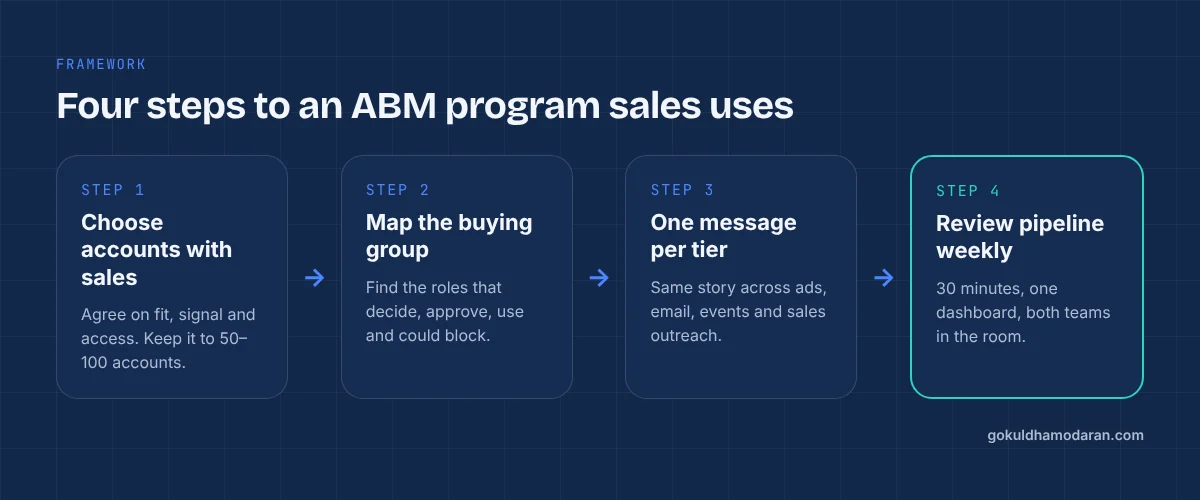
Four steps to an ABM program sales uses
- 01Choose accounts with salesAgree on fit, signal and access. Keep it to 50–100 accounts.
- 02Map the buying groupFind the roles that decide, approve, use and could block.
- 03One message per tierSame story across ads, email, events and sales outreach.
- 04Review pipeline weekly30 minutes, one dashboard, both teams in the room.
gokuldhamodaran.com
Why do most ABM programs stall after three months?
They stall because the list belongs to marketing. Sales was handed 200 logos, never agreed to them and kept working its own deals. Three months later, marketing reports rising engagement while sales reports nothing new. Both are right, and the program loses its budget.
The second reason is reach. Big purchases are decided by groups, not individuals. MarTech, citing Gartner, puts the average buying team at 14 to 23 people, depending on the size of the spend. If your campaigns only reach the one contact who downloaded an e-book, most of the people who can block the deal never hear from you.
The third reason is measurement. Clicks and impressions are easy to report, so teams report them. Leadership asks what changed in the pipeline, nobody can answer, and the program gets cut.
How do you choose the right accounts with sales?
Start with one working session, not a spreadsheet sent by email. Bring the sales leader, two account executives and whoever owns your CRM. Agree on three things before you name a single company.
- Fit: industry, size and region where you already win deals.
- Signal: a reason to act now, such as a new leader, a funding round, a system migration or a hiring wave.
- Access: a path in, such as a past contact, a partner or an existing customer in the same group.
Then build the list together and keep it small. Fifty to one hundred accounts is enough for a first program. Split them into tiers: a handful of top accounts that get custom work, a larger tier that gets industry-level campaigns, and the rest that get lighter, automated touches.
The test is simple. Every account executive should be able to say, without looking, why each of their accounts is on the list. If they can’t, the account comes off.
Who is in the buying group, and how do you map it?
For each top-tier account, sketch the buying group before you write any copy. Demandbase describes a buying group as a set of people, often six to ten, who share the decision. In practice I group them into five roles.
The five roles to map at each top account
| Role | What they need to believe | Where to reach them |
|---|---|---|
| Decision maker | It solves a problem worth the spend | Executive briefing, sales outreach |
| Finance | Cost and risk are clear | Business case, ROI one-pager |
| IT or operations | Rollout won't break current systems | Technical webinar, case study |
| End users | Daily work gets easier | Product demo, short videos |
| Champion | Backing this makes them look good | Personal outreach, events |
gokuldhamodaran.com
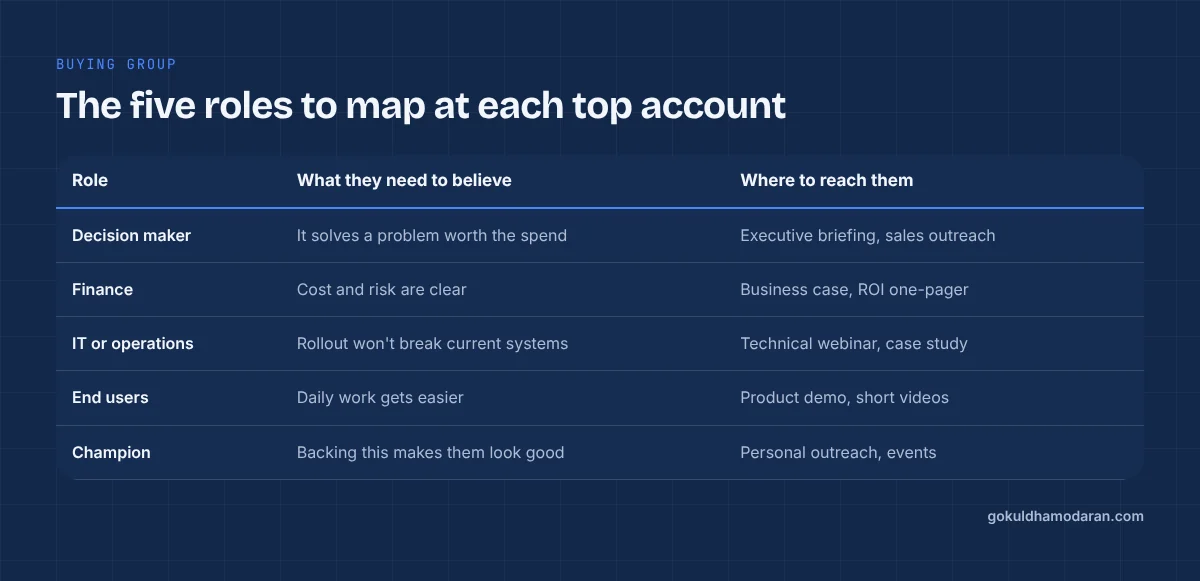
You don’t need every name on day one. You need to know which roles you can already reach and which ones are missing. Tools like HubSpot, ZoomInfo, Apollo and LinkedIn Sales Navigator help fill the gaps, but the first draft should come from sales, because they already know who said yes in past deals.
What should you say to each account tier?
Write one message per tier and one proof point per role. The message is the business problem you solve for that type of company. The proof point is what each role needs to believe it.
For example, a finance leader needs to see cost and risk. An IT leader needs to see that the rollout won’t break existing systems. An end user needs to see that daily work gets easier. Same company, same message, different proof.
Then run that message through every channel at once: LinkedIn and Google ads aimed at the account list, email to known contacts, a webinar or event invitation, and sales outreach that references the same problem. The goal is that every person in the buying group hears one consistent story within the same few weeks.
How do you measure an account-based marketing program?
Measure accounts, not leads. I track four numbers on one dashboard that sales and marketing both open every week:
- Engaged accounts: how many target accounts had two or more people interact this month.
- Buying group coverage: the share of key roles you can reach at each top account.
- Meetings and opportunities: how many target accounts moved into a sales conversation.
- Qualified pipeline: the value of open opportunities from target accounts, compared with non-target accounts.
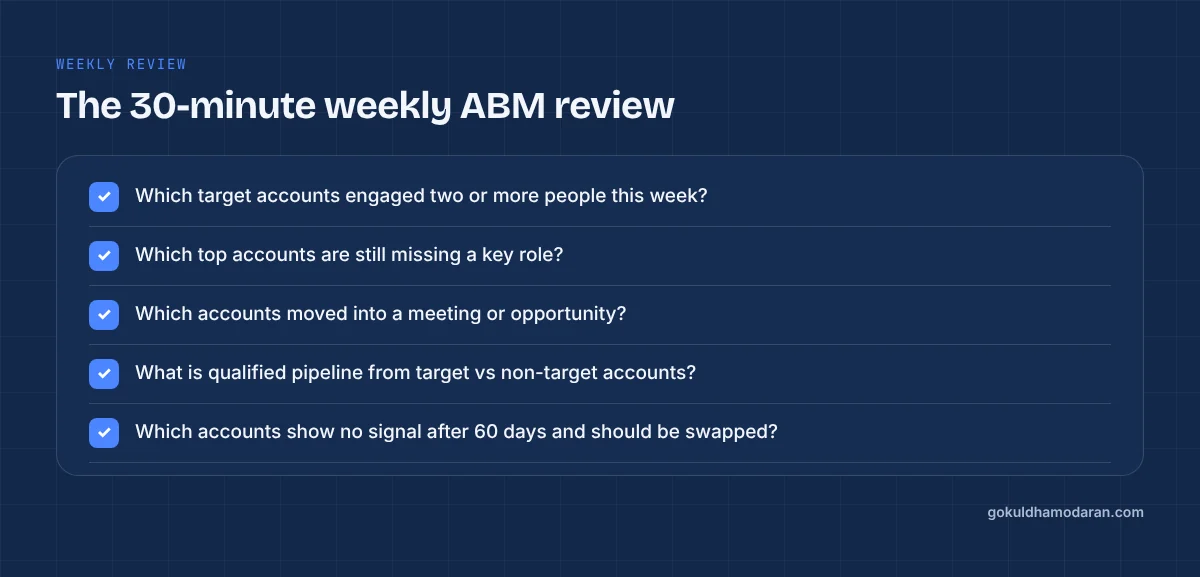
At Kaar Tech I built these views in Power BI and Google Analytics, fed by SQL and Python, and we reviewed them every week with leadership. The weekly rhythm matters more than the tool. A 30-minute review where sales and marketing look at the same numbers keeps the list honest and the program funded.
The 30-minute weekly ABM review
- Which target accounts engaged two or more people this week?
- Which top accounts are still missing a key role?
- Which accounts moved into a meeting or opportunity?
- What is qualified pipeline from target vs non-target accounts?
- Which accounts show no signal after 60 days and should be swapped?
gokuldhamodaran.com
What does a 30-day ABM launch plan look like?
You can launch a first program in a month if you keep the scope tight.
- Week 1: run the account selection session and agree on tiers.
- Week 2: map buying groups for the top tier and fill contact gaps.
- Week 3: write the tier messages and role proof points, then build the ads and emails.
- Week 4: launch, set up the shared dashboard and hold the first weekly review.
After the first month, change one thing at a time. Swap out accounts that show no signal after 60 days. Add roles you keep missing. Move budget toward the channels that create meetings, not just clicks.
Where to go from here
An account-based marketing program is a working agreement between marketing and sales as much as a campaign plan. Get the list, the buying group and the weekly review right, and the campaigns have something to build on.
If you want more practical guides like this one, join my newsletter. If you are planning an ABM program and want a second opinion, get in touch.
Frequently asked questions
How many accounts should a first ABM program target?
Start with 50 to 100 accounts, split into tiers. That is small enough for sales to know every account and large enough to show a pipeline trend within a quarter.
Is ABM only for large enterprises?
No. Any B2B company with a clear ideal customer and deals large enough to involve several decision makers can run a focused ABM program, even with a small team.
What tools do you need for account-based marketing?
A CRM such as HubSpot, a way to find contacts such as ZoomInfo, Apollo or LinkedIn Sales Navigator, ad platforms that can target account lists, and one shared dashboard. An ABM platform such as Demandbase helps at scale but is not required to start.
How long before an ABM program shows results?
Engagement shows within weeks. Meetings and opportunities usually take one to two quarters, depending on your sales cycle, which is why the weekly pipeline review matters.
Sources

Gokul Dhamodaran
I turn what is happening at the AI frontier into what it means for enterprise systems, and I build AI products myself (Euliv Analytics, Vantage). I write Leading Indicator every Friday: the AI and enterprise tech moves that matter, and what they mean for you.
Views are my own and do not represent any employer or client. Graphics are original; sources are linked.