Updated November 2026: list prices, AI agent products and the latest IDC market-share data are refreshed below.
Choosing the right enterprise CRM software is one of the most consequential technology decisions a large organisation will make. With the global CRM market projected to surpass $157 billion by 2030 and AI rewriting every aspect of customer engagement, the stakes have never been higher — or the options more complex.
Quick answer: For most large companies, Salesforce Sales Cloud is the best enterprise CRM software overall. Choose Microsoft Dynamics 365 if you run on Microsoft 365 and Azure, Oracle CX for data-heavy industries, SAP for companies already on SAP ERP, and HubSpot Enterprise for the fastest time to value. The full ranking, reviews and a decision framework follow.
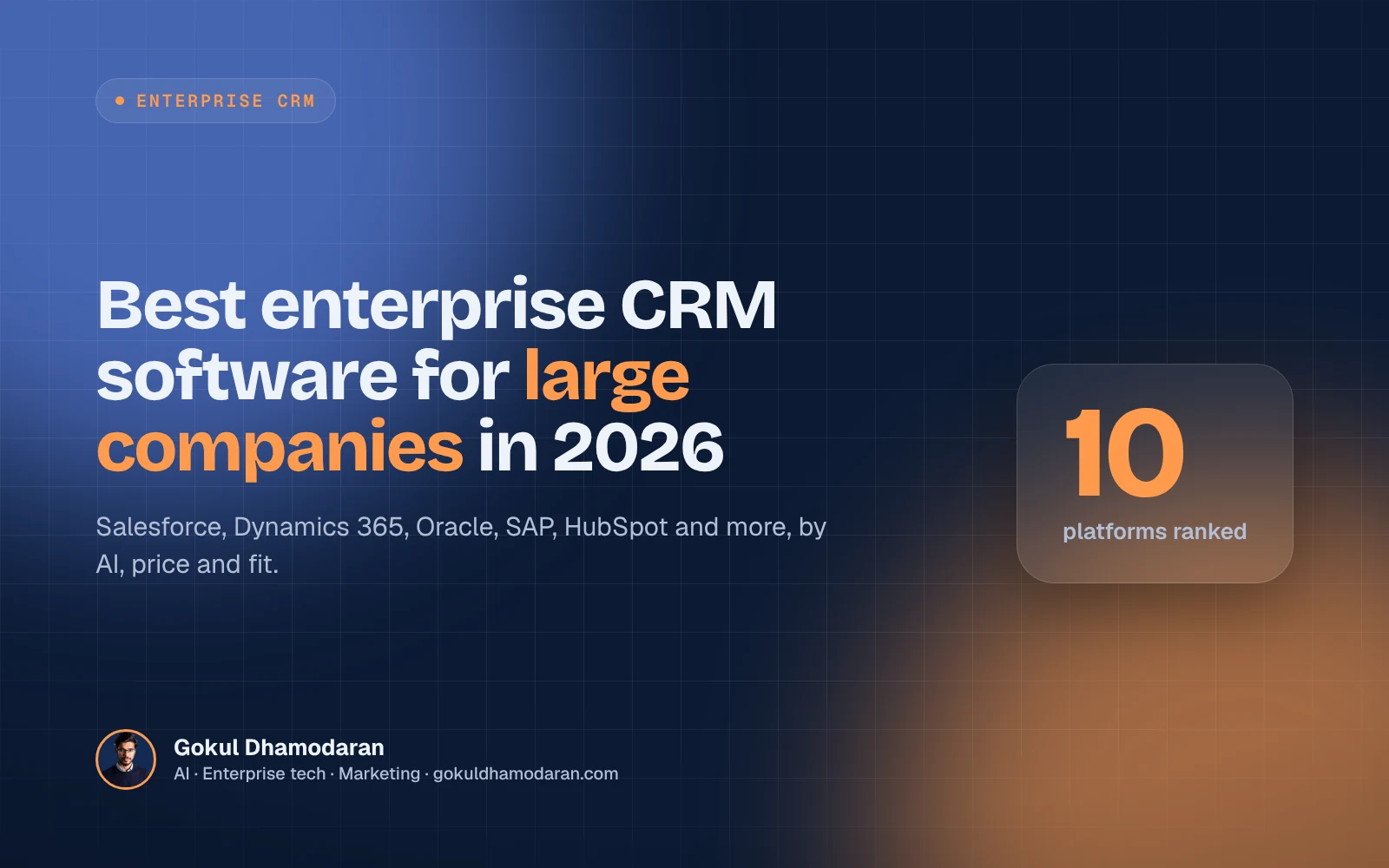
This comprehensive guide ranks and compares the 10 best enterprise CRM platforms for large companies in 2026. Every platform has been evaluated across 50+ criteria including AI capabilities, implementation timeline, total cost of ownership, Gartner Peer Insights ratings, G2 user scores, integration depth, and analyst positioning.
What Is Enterprise CRM Software?
Enterprise CRM (Customer Relationship Management) software is a platform designed for large organisations — typically with 250+ users, multi-country operations, or complex sales cycles — that need deep customisation, robust security, and seamless integration with ERP, marketing automation, and service management systems.
Unlike SMB CRM tools, enterprise platforms offer:
- Role-based access control (RBAC) and SSO/SAML security
- API-first architecture for deep ERP and supply chain integration
- AI-powered forecasting, lead scoring and next-best-action automation
- Multi-currency, multi-language, multi-entity support for global teams
- Custom objects, workflows and approval chains without code limits
- SLAs guaranteeing 99.9%+ uptime with dedicated enterprise support
Enterprise CRM Market Share in 2026
The enterprise CRM market is dominated by a handful of global players, yet no single vendor holds majority share. Understanding market position helps you assess vendor viability, support quality, and ecosystem depth.
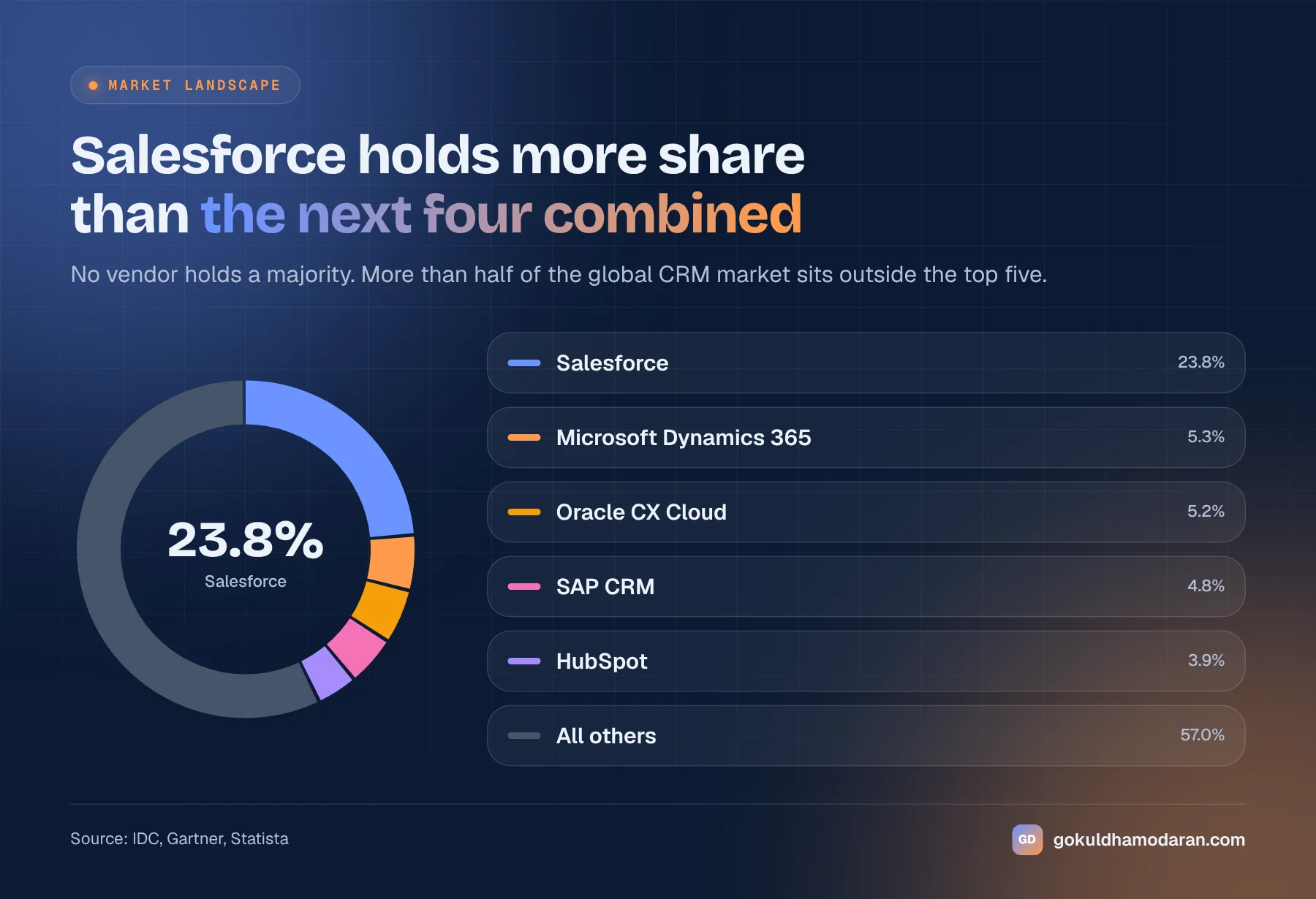
Figure 1: Enterprise CRM market share and annual revenue, 2024 estimates (Sources: IDC, Gartner, Statista)
The latest IDC ranking (published June 2026, covering 2025) puts Salesforce first for the 13th year running with 20.0% of the global CRM market, down from 20.7% a year earlier because the market grew faster than the leader. Oracle (about 4.1%) and Microsoft (about 4.0%) follow, far behind. However, for enterprise buyers, market share alone is not the decision driver. Integration fit, implementation partner ecosystem, and total cost of ownership are equally critical factors.
Top 10 Enterprise CRM Platforms Ranked for 2026
The table below presents our ranked list of the best enterprise CRM software for large companies, based on analyst positioning, published list prices, each vendor’s AI agent layer and real-world implementation data.
| # | CRM Platform | Best For | Enterprise list price (per user/mo) | AI agent layer | Ideal Company Profile |
| 1 | Salesforce Sales Cloud | Overall leader | $175 (Enterprise) | Agentforce (add-ons from $125/user/mo) | Global enterprises needing full-suite CRM + AI |
| 2 | Microsoft Dynamics 365 Sales | Microsoft-stack orgs | $105 (Sales Enterprise) | Copilot + Copilot Studio agents | Companies embedded in Microsoft 365 and Azure |
| 3 | Oracle CX Sales | Data-heavy industries | Quote-based | Oracle AI agents | Finance, telecom, utilities with complex data |
| 4 | SAP Sales Cloud | Manufacturing & SAP ERP | Quote-based | Joule agents | SAP ERP shops needing native CRM integration |
| 5 | HubSpot Sales Hub Enterprise | Ease of use, fastest ROI | $150 per seat (+$3,500 onboarding) | Breeze agents, priced per outcome | Mid-to-large companies prioritising UX & speed |
| 6 | Zoho CRM Plus | Value for money | $57 | Zia AI | Cost-conscious enterprises needing depth |
| 7 | Creatio | No-code customisation | From $40 platform + $15 Sales | Creatio AI agents | Ops teams wanting process automation without dev |
| 8 | Pega | Decision automation | Quote-based | Pega GenAI | Regulated industries: insurance, banking |
| 9 | SugarAI Sell (formerly SugarCRM) | Deep customisation | $98 (Advanced+) | SugarAI | Teams needing deep customisation at a mid-range price |
| 10 | Freshsales Enterprise | Fast implementation | $59 | Freddy AI | Growing companies needing quick ROI in < 60 days |
Table 1: Top 10 Enterprise CRM Platforms for 2026. List prices are per user per month, billed annually, checked November 2026. “Quote-based” means the vendor does not publish a list price.
Detailed Reviews: Top 5 Enterprise CRM Platforms
1. Salesforce Sales Cloud — Best Overall Enterprise CRM
Salesforce has dominated enterprise CRM for over two decades, and 2026 is no exception. The platform’s Einstein AI suite, combined with the world’s largest CRM partner ecosystem (8,000+ apps on AppExchange), makes it the default choice for large organisations building a future-proof customer stack.
Standout 2026 features: Agentforce (autonomous AI agents, which replaced the older Einstein add-ons), Data 360 (formerly Data Cloud, real-time customer data unification) and Flow Orchestration for complex multi-step automation. Agentforce add-ons start at $125 per user per month, and the all-in Agentforce 1 Sales edition lists at $550.
Pros
- Best-in-class Einstein AI with generative capabilities
- Largest partner/integration ecosystem globally
- Highly scalable — from 50 to 500,000 users
- Strong multi-cloud suite: Sales + Service
- Marketing + Commerce + Gold standard support with Trailhead learning platform
Cons
- Highest total cost of ownership of any CRM
- Steepest learning curve — often needs a dedicated Salesforce admin
- Implementation timelines of 3–9 months for enterprise rollouts
- Can become bloated without governance — licence creep is real
- Pricing complexity: most features are add-ons at extra cost
Best for: Global enterprises with $1B+ revenue needing a full-suite CRM, AI automation, and a large partner ecosystem. Not ideal if budget is the primary constraint.
2. Microsoft Dynamics 365 — Best for Microsoft-Stack Organisations
Microsoft Dynamics 365 is the natural choice for enterprises already running Microsoft 365, Azure, Teams, and Power Platform. Its native integration with these tools eliminates the integration tax that Salesforce users pay and its Copilot AI — powered by OpenAI — delivers genuinely impressive productivity gains.
Pros
- Native integration across Microsoft 365, Teams, Azure, Power BI
- Copilot AI (GPT-powered) built into every module
- Lower TCO vs Salesforce for Microsoft-heavy organisations + Power Apps and Power Automate extend CRM with no-code tools
- Sales Enterprise lists at $105/user/month; Sales Premium ($150) includes Copilot Credits for running agents
Cons
- Weaker CRM-only product vs Salesforce outside Microsoft ecosystem
- UI consistency issues between Dynamics modules
- AppSource marketplace smaller than Salesforce AppExchange
- Significant implementation complexity for non-Microsoft environments
- Requires strong Microsoft partner for enterprise deployments
Best for: Enterprises running Microsoft 365/Azure seeking a fully integrated productivity + CRM stack with discounted “attach” licences when they add more Dynamics 365 apps.
3. Oracle CX Cloud — Best for Data-Heavy Industries
Oracle CX Cloud excels where data depth and integration with Oracle’s broader technology stack — ERP, HCM, and supply chain — matter most. Finance, telecom, and utilities companies with complex pricing, entitlements, and billing needs frequently choose Oracle CX for its unmatched data model flexibility.
Pros
- Unmatched integration with Oracle ERP (Fusion/NetSuite) + Strongest CPQ (Configure Price Quote) in the market
- Deep data model for complex products, services and subscriptions
- AI-powered Oracle Analytics built natively into the platform + Industry-specific clouds for financial services, manufacturing
Cons
- Steeper learning curve than Salesforce or HubSpot
- Implementation typically takes 6–12 months for enterprise rollouts
- Partner ecosystem smaller than Salesforce or Microsoft
- UI modernisation is ongoing — some modules still feel dated
- Less suitable for companies not using Oracle’s broader stack
Best for: Enterprises already on Oracle ERP or those in complex-product industries needing advanced CPQ and subscription billing within their CRM.
4. SAP Sales Cloud — Best for Manufacturing & SAP ERP Users
For organisations running SAP S/4HANA or SAP ECC as their core ERP, SAP Sales Cloud (Version 2, part of SAP Customer Experience) delivers a level of native integration that no third-party CRM can match. The suite — covering sales, service, marketing, commerce and CDP — connects directly to the ERP without middleware, reducing latency and data discrepancies. In 2026 SAP added Joule agents and assistants under its “Autonomous CX” vision, which work on customer data and the order, entitlement and financial data behind it.
Pros
- Deepest native integration with SAP ERP — no middleware needed
- Single data model for customer, product and order information
- Strong in complex manufacturing, process industries and utilities
- SAP Business Technology Platform (BTP) enables extensions
- Roadmap tied to SAP RISE — cloud migration incentives available
Cons
- Highest implementation complexity and longest timelines (6–18 months)
- UI/UX significantly behind Salesforce and HubSpot
- Lower user satisfaction scores on G2 (7.4/10) vs competitors
- Expensive to customise — requires specialised SAP consultants
- Limited value for companies not already in the SAP ecosystem
Best for: Existing SAP ERP customers in manufacturing, process industries, or utilities needing a single data model for customer and operational data without integration layers.
5. HubSpot Enterprise — Best UX, Fastest ROI
HubSpot has fundamentally repositioned itself in the enterprise market. With HubSpot Enterprise — which includes Sales Hub, Marketing Hub, Service Hub, CMS Hub, and Operations Hub — large companies can run a fully integrated CRM stack with the best user experience on the market and implementation timelines of just one to three months.
Pros
- Highest user satisfaction ratings — G2 score 8.8/10 + Fastest implementation: average 4-6 weeks for mid-enterprise teams
- Breeze AI included in paid hubs; Breeze agents priced per outcome since April 2026 + Best-in-class marketing automation
- CRM in a single platform
- Transparent pricing — no surprise add-on costs
Cons
- Not as deep as Salesforce for hyper-complex customisation needs
- Weaker CPQ and service management for highly complex products
- API rate limits can be restrictive for real-time enterprise scenarios
- Less suitable for 10,000+ user global rollouts at maximum scale
- Partner ecosystem smaller than Salesforce or Microsoft
Best for: Mid-to-large companies (50–5,000 users) that prioritise user adoption, marketing-sales alignment, and fast time-to-value over maximum configurability.
Feature Comparison: How the Top 5 Stack Up
The radar chart below visualises how the top 5 enterprise CRM platforms compare across eight critical capability dimensions. The scoring is based on analyst assessments, G2 user data, and our own product evaluations.
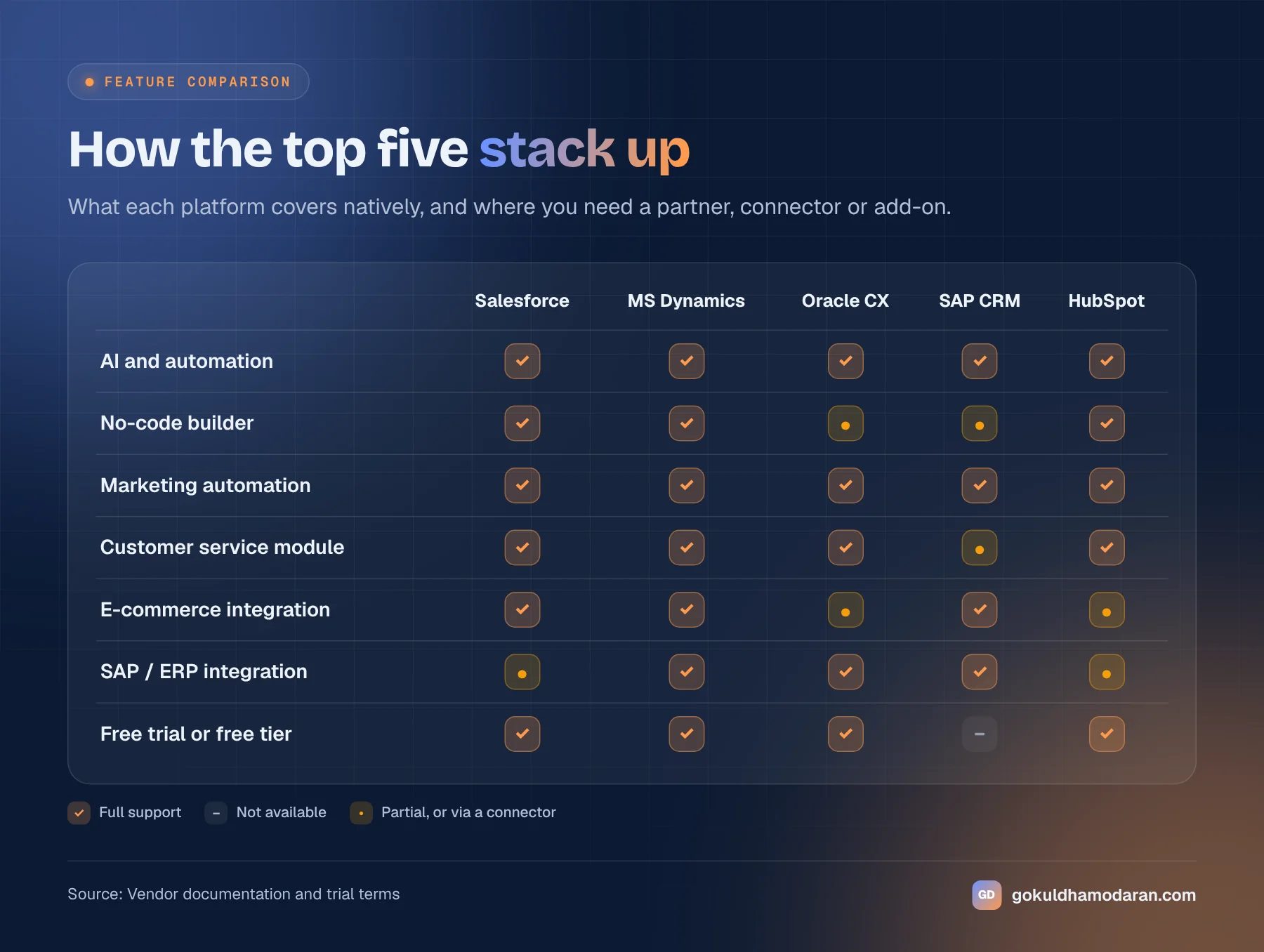
Figure 2: Enterprise CRM Feature Comparison Radar — AI, Customisation, Integrations, UX, Analytics and More (2026)
| Feature | Salesforce | MS Dynamics | Oracle CX | SAP CRM | HubSpot Ent. |
| AI / Automation | ✅ Einstein AI | ✅ Copilot AI | ✅ Oracle AI | ✅ SAP AI | ✅ Breeze AI |
| No-Code Builder | ✅ Flow | ✅ Power Apps | ⚡ Partial | ⚡ Partial | ✅ Full |
| Marketing Automation | ✅ Mktg Cloud | ✅ Customer Ins | ✅ Eloqua | ✅ C/4HANA | ✅ Marketing Hub |
| Customer Service Module | ✅ Service Cloud | ✅ Dynamics CS | ✅ Oracle Svc | ⚡ Partial | ✅ Service Hub |
| E-commerce Integration | ✅ Commerce Cld | ✅ Dynamics Com | ⚡ Partial | ✅ Commerce | ⚡ Via HubSpot |
| SAP / ERP Integration | ⚡ 3rd party | ✅ Native AX | ✅ Oracle ERP | ✅ Native | ⚡ Connector |
| Mobile App Quality | ⭐⭐⭐⭐½ | ⭐⭐⭐⭐ | ⭐⭐⭐½ | ⭐⭐⭐ | ⭐⭐⭐⭐⭐ |
| Implementation Timeline | 3-9 months | 3-8 months | 4-12 months | 6-18 months | 1-3 months |
| Customer Support | 24/7 Premier+ | 24/7 w/ plan | 24/7 Premier | 24/7 Ent. | 24/7 all tiers |
| Free Trial Available | 30 days | 30 days | 30 days | ❌ No | ✅ Free tier |
Table 2: Enterprise CRM Feature Comparison Matrix — Top 5 Platforms (✅ Full Support ⚡ Partial ❌ Not Available)
Enterprise CRM Pricing & Customer Satisfaction Analysis
Price is only one part of the CRM total cost equation. Implementation, training, customisation, integrations, and ongoing admin costs can multiply the per-user licence price by a factor of 3–10x. The chart below compares starting enterprise licence costs alongside real user satisfaction scores from G2 and Gartner Peer Insights.
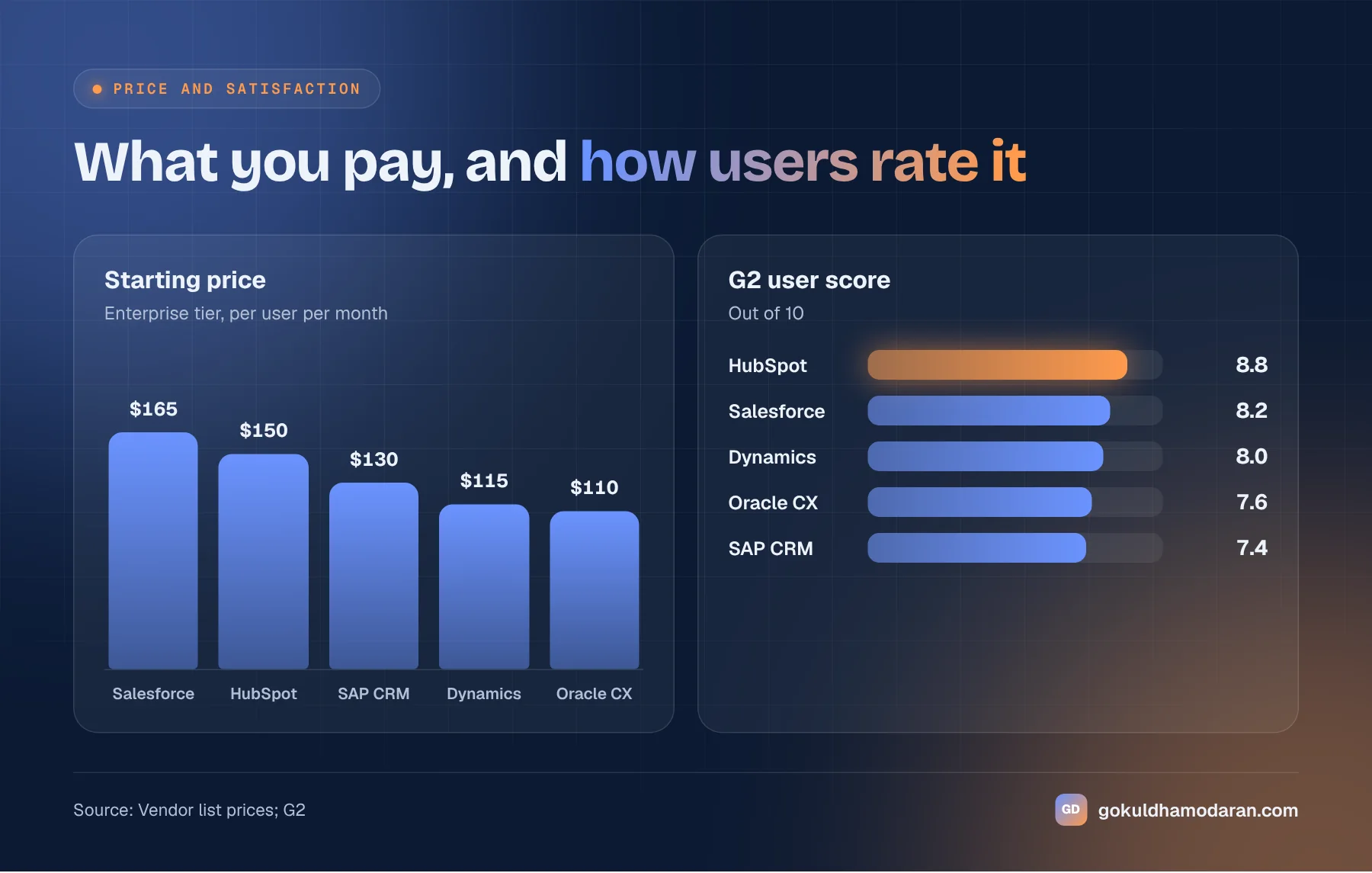
Figure 3: Enterprise CRM pricing (per user/month) and customer satisfaction scores, 2025 snapshot. Current list prices are in Table 1.
How to Choose the Right Enterprise CRM: Decision Framework
There is no single best enterprise CRM — the right choice depends on your company’s existing technology ecosystem, industry, budget, and implementation capacity. Use this decision framework to narrow your shortlist:
| Selection Criteria | Recommended Platform by Scenario |
| 1. Company Size | < 500 users → HubSpot/Zoho 500-5,000 → Salesforce/Dynamics 5,000+ → Salesforce/Oracle/SAP |
| 2. Existing Stack | Microsoft shops → Dynamics 365 SAP ERP shops → SAP CRM or Salesforce Google Workspace → HubSpot or Salesforce |
| 3. Industry | Healthcare/Finance → Salesforce or Oracle Manufacturing → SAP CRM Retail → Salesforce Commerce Cloud |
| 4. Budget (per user) | < $100/mo → HubSpot, Zoho, Freshsales $100-$150/mo → Dynamics 365, Oracle $150+ → Salesforce Enterprise |
| 5. Implementation | Need fast ROI < 90 days → HubSpot or Freshsales Complex multi-country rollout → Salesforce or SAP |
| 6. AI Capabilities | Leading AI: Salesforce Einstein > Dynamics Copilot > Oracle AI For NLP: Salesforce > HubSpot |
| 7. Customisation | Maximum flex → Salesforce or Creatio Low/no-code → HubSpot Power Platform Open source → SugarCRM |
| 8. Support Quality | Highest user-rated: HubSpot > Freshsales > Salesforce For 24/7 premium: all top 5 offer this |
Table 3: Enterprise CRM Selection Framework — Match Platform to Your Company Profile
The 5 Questions to Ask Every CRM Vendor
Before signing any enterprise CRM contract, demand clear answers to these five questions:
- What is the all-in implementation cost for our company size and complexity? (Not just licence fees)
- What is the average go-live timeline for companies similar to ours, and what are the most common project delays?
- What data migration support do you provide and how does it integrate with our existing ERP and data warehouse?
- What is included in enterprise support and what additional premium support contracts are available (and at what cost)?
- What are your AI roadmap commitments for the next 24 months and how are new AI features priced — included or add-on?
What Changed in Enterprise CRM in 2026
If you shortlisted vendors last year, five changes matter before you sign:
- Prices went up at the top. Salesforce raised Enterprise and Unlimited list prices by an average of 6% on August 1, 2025, so Sales Cloud Enterprise now lists at $175 per user per month (Salesforce).
- AI moved from features to agents with their own price. Agentforce replaced the Einstein add-ons, from $125 per user per month. Microsoft meters Dynamics 365 agents in Copilot Credits. HubSpot moved its Breeze Customer and Prospecting agents to outcome pricing on April 14, 2026: $0.50 per resolved conversation and $1 per recommended lead (INSIDEA).
- Agents are real revenue now. Salesforce reported Agentforce ARR above $500 million in the quarter to October 2025, up 330% year on year (Salesforce Q3 FY26).
- The market leader’s share slipped, but the gap widened. IDC puts Salesforce at 20.0% of CRM for 2025, still about five times Oracle and Microsoft (IDC via Salesforce).
- ERP vendors are pulling CRM closer. SAP launched Joule assistants for its “Autonomous CX” vision in 2026, built on the operational data behind each customer (CX Foundation). Microsoft is bringing Dynamics 365 skills directly into Copilot.
The practical effect: compare the cost of the AI you will actually use, not just the seat price. Two vendors with similar licences can differ by more than the licence once agents run at volume.
Enterprise CRM Trends to Watch in 2026–2027
The enterprise CRM market is undergoing the most significant transformation since the move to SaaS a decade ago. These are the trends reshaping purchasing decisions:
- AI Agents (Agentic AI): Salesforce Agentforce and Microsoft Copilot Studio are pioneering autonomous AI agents that can autonomously complete multi-step CRM tasks — from qualifying leads to resolving service tickets — without human intervention.
- Unified Customer Data Platforms: CRM vendors are acquiring or building native CDPs to unify real-time customer signals from CRM, web, mobile, and offline touchpoints. Salesforce Data Cloud and Adobe Real-Time CDP are leading this convergence.
- Composable CRM Architecture: Large enterprises increasingly resist monolithic CRM suites in favour of best-of-breed point solutions connected via iPaaS middleware (MuleSoft, Boomi). This modular approach offers flexibility but increases integration complexity.
- Vertical-Specific CRM Clouds: Vendors are launching industry-specific CRM products for healthcare (Salesforce Health Cloud), financial services (Salesforce Financial Services Cloud), automotive, energy, and manufacturing with pre-built data models and compliance features.
- Outcome-Based Pricing: Some vendors are piloting usage-based and outcome-based pricing models, moving away from per-seat pricing — a trend that could reshape CRM cost structures by 2026.
How to judge enterprise CRM platforms on AI agents
Every major enterprise CRM platform now sells AI agents, so the demo will always look good. These five checks separate a platform your team can trust in production from one that only works on stage.
- Where the agent’s data comes from. CRM records alone, or CRM plus ERP, support and product data? Agents are only as good as the context they can read.
- What it may do alone. Ask for the controls that decide which actions need a person’s approval, such as discounts, refunds or anything that moves money.
- How you will test it. Before go-live, run the agent on a set of real cases with known right answers and keep that test set for every update.
- Identity and audit trail. The agent should act under its own identity with least-privilege access, and every action should be logged.
- How AI usage is priced. Ask what a correct outcome costs, not just the price per seat, and how that changes as usage grows.
If your CRM also drives an account-based marketing motion, see how the data and scoring fit together in this guide to running an account-based marketing program.
Frequently Asked Questions (FAQ)
Q1: What is the best enterprise CRM in 2026?
Q2: How much does enterprise CRM cost?
Q3: How long does enterprise CRM implementation take?
Q4: Can I integrate CRM with SAP ERP?
Q5: Which CRM has the best AI features?
Q6: Is Salesforce worth the high price for enterprise?
What is the most reliable CRM for enterprise teams?
Table 4: Top CRM Questions Answered — Sourced from Real Buyer Research and Analyst Interviews
Conclusion: Which Enterprise CRM Should You Choose in 2026?
The enterprise CRM market in 2026 offers more capable, more AI-powered, and more specialised platforms than at any point in history. But greater choice also means greater complexity in the decision.
Our recommendation summary:
- Choose Salesforce if: you need the most feature-complete, AI-advanced, globally scalable enterprise CRM and can invest the time and budget for a proper implementation.
- Choose Microsoft Dynamics 365 if: your organisation is Microsoft-first and you want deep native integration with Teams, Azure, Power BI and Microsoft 365.
- Choose Oracle CX Cloud if: you run Oracle ERP and need complex CPQ, subscription billing, or industry-specific data models in finance, telecom or utilities.
- Choose SAP CRM if: you are an SAP ERP customer in manufacturing, process industries or utilities needing native ERP-CRM data integration.
- Choose HubSpot Enterprise if: you prioritise user experience, fast deployment, high adoption rates, and transparent pricing over maximum customisability.

Gokul Dhamodaran
I turn what is happening at the AI frontier into what it means for enterprise systems, and I build AI products myself (Euliv Analytics, Vantage). I write Leading Indicator every Friday: the AI and enterprise tech moves that matter, and what they mean for you.
Views are my own and do not represent any employer or client. Graphics are original; sources are linked.