
Choosing between Salesforce and Microsoft Dynamics 365 is the defining CRM decision for most large enterprises in 2026. Both platforms have passed the $7 billion annual revenue mark, both have embedded generative AI into every module, and both can scale to tens of thousands of users globally. Yet they serve fundamentally different organisational profiles — and choosing the wrong one costs millions.
This head-to-head comparison covers pricing, AI capabilities, integration depth, implementation timelines, total cost of ownership, and the specific company profiles that make one platform clearly better than the other.
| 💡 Quick Verdict: Salesforce wins on AI depth, ecosystem size and feature breadth. Dynamics 365 wins on Microsoft integration, value for Microsoft-first organisations, and Copilot AI. Neither is universally better — your existing tech stack is the primary decision factor. |
Market Position & Revenue 2025
Understanding each vendor’s market position reveals their investment priorities, support capacity, and long-term viability as your CRM partner.
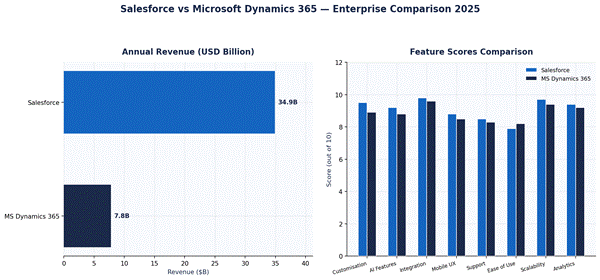
Figure 1: Salesforce vs MS Dynamics 365 — Revenue and Feature Dimension Scores 2025
Platform Overview
| Dimension | Salesforce Sales Cloud | Microsoft Dynamics 365 Sales |
| Founded | 1999 | 2016 (rebranded from Dynamics CRM) |
| Annual CRM Revenue | $34.9B (total) | $7.8B (est. Dynamics) |
| Global CRM Market Share | 23.8% | 5.3% |
| Active Enterprise Customers | 150,000+ | 295,000+ (incl. SMB) |
| AI Engine | Einstein AI + Agentforce | Microsoft Copilot (GPT-4o) |
| AppExchange/Marketplace | 8,000+ apps | 3,200+ apps (AppSource) |
| Gartner Magic Quadrant | Leader (2024/2025) | Leader (2024/2025) |
| G2 Score (Enterprise) | 8.2/10 | 8.0/10 |
| Starting Enterprise Price | $165/user/month | $115/user/month |
| Avg Implementation (Enterprise) | 3-9 months | 3-8 months |
Table 1: Salesforce vs Microsoft Dynamics 365 — Side-by-Side Platform Overview
Feature-by-Feature Comparison
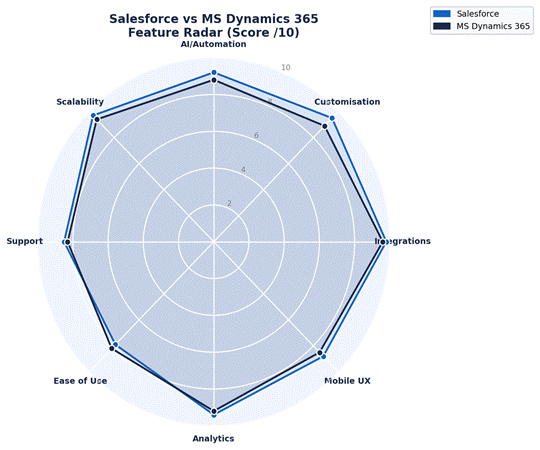
Figure 2: Salesforce vs MS Dynamics 365 — Feature Capability Radar (Score /10, 2025)
AI Capabilities: Einstein vs Copilot
AI is now the central differentiator in enterprise CRM. Both Salesforce and Microsoft have invested billions in making AI a native part of their platforms.
| AI Feature | Salesforce Einstein + Agentforce | MS Dynamics 365 Copilot |
| Generative AI | ✅ Einstein Copilot + Agentforce agents | ✅ Copilot for Sales (GPT-4o powered) |
| Lead Scoring | ✅ Predictive AI scoring | ✅ Predictive lead scoring |
| Email Drafting | ✅ Einstein email generation | ✅ Copilot email drafts in Outlook |
| Call Summaries | ✅ Einstein Conversation Insights | ✅ Copilot call recording + summary |
| Autonomous Agents | ✅ Agentforce (unique capability) | ⚡ Copilot Studio (limited agents) |
| Data Enrichment | ✅ Data Cloud integration | ✅ LinkedIn Sales Navigator (native) |
| Forecasting AI | ✅ Einstein Forecasting | ✅ Predictive forecasting |
| Extra AI Cost | Add-on pricing for advanced AI | Mostly included in E5 licence |
Table 2: AI Feature Comparison — Salesforce Einstein vs Microsoft Dynamics Copilot (2025)
Pros and Cons
Salesforce — Pros & Cons
| ✅ Pros | ❌ Cons |
| + World’s largest CRM ecosystem — 8,000 + AppExchange apps + Einstein Agentforce: most advanced autonomous AI agents + Superior configurability for complex multi-cloud deployments + Industry clouds for 12 + verticals with pre-built data models + Gold-standard training platform (Trailhead) with 50M + learners | – Highest TCO: implementation + licence often 3-5x sticker price – Complex admin — most enterprises need a dedicated Salesforce admin – AI features (Agentforce, Data Cloud) are expensive add-ons – Steep learning curve for non-technical business users – Licence sprawl: most capabilities are separate paid modules |
Microsoft Dynamics 365 — Pros & Cons
| ✅ Pros | ❌ Cons |
| + Native integration with Teams, Outlook, Azure, Power BI, SharePoint + Copilot AI (GPT-4o) built into every module at low additional cost + Lower TCO for Microsoft-first organisations with E5 licensing + Power Platform (low-code) extends CRM without developer dependency + LinkedIn Sales Navigator integration is unique to Microsoft | – CRM-only product is weaker than Salesforce outside Microsoft ecosystem – AppSource marketplace significantly smaller than Salesforce AppExchange – UI inconsistency across Dynamics 365 apps (different design languages) – Requires Microsoft partner for enterprise deployment — quality varies – Customisation beyond standard workflows needs Azure developer skills |
Pricing & Total Cost of Ownership
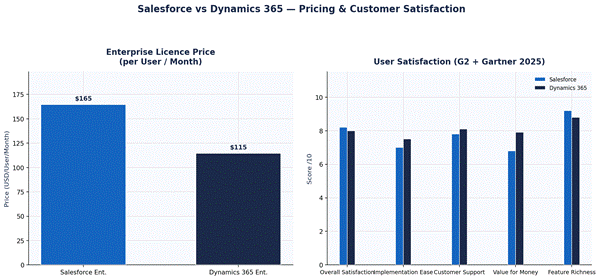
Figure 3: Salesforce vs Dynamics 365 — Pricing and Customer Satisfaction Scores (2025)
| Cost Component | Salesforce Enterprise | MS Dynamics 365 Enterprise |
| Base Licence (per user/mo) | $165 (Sales Enterprise) | $115 (Dynamics 365 Sales) |
| Marketing Module | $1,250/mo (Marketing Cloud Growth) | $1,500/mo (Customer Insights) |
| Service Module | $150/user/mo (Service Cloud) | $115/user/mo (Dynamics CS) |
| AI Add-ons | $50-$75/user/mo (Einstein/Agentforce) | Mostly included in E5 licence |
| Implementation (500 users) | $800K – $2.5M | $500K – $1.8M |
| Annual Support (Premium) | $30,000 – $100,000 | $20,000 – $60,000 |
| Est. 3-Year TCO (500 users) | $4.5M – $9M | $3M – $6.5M |
| Data Storage Included | 10GB + 20MB/user | 10GB + 5MB/user |
Table 3: Salesforce vs Dynamics 365 — Complete Pricing and TCO Breakdown (500-User Enterprise)
When to Choose Salesforce vs Dynamics 365
| Choose Salesforce If… | Choose Dynamics 365 If… |
| You need the most advanced AI and autonomous agents (Agentforce) | Your organisation runs Microsoft 365 and Azure as primary stack |
| You require multi-cloud: Sales + Service + Marketing + Commerce + Analytics | You want Copilot AI deeply embedded in Teams, Outlook and SharePoint |
| You operate across 50+ countries with complex regulatory requirements | You have existing Microsoft E5 licences — Dynamics licences can be bundled |
| You need the largest partner and app ecosystem globally | You want lower implementation and ongoing admin costs |
| Your industry is heavily served by Salesforce (retail, financial services, media) | Your industry uses LinkedIn heavily — native Sales Navigator integration |
| ROI is measured in years — you can invest in a full platform build | You need faster time-to-value — Dynamics deploys faster in Microsoft environments |
Table 4: Decision Framework — When to Choose Salesforce vs Microsoft Dynamics 365
Frequently Asked Questions
| Frequently Asked Question | Expert Answer |
| Is Salesforce better than Dynamics 365 in 2025? | Salesforce leads in AI depth, ecosystem size, and global enterprise features. Dynamics 365 leads in value for Microsoft-stack organisations and Copilot AI accessibility. Neither is universally better — the right choice depends on your tech stack and budget. |
| Can Dynamics 365 replace Salesforce? | For Microsoft-first organisations, yes — Dynamics 365 can handle most CRM requirements while offering better integration and lower cost. For companies needing Agentforce AI, multi-cloud CRM, or the broadest app ecosystem, Salesforce remains superior. |
| What is the price difference between Salesforce and Dynamics? | Salesforce Enterprise starts at $165/user/month vs Dynamics 365 Sales at $115/user/month. However, total 3-year TCO for 500 users is typically $4.5-9M for Salesforce vs $3-6.5M for Dynamics 365. |
| Does Dynamics 365 work with Salesforce? | Yes — via middleware such as Boomi, MuleSoft, or Microsoft Azure Logic Apps. However, running both simultaneously is expensive and creates data sync complexity. Most enterprises choose one platform. |
| Which has better AI — Salesforce or Dynamics? | Salesforce Einstein Agentforce offers more advanced autonomous agent capabilities. Microsoft Copilot offers deeper integration with Microsoft 365 tools and is more accessible for non-technical users. Both are genuinely competitive in 2025. |
| How long does implementation take? | Salesforce Enterprise: 3-9 months. Dynamics 365 Enterprise: 3-8 months. Timeline is driven by data migration complexity, custom workflows, and integrations — not the platform itself. |
Conclusion: Salesforce vs Dynamics 365 — The Verdict
The Salesforce vs Microsoft Dynamics 365 decision comes down to one core question: is your organisation Microsoft-first or platform-agnostic?
- Microsoft-first organisations (Office 365, Azure, Teams as primary tools) should choose Dynamics 365 — lower TCO, native Copilot AI, and seamless productivity integration.
- Platform-agnostic enterprises needing the deepest AI, largest ecosystem, and global multi-cloud capability should choose Salesforce.
- Companies with less than 500 users should seriously evaluate HubSpot Enterprise before committing to either platform’s enterprise pricing.
| 🚀 Next Step: Request a 30-day proof-of-concept from both vendors using your own data, your actual use cases, and involvement from your IT, sales, and marketing teams. Never sign a multi-year enterprise CRM contract based on a demo alone. read more article-https://gokuldhamodaran.com/blog |