The short answer
Agentforce vs Microsoft Copilot for CRM comes down to where your customer record lives. Choose Agentforce when Salesforce is the system of record and agents should act on it. Choose Copilot when sellers work in Outlook, Teams and Dynamics 365. Running Salesforce and Microsoft 365? Use both, bridged by Copilotforce once it leaves preview.
Key takeaways
- Pick the agent that sits next to your CRM record. Surface it where reps already work.
- List prices: Agentforce add-on $125 per user per month; Microsoft 365 Copilot $30, with Copilot for Sales included.
- Per action: about $0.10 in Flex Credits vs $0.04 for a Copilot agent action at the pack rate. Definitions differ.
- Copilotforce (Nov 19, 2026) brings Salesforce data and writeback into Copilot. It is in public preview.
- Run a 30-day bake-off on three real jobs per team, with human confirmation on every write.
The two biggest CRM rivals just built a bridge between their AI agents. On Nov 19, 2026, at Microsoft Ignite, Salesforce and Microsoft announced Copilotforce: Salesforce customer data and sales actions inside Microsoft Copilot, with changes saved back to Salesforce. Two months earlier, Dreamforce had put Agentforce agents for sales and service at the center of Salesforce’s roadmap. They still sell against each other every day.
That changes how to read Agentforce vs Microsoft Copilot for CRM. It is no longer only “which AI is smarter.” It is a choice about where your system of record lives and where your reps spend the day. It is also about how each vendor meters an agent’s work. My read: pick the agent that sits next to your CRM record, then decide how much of the work should surface in Outlook and Teams.
What changed in 2026?
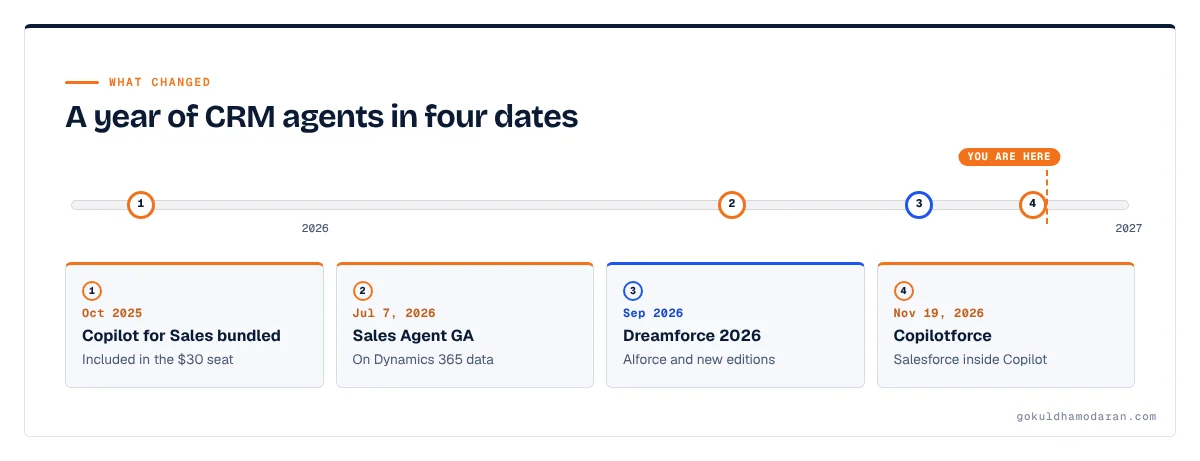
Both vendors moved from chat assistants to agents that act on CRM records, and both moved more of the bill to metered credits. Here is the dated list, each from the publisher that announced it:
- Feb 24, 2026: Salesforce put the Agentforce Sales App in ChatGPT into open beta. It said its own Service Agent handled more than 2.8 million support requests in a year (Salesforce Q4 FY26 highlights).
- Jul 7, 2026: Microsoft made Sales Agent and Service Agent generally available in Microsoft 365 Copilot, Outlook, Teams and Dynamics 365. Both read live Dynamics 365 data through a Model Context Protocol (MCP) layer (CX Today).
- Sep 2026: At Dreamforce, Salesforce showed AIforce, a new interface layer over its APIs and MCP tools. It also showed Koa, a CRM reasoning model built with NVIDIA, and new Core, Advanced and Max editions that bundle Flex Credits (Forrester, Sep 29, 2026).
- Oct 31, 2026: Microsoft’s Copilot Studio billing table set the current credit rates: 2 Copilot Credits for a generative answer, 5 for an agent action, 10 for tenant graph grounding (Microsoft Learn).
- Nov 19, 2026: Copilotforce announced. Salesforce in Microsoft Copilot is in public preview (beta), Salesforce in Teams is in pilot, and querying Fabric OneLake from Salesforce Data 360 is generally available (Salesforce press release).
One older change still shapes every quote you’ll see. Since mid-October 2025, Copilot for Sales comes with Microsoft 365 Copilot at no extra cost. It used to be a $20 per user add-on on top of the $30 seat (Directions on Microsoft).
A year of CRM agents in four dates
- 1Copilot for Sales bundledIncluded in the $30 seat
- 2Sales Agent GAOn Dynamics 365 data
- 3Dreamforce 2026AIforce and new editions
- 4CopilotforceSalesforce inside Copilot
gokuldhamodaran.com
Agentforce vs Microsoft Copilot for CRM at a glance
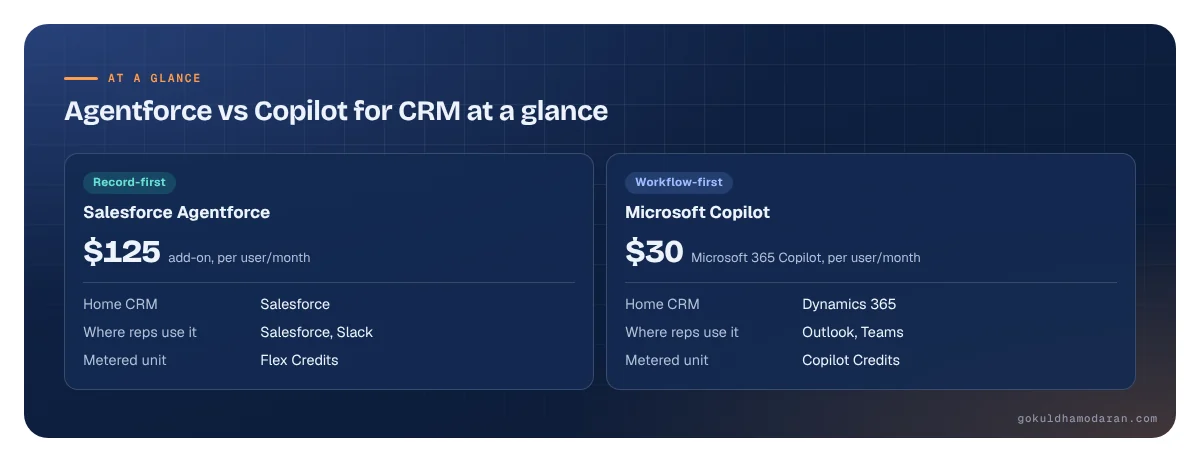
Agentforce is Salesforce’s agent platform. It runs inside the CRM, reads and writes Salesforce records, and is priced per user, per conversation or per action through Flex Credits. Microsoft Copilot for CRM is a stack. Copilot for Sales works in Outlook and Teams, Sales Agent and Service Agent run on Dynamics 365, and Copilot Studio builds custom agents, metered in Copilot Credits. So Agentforce vs Copilot Studio is the platform question, and the rest is where reps meet the agent.
| What to compare | Salesforce Agentforce | Microsoft Copilot for CRM |
|---|---|---|
| Home CRM | Salesforce (Sales, Service, Field Service, Industries) | Dynamics 365; Copilot for Sales also works with Salesforce |
| Where reps use it | Salesforce apps, Slack, and now Microsoft Copilot (preview) | Outlook, Teams, Microsoft 365 Copilot, Dynamics 365 |
| Per-user list price | $125 user/month add-on (Sales, Service, Field Service); Agentforce 1 Editions from $550 user/month | Microsoft 365 Copilot $30 user/month (annual), Copilot for Sales included |
| Metered unit | Flex Credits: $500 per 100,000; $2 per conversation option | Copilot Credits: $200 per 25,000 per month, or pay-as-you-go via Azure |
| Custom agents | Agentforce builder on the Salesforce platform | Copilot Studio |
| Data layer | Data 360, now able to query Fabric OneLake (GA) | Microsoft Graph, Dataverse, Fabric |
| Best fit | Salesforce is the system of record | Work lives in Microsoft 365 and Dynamics 365 |
List prices checked November 2026 on the Salesforce and Microsoft pricing pages. Both vendors negotiate enterprise agreements, so treat these as the starting point, not the deal.
Agentforce vs Copilot for CRM at a glance
Salesforce Agentforce
Microsoft Copilot
gokuldhamodaran.com
How much does Agentforce cost compared with Copilot?
Agentforce pricing starts at $125 per user per month as an add-on for Sales, Service or Field Service, or $500 per 100,000 Flex Credits when you pay by usage. Microsoft 365 Copilot costs $30 per user per month and includes Copilot for Sales. Custom and autonomous agents draw Copilot Credits at $200 per 25,000 a month. Neither number is the full bill.
Here is what each pricing page actually says (Salesforce Agentforce pricing, Microsoft Copilot Studio pricing):
- Agentforce add-ons: $125 per user per month for Sales, Service and Field Service, $150 for Industries, with unmetered employee use.
- Agentforce 1 Editions: from $550 per user per month, including the add-on and 2.5 million Flex Credits per org per year.
- Agentforce usage: Flex Credits at $500 per 100,000, or $2 per conversation. You can’t run both models in the same org, and unused Flex Credits don’t roll over.
- Microsoft 365 Copilot: $30 per user per month, paid yearly. Licensed users can build and use internal agents in Microsoft 365 at no extra cost.
- Copilot Studio: packs of 25,000 Copilot Credits for $200 a month, pay-as-you-go through an Azure subscription, or prepaid commit units that save up to 20%.
- Dynamics 365 Sales Premium: includes 1,000 Copilot Credits per user per month for prebuilt and custom agents (Microsoft Dynamics 365 Sales pricing).
Copilot Credits vs Flex Credits: what one action costs
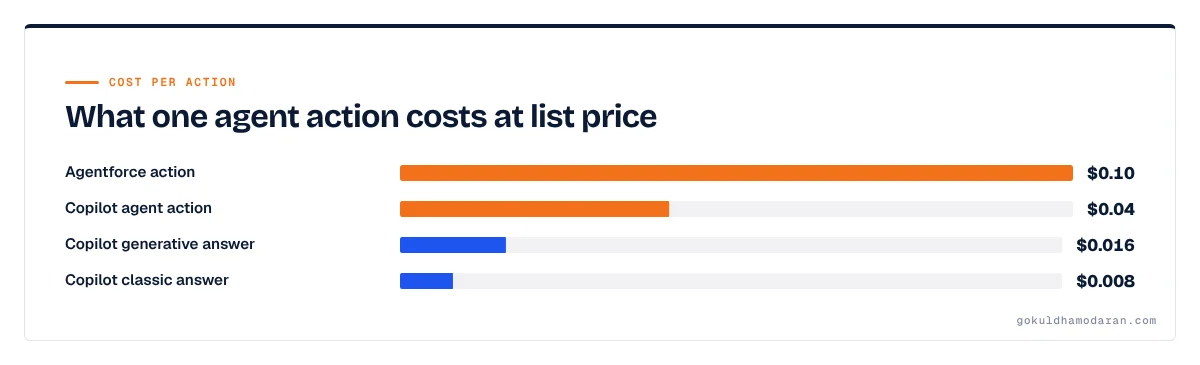
The fairest comparison is the price of one agent action. Salesforce’s examples work out to 20 Flex Credits per standard action, which is $0.10. Microsoft charges 5 Copilot Credits for an agent action, which is $0.04 at the pack rate of $0.008 per credit. A generative answer costs 2 Copilot Credits, about $0.016.
That looks like a clear win for Microsoft. It isn’t that simple. The two vendors define an “action” differently, Copilot adds charges for grounding and flows, and many Copilot features carry no charge for users who already hold a Microsoft 365 Copilot license. Agentforce’s per-user add-on also makes employee use unmetered. So the cheaper platform depends on who triggers the work: your licensed employees, or agents running in the background for customers.
A practical rule: price your three most common agent jobs on both platforms, at your real monthly volume, before anyone compares seat prices. If the work is mostly employees asking questions in Outlook or Salesforce, seats dominate. If it’s autonomous agents working leads or cases around the clock, credits dominate.
What can each agent read and write in your CRM?
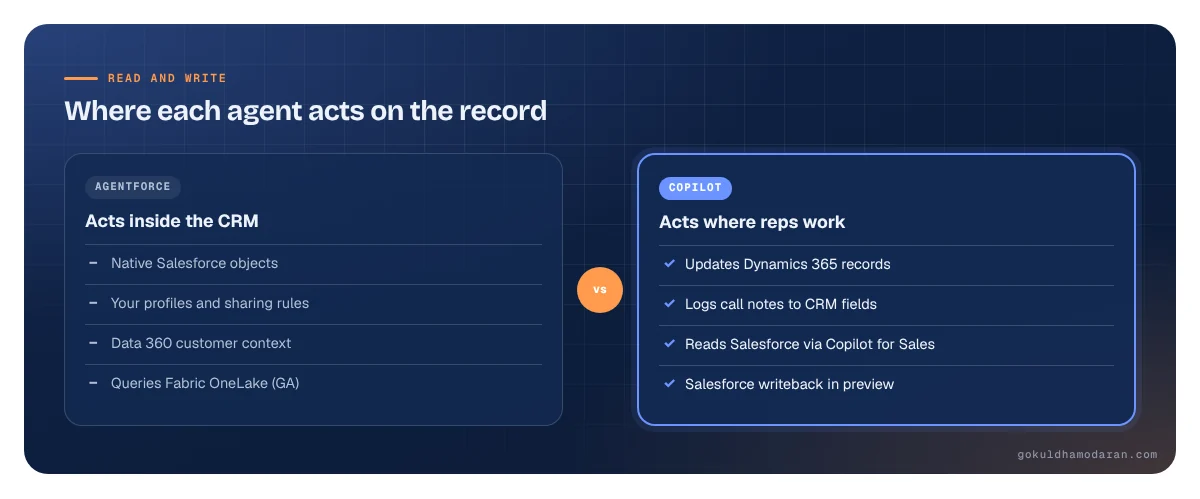
Agentforce reads and writes Salesforce records natively, so its agents act on the same objects, permissions and validation rules your admins already run. Microsoft’s Sales Agent and Service Agent read and update Dynamics 365 records, and Copilot for Sales also connects to Salesforce. With Copilotforce, Copilot can now write supported opportunity changes back to Salesforce, with the user’s confirmation.
The detail matters because writing is where risk lives. A summary that’s slightly off costs a rep a minute. A wrong stage, amount or close date flows into the forecast your CFO reads on Monday.
- Agentforce: works on Salesforce objects in Sales, Service and Field Service. It uses Data 360 for unified customer data and can now query Fabric OneLake without copying data (generally available).
- Microsoft Sales Agent: gives account summaries and opportunity context and logs “takeaways, objections, and commitments directly into CRM fields” in Dynamics 365 (CX Today).
- Microsoft Service Agent: writes case summaries, suggests next best actions, drafts resolution emails and updates records.
- Copilot for Sales: works with both Dynamics 365 Sales and Salesforce, says Microsoft’s 2026 release plan. It adds meeting prep and record summaries in Outlook and Teams (Microsoft Learn release plan).
- Copilotforce (preview): sellers can analyze and prioritize opportunities and take CRM actions in Copilot. Writeback needs explicit user confirmation and respects existing Salesforce validation rules.
Where each agent acts on the record
Acts inside the CRM
- Native Salesforce objects
- Your profiles and sharing rules
- Data 360 customer context
- Queries Fabric OneLake (GA)
Acts where reps work
- Updates Dynamics 365 records
- Logs call notes to CRM fields
- Reads Salesforce via Copilot for Sales
- Salesforce writeback in preview
gokuldhamodaran.com
Which is better if Salesforce is your system of record?
If Salesforce holds your accounts, opportunities and cases, Agentforce is the better primary agent platform. Its agents act where the data, permissions and automation already live, and Data 360 gives them unified customer context. Use Microsoft Copilot as the front door in Outlook and Teams, through Copilot for Sales or Copilotforce, rather than as a second agent brain.
The mistake I see most in these programs is splitting agent logic across two platforms in year one. One team builds a lead-routing agent in Copilot Studio, another builds a follow-up agent in Agentforce, and nobody can say which one changed the record. Keep autonomous work on the platform that owns the record. Let the other one read and suggest.
Three questions for your Salesforce account team this quarter:
- Which of our planned agents fit the $125 per user add-on, and which will burn Flex Credits?
- When does Salesforce in Microsoft Copilot leave preview, and what will it cost?
- How do the new Core, Advanced and Max editions change our current contract?
If you’re still weighing the CRMs themselves, start with my Salesforce vs Microsoft Dynamics 365 comparison and the guide to the best enterprise CRM software for large companies.
Which is better for Dynamics 365 and Microsoft 365 shops?
If your CRM is Dynamics 365 and your sellers live in Outlook and Teams, Microsoft Copilot is the better fit. Copilot for Sales comes with the $30 Microsoft 365 Copilot seat. Sales Agent and Service Agent are generally available on Dynamics 365 data. Copilot Studio adds custom agents, billed in Copilot Credits.
The trap here is different. Because so much is “included,” teams switch on agents without a credit budget. Included means included for licensed users working under their own identity. Agents that run for unlicensed users, publish to external channels or ground on tenant data draw credits. Set a monthly credit cap per agent before the pilot, and read the Copilot Studio billing table with your finance partner.
The same logic applies to the wider Microsoft 365 decision. I covered the work-surface choice in Claude vs Microsoft 365 Copilot: pick by where the team’s work lives, not by which model scores higher this month.
What if you run Salesforce and Microsoft 365?
Most large North American companies do. For them, Agentforce vs Microsoft Copilot for CRM is not either-or. Run Agentforce for agents that act on Salesforce records, and use Copilot as the place reps ask questions and approve changes, through Copilot for Sales today and Copilotforce once it leaves preview.
Copilotforce is the signal to plan for. It is in public preview, Salesforce in Teams is still a pilot, and the press release says pricing and packaging may change. So don’t sign anything that assumes it’s production-ready. Do map which of your sales workflows would move to Copilot if it works: meeting prep, opportunity updates after calls, pipeline reviews in Teams.
Data is where the two stacks meet first. Salesforce Data 360 can already query Fabric OneLake (generally available), and sharing Data 360 data to OneLake is in public preview. If your analytics team runs on Fabric, that is a quieter but more useful change than any chat feature.
 Data firstThe agents meet in the data layer first
How do admin controls and audit compare?
Both platforms run agents under the permissions your CRM already enforces, so the controls you need are mostly the ones you have: profiles, roles, sharing rules and validation rules. What’s new is metering and traceability. Ask each vendor to show, in a live demo, who approved each agent write and what it cost.
From the bench: when I build analytics that answer business questions in plain English, the rule I keep relearning is that every number has to trace back to the query behind it. Agent writes need the same trail. If a rep can’t see why a close date changed, they’ll stop trusting the forecast, and the agent program stalls. That’s the pattern behind most agentic AI projects that fail.
Put these on your demo checklist for both vendors:
- Which agent actions write to the record, and which only suggest?
- Does every write need a human confirmation, and can you require it per field?
- Where do you see a log of agent actions, by agent and by user?
- How do you set a monthly credit cap per agent, and what happens when it’s hit?
- Which features run on licensed seats, and which draw credits?
How to choose in 30 days
Run a bake-off on real work, not a vendor demo. Pick one sales team and one service team, three agent jobs each, and run them on the platform that owns the record. Track accuracy, time saved, reviewer effort and cost per completed task.
- Week 1, map the record. List the objects each agent job reads and writes, and who owns them.
- Week 1, price the jobs. Estimate monthly volume and cost on both platforms, using the rates above.
- Weeks 2 and 3, run the pilot. Keep human confirmation on every write. Log every change.
- Week 4, decide by team. Keep what beats the baseline, set credit caps, and write the rule for which platform owns which job.
The same discipline works outside CRM. If your agents will also touch orders or invoices, read AI agents in ERP before you scope the second wave.
Which CRM agent fits your stack?
Where does your customer record live?
- Salesforce, reps in SalesforceAgentforceAgents act on the record
- Dynamics 365, reps in OutlookMicrosoft CopilotCopilot for Sales included
- Salesforce, reps in TeamsBoth, one owner per jobCopilotforce in preview
Unsure? Price three real jobs on both.
gokuldhamodaran.com
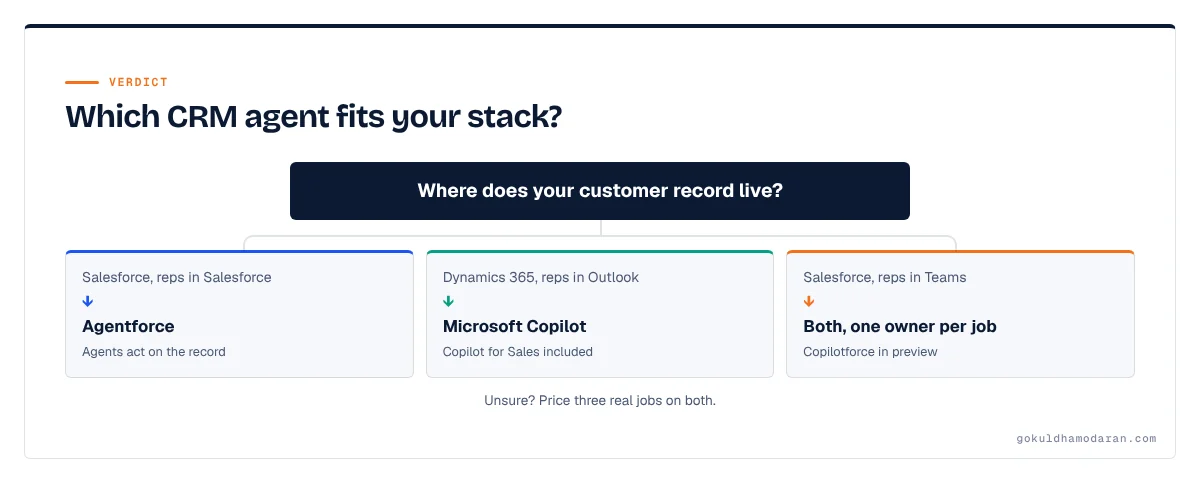
My read: the vendor that owns your customer record should own your autonomous agents. The other one earns its place where your people already work. Copilotforce makes that split easier to run, once it ships.
Frequently asked questions
Is Agentforce better than Microsoft Copilot for CRM?
Neither wins everywhere. Agentforce is the stronger choice when Salesforce holds your accounts, opportunities and cases, because its agents act on those records under your existing permissions. Microsoft Copilot fits teams on Dynamics 365 who work in Outlook and Teams. Companies running Salesforce and Microsoft 365 usually keep autonomous agents on Agentforce and use Copilot as the front door.
Does Microsoft Copilot for Sales work with Salesforce?
Yes. Microsoft's 2026 release plan says Microsoft 365 Copilot for Sales works with both Dynamics 365 Sales and Salesforce, adding record summaries and meeting prep in Outlook and Teams. Copilotforce, announced Nov 19, 2026, goes further: sellers can update supported Salesforce opportunity fields from Copilot, with user confirmation. That part is still in public preview.
What is Copilotforce?
Copilotforce is a Salesforce and Microsoft partnership announced at Microsoft Ignite on Nov 19, 2026. It brings Salesforce customer context and sales actions into Microsoft Copilot and Teams, and links Salesforce Data 360 with Microsoft Fabric OneLake. Salesforce in Copilot is in public preview, Salesforce in Teams is a pilot, and pricing and packaging have not been published.
How much does Agentforce cost per user?
Salesforce lists Agentforce add-ons for Sales, Service and Field Service at $125 per user per month, with unmetered employee use, and Industries add-ons at $150. Agentforce 1 Editions start at $550 per user per month and include 2.5 million Flex Credits per org per year. Usage pricing is $500 per 100,000 Flex Credits or $2 per conversation.
Are Copilot Credits cheaper than Flex Credits?
Per action, the list prices favor Microsoft: a Copilot agent action costs 5 Copilot Credits, about $0.04 at the $200 per 25,000 pack rate, while a standard Agentforce action works out to about $0.10 in Flex Credits. But the vendors count actions differently, and seat licenses cover much employee use on both. Price your three most common jobs at real volume.
Sources
- Salesforce: Salesforce and Microsoft announce Copilotforce (Nov 19, 2026)
- Salesforce: Agentforce pricing (checked Nov 2026)
- Microsoft: Copilot Studio pricing (checked Nov 2026)
- Microsoft Learn: Copilot Studio billing rates and management (updated Oct 31, 2026)
- Microsoft: Dynamics 365 Sales pricing (checked Nov 2026)
- Microsoft Learn: Copilot for Sales, 2026 release wave 1 plan
- CX Today: Microsoft Sales Agent and Service Agent generally available (Jul 8, 2026)
- Forrester: Salesforce's biggest Dreamforce 2026 reveals (Sep 29, 2026)
- Salesforce: Q4 FY26 product highlights (Feb 24, 2026)
- Directions on Microsoft: Microsoft is fixing its Copilot branding and pricing (Sep 10, 2025)

Gokul Dhamodaran
I turn what is happening at the AI frontier into what it means for enterprise systems, and I build AI products myself (Euliv Analytics, Vantage). I write Leading Indicator every Friday: the AI and enterprise tech moves that matter, and what they mean for you.
Views are my own and do not represent any employer or client. Graphics are original; sources are linked.