Choosing between Salesforce and Microsoft Dynamics 365 is the defining CRM decision for most large enterprises in 2026. Both platforms have passed the $7 billion annual revenue mark, both have embedded generative AI into every module, and both can scale to tens of thousands of users globally. Yet they serve fundamentally different organisational profiles — and choosing the wrong one costs millions.
This head-to-head comparison covers pricing, AI capabilities, integration depth, implementation timelines, total cost of ownership, and the specific company profiles that make one platform clearly better than the other.
💡 Quick Verdict: Salesforce wins on AI depth, ecosystem size and feature breadth. Dynamics 365 wins on Microsoft integration, value for Microsoft-first organisations, and Copilot AI. Neither is universally better — your existing tech stack is the primary decision factor.
Market Position & Revenue 2025
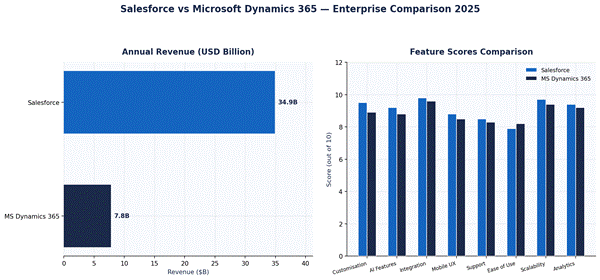
Understanding each vendor’s market position reveals their investment priorities, support capacity, and long-term viability as your CRM partner.
Figure 1: Salesforce vs MS Dynamics 365 — Revenue and Feature Dimension Scores 2025
Platform Overview
Dimension
Salesforce Sales Cloud
Microsoft Dynamics 365 Sales
Founded
1999
2016 (rebranded from Dynamics CRM)
Annual CRM Revenue
$34.9B (total)
$7.8B (est. Dynamics)
Global CRM Market Share
23.8%
5.3%
Active Enterprise Customers
150,000+
295,000+ (incl. SMB)
AI Engine
Einstein AI + Agentforce
Microsoft Copilot (GPT-4o)
AppExchange/Marketplace
8,000+ apps
3,200+ apps (AppSource)
Gartner Magic Quadrant
Leader (2024/2025)
Leader (2024/2025)
G2 Score (Enterprise)
8.2/10
8.0/10
Starting Enterprise Price
$165/user/month
$115/user/month
Avg Implementation (Enterprise)
3-9 months
3-8 months
Table 1: Salesforce vs Microsoft Dynamics 365 — Side-by-Side Platform Overview
Feature-by-Feature Comparison
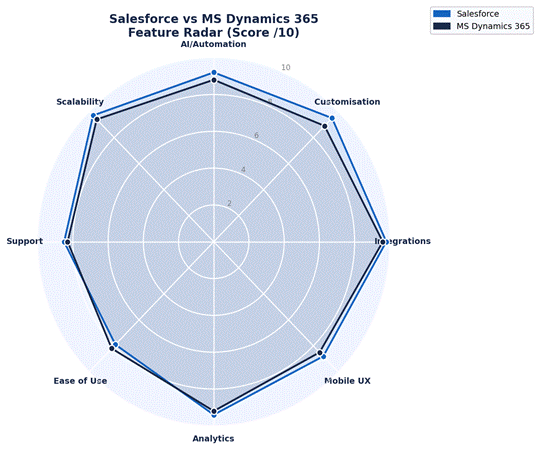
Figure 2: Salesforce vs MS Dynamics 365 — Feature Capability Radar (Score /10, 2025)
AI Capabilities: Einstein vs Copilot
AI is now the central differentiator in enterprise CRM. Both Salesforce and Microsoft have invested billions in making AI a native part of their platforms.
AI Feature
Salesforce Einstein + Agentforce
MS Dynamics 365 Copilot
Generative AI
✅ Einstein Copilot + Agentforce agents
✅ Copilot for Sales (GPT-4o powered)
Lead Scoring
✅ Predictive AI scoring
✅ Predictive lead scoring
Email Drafting
✅ Einstein email generation
✅ Copilot email drafts in Outlook
Call Summaries
✅ Einstein Conversation Insights
✅ Copilot call recording + summary
Autonomous Agents
✅ Agentforce (unique capability)
⚡ Copilot Studio (limited agents)
Data Enrichment
✅ Data Cloud integration
✅ LinkedIn Sales Navigator (native)
Forecasting AI
✅ Einstein Forecasting
✅ Predictive forecasting
Extra AI Cost
Add-on pricing for advanced AI
Mostly included in E5 licence
Table 2: AI Feature Comparison — Salesforce Einstein vs Microsoft Dynamics Copilot (2025)
Pros and Cons
Salesforce — Pros & Cons
✅ Pros
❌ Cons
+ World’s largest CRM ecosystem — 8,000 + AppExchange apps + Einstein Agentforce: most advanced autonomous AI agents + Superior configurability for complex multi-cloud deployments + Industry clouds for 12 + verticals with pre-built data models + Gold-standard training platform (Trailhead) with 50M + learners
– Highest TCO: implementation + licence often 3-5x sticker price – Complex admin — most enterprises need a dedicated Salesforce admin – AI features (Agentforce, Data Cloud) are expensive add-ons – Steep learning curve for non-technical business users – Licence sprawl: most capabilities are separate paid modules
Microsoft Dynamics 365 — Pros & Cons
✅ Pros
❌ Cons
+ Native integration with Teams, Outlook, Azure, Power BI, SharePoint + Copilot AI (GPT-4o) built into every module at low additional cost + Lower TCO for Microsoft-first organisations with E5 licensing + Power Platform (low-code) extends CRM without developer dependency + LinkedIn Sales Navigator integration is unique to Microsoft
– CRM-only product is weaker than Salesforce outside Microsoft ecosystem – AppSource marketplace significantly smaller than Salesforce AppExchange – UI inconsistency across Dynamics 365 apps (different design languages) – Requires Microsoft partner for enterprise deployment — quality varies – Customisation beyond standard workflows needs Azure developer skills
Pricing & Total Cost of Ownership
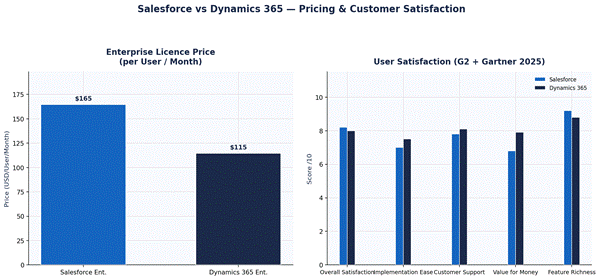
Figure 3: Salesforce vs Dynamics 365 — Pricing and Customer Satisfaction Scores (2025)
Cost Component
Salesforce Enterprise
MS Dynamics 365 Enterprise
Base Licence (per user/mo)
$165 (Sales Enterprise)
$115 (Dynamics 365 Sales)
Marketing Module
$1,250/mo (Marketing Cloud Growth)
$1,500/mo (Customer Insights)
Service Module
$150/user/mo (Service Cloud)
$115/user/mo (Dynamics CS)
AI Add-ons
$50-$75/user/mo (Einstein/Agentforce)
Mostly included in E5 licence
Implementation (500 users)
$800K – $2.5M
$500K – $1.8M
Annual Support (Premium)
$30,000 – $100,000
$20,000 – $60,000
Est. 3-Year TCO (500 users)
$4.5M – $9M
$3M – $6.5M
Data Storage Included
10GB + 20MB/user
10GB + 5MB/user
Table 3: Salesforce vs Dynamics 365 — Complete Pricing and TCO Breakdown (500-User Enterprise)
When to Choose Salesforce vs Dynamics 365
Choose Salesforce If…
Choose Dynamics 365 If…
You need the most advanced AI and autonomous agents (Agentforce)
Your organisation runs Microsoft 365 and Azure as primary stack
You require multi-cloud: Sales + Service + Marketing + Commerce + Analytics
You want Copilot AI deeply embedded in Teams, Outlook and SharePoint
You operate across 50+ countries with complex regulatory requirements
You have existing Microsoft E5 licences — Dynamics licences can be bundled
You need the largest partner and app ecosystem globally
You want lower implementation and ongoing admin costs
Your industry is heavily served by Salesforce (retail, financial services, media)
Your industry uses LinkedIn heavily — native Sales Navigator integration
ROI is measured in years — you can invest in a full platform build
You need faster time-to-value — Dynamics deploys faster in Microsoft environments
Table 4: Decision Framework — When to Choose Salesforce vs Microsoft Dynamics 365
Frequently Asked Questions
Frequently Asked Question
Expert Answer
Is Salesforce better than Dynamics 365 in 2025?
Salesforce leads in AI depth, ecosystem size, and global enterprise features. Dynamics 365 leads in value for Microsoft-stack organisations and Copilot AI accessibility. Neither is universally better — the right choice depends on your tech stack and budget.
Can Dynamics 365 replace Salesforce?
For Microsoft-first organisations, yes — Dynamics 365 can handle most CRM requirements while offering better integration and lower cost. For companies needing Agentforce AI, multi-cloud CRM, or the broadest app ecosystem, Salesforce remains superior.
What is the price difference between Salesforce and Dynamics?
Salesforce Enterprise starts at $165/user/month vs Dynamics 365 Sales at $115/user/month. However, total 3-year TCO for 500 users is typically $4.5-9M for Salesforce vs $3-6.5M for Dynamics 365.
Does Dynamics 365 work with Salesforce?
Yes — via middleware such as Boomi, MuleSoft, or Microsoft Azure Logic Apps. However, running both simultaneously is expensive and creates data sync complexity. Most enterprises choose one platform.
Which has better AI — Salesforce or Dynamics?
Salesforce Einstein Agentforce offers more advanced autonomous agent capabilities. Microsoft Copilot offers deeper integration with Microsoft 365 tools and is more accessible for non-technical users. Both are genuinely competitive in 2025.
How long does implementation take?
Salesforce Enterprise: 3-9 months. Dynamics 365 Enterprise: 3-8 months. Timeline is driven by data migration complexity, custom workflows, and integrations — not the platform itself.
Conclusion: Salesforce vs Dynamics 365 — The Verdict
The Salesforce vs Microsoft Dynamics 365 decision comes down to one core question: is your organisation Microsoft-first or platform-agnostic?
Microsoft-first organisations (Office 365, Azure, Teams as primary tools) should choose Dynamics 365 — lower TCO, native Copilot AI, and seamless productivity integration.
Platform-agnostic enterprises needing the deepest AI, largest ecosystem, and global multi-cloud capability should choose Salesforce.
Companies with less than 500 users should seriously evaluate HubSpot Enterprise before committing to either platform’s enterprise pricing.
🚀 Next Step: Request a 30-day proof-of-concept from both vendors using your own data, your actual use cases, and involvement from your IT, sales, and marketing teams. Never sign a multi-year enterprise CRM contract based on a demo alone.
Choosing the right enterprise CRM software is one of the most consequential technology decisions a large organisation will make. With the global CRM market projected to surpass $157 billion by 2030 and AI rewriting every aspect of customer engagement, the stakes have never been higher — or the options more complex.
This comprehensive guide ranks and compares the 10 best enterprise CRM platforms for large companies in 2026. Every platform has been evaluated across 50+ criteria including AI capabilities, implementation timeline, total cost of ownership, Gartner Peer Insights ratings, G2 user scores, integration depth, and analyst positioning.
💡 Quick Answer: If you need one recommendation — Salesforce Sales Cloud for global enterprises with complex needs, Microsoft Dynamics 365 for Microsoft-heavy organisations, or HubSpot Enterprise for the best user experience and fastest ROI.
What Is Enterprise CRM Software?
Enterprise CRM (Customer Relationship Management) software is a platform designed for large organisations — typically with 250+ users, multi-country operations, or complex sales cycles — that need deep customisation, robust security, and seamless integration with ERP, marketing automation, and service management systems.
Unlike SMB CRM tools, enterprise platforms offer:
Role-based access control (RBAC) and SSO/SAML security
API-first architecture for deep ERP and supply chain integration
AI-powered forecasting, lead scoring and next-best-action automation
Multi-currency, multi-language, multi-entity support for global teams
Custom objects, workflows and approval chains without code limits
SLAs guaranteeing 99.9%+ uptime with dedicated enterprise support
Enterprise CRM Market Landscape 2025
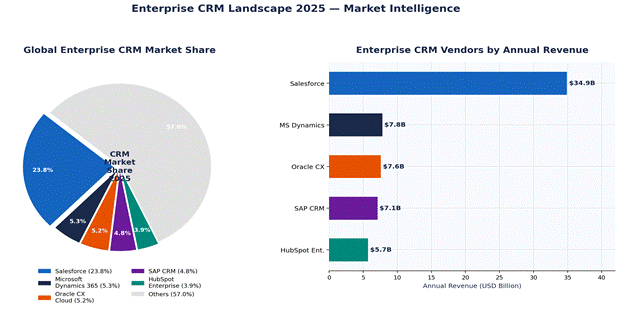
The enterprise CRM market is dominated by a handful of global players, yet no single vendor holds majority share. Understanding market position helps you assess vendor viability, support quality, and ecosystem depth.
Figure 1: Enterprise CRM Market Share and Annual Revenue — Global 2025 (Sources: IDC, Gartner, Statista)
Salesforce holds a 23.8% share of the global CRM market — more than the next four competitors combined. However, for enterprise buyers, market share alone is not the decision driver. Integration fit, implementation partner ecosystem, and total cost of ownership are equally critical factors.
Top 10 Enterprise CRM Platforms Ranked for 2026
The table below presents our ranked list of the best enterprise CRM software for large companies, incorporating Gartner Peer Insights, G2 scores, analyst positioning, and real-world implementation data.
SI No
CRM Platform
Best For
Price/User/Mo
Gartner
G2
KD
Ideal Company Profile
1
Salesforce Sales Cloud
Overall Leader
$165
4.4/5
8.2/10
62
Global enterprises needing full-suite CRM + AI
2
Microsoft Dynamics 365
Microsoft-stack orgs
$115
4.3/5
8.0/10
56
Companies embedded in Microsoft 365 ecosystem
3
Oracle CX Cloud
Data-heavy industries
$110
4.1/5
7.6/10
50
Finance, telecom, utilities with complex data
4
SAP CRM / C/4HANA
Manufacturing & ERP
$130
4.0/5
7.4/10
52
SAP ERP shops needing native CRM integration
5
HubSpot Enterprise
Ease of use + Support
$150
4.5/5
8.8/10
54
Mid-to-large companies prioritising UX & speed
6
Zoho CRM Plus
Value for money
$57
4.2/5
8.1/10
48
Cost-conscious enterprises needing depth
7
Creatio CRM
No-code customisation
$25
4.4/5
8.4/10
38
Ops teams wanting process automation without dev
8
Pega CRM
Decision automation
Custom
4.1/5
7.8/10
44
Regulated industries: insurance, banking
9
SugarCRM Sell
Open-source flexibility
$80
4.0/5
7.5/10
40
Tech-savvy teams needing deep customisation
10
Freshsales Enterprise
Fast implementation
$69
4.3/5
8.5/10
42
Growing companies needing quick ROI in < 60 days
Table 1: Top 10 Enterprise CRM Platforms — Ranked by Overall Score, Pricing, and Analyst Ratings (2026)
Detailed Reviews: Top 5 Enterprise CRM Platforms
1. Salesforce Sales Cloud — Best Overall Enterprise CRM
Salesforce has dominated enterprise CRM for over two decades, and 2026 is no exception. The platform’s Einstein AI suite, combined with the world’s largest CRM partner ecosystem (8,000+ apps on AppExchange), makes it the default choice for large organisations building a future-proof customer stack.
Standout 2026 Features: Einstein Copilot (conversational AI), Data Cloud (real-time customer data unification), Agentforce (autonomous AI agents), and Flow Orchestration for complex multi-step automation.
✅ Pros
❌ Cons
+ Best-in-class Einstein AI with generative capabilities + Largest partner/integration ecosystem globally + Highly scalable — from 50 to 500,000 users + Strong multi-cloud suite: Sales + Service + Marketing + Commerce + Gold standard support with Trailhead learning platform
– Highest total cost of ownership of any CRM – Steepest learning curve — often needs a dedicated Salesforce admin – Implementation timelines of 3–9 months for enterprise rollouts – Can become bloated without governance — licence creep is real – Pricing complexity: most features are add-ons at extra cost
Best for: Global enterprises with $1B+ revenue needing a full-suite CRM, AI automation, and a large partner ecosystem. Not ideal if budget is the primary constraint.
2. Microsoft Dynamics 365 — Best for Microsoft-Stack Organisations
Microsoft Dynamics 365 is the natural choice for enterprises already running Microsoft 365, Azure, Teams, and Power Platform. Its native integration with these tools eliminates the integration tax that Salesforce users pay and its Copilot AI — powered by OpenAI — delivers genuinely impressive productivity gains.
✅ Pros
❌ Cons
+ Native integration across Microsoft 365, Teams, Azure, Power BI + Copilot AI (GPT-powered) built into every module + Lower TCO vs Salesforce for Microsoft-heavy organisations + Power Apps and Power Automate extend CRM with no-code tools + Competitive starting price of $115/user/month for Sales Enterprise
– Weaker CRM-only product vs Salesforce outside Microsoft ecosystem – UI consistency issues between Dynamics modules – AppSource marketplace smaller than Salesforce AppExchange – Significant implementation complexity for non-Microsoft environments – Requires strong Microsoft partner for enterprise deployments
Best for: Enterprises running Microsoft 365/Azure seeking a fully integrated productivity + CRM stack with competitive licensing bundled into E5 agreements.
3. Oracle CX Cloud — Best for Data-Heavy Industries
Oracle CX Cloud excels where data depth and integration with Oracle’s broader technology stack — ERP, HCM, and supply chain — matter most. Finance, telecom, and utilities companies with complex pricing, entitlements, and billing needs frequently choose Oracle CX for its unmatched data model flexibility.
✅ Pros
❌ Cons
+ Unmatched integration with Oracle ERP (Fusion/NetSuite) + Strongest CPQ (Configure Price Quote) in the market + Deep data model for complex products, services and subscriptions + AI-powered Oracle Analytics built natively into the platform + Industry-specific clouds for financial services, manufacturing
– Steeper learning curve than Salesforce or HubSpot – Implementation typically takes 6–12 months for enterprise rollouts – Partner ecosystem smaller than Salesforce or Microsoft – UI modernisation is ongoing — some modules still feel dated – Less suitable for companies not using Oracle’s broader stack
Best for: Enterprises already on Oracle ERP or those in complex-product industries needing advanced CPQ and subscription billing within their CRM.
4. SAP CRM / C/4HANA — Best for Manufacturing & SAP ERP Users
For organisations running SAP S/4HANA or SAP ECC as their core ERP, SAP CRM delivers a level of native integration that no third-party CRM can match. The SAP Customer Experience suite — covering sales, service, marketing, commerce and CDP — connects directly to the ERP without middleware, reducing latency and data discrepancies.
✅ Pros
❌ Cons
+ Deepest native integration with SAP ERP — no middleware needed + Single data model for customer, product and order information + Strong in complex manufacturing, process industries and utilities + SAP Business Technology Platform (BTP) enables extensions + Roadmap tied to SAP RISE — cloud migration incentives available
– Highest implementation complexity and longest timelines (6–18 months) – UI/UX significantly behind Salesforce and HubSpot – Lower user satisfaction scores on G2 (7.4/10) vs competitors – Expensive to customise — requires specialised SAP consultants – Limited value for companies not already in the SAP ecosystem
Best for: Existing SAP ERP customers in manufacturing, process industries, or utilities needing a single data model for customer and operational data without integration layers.
5. HubSpot Enterprise — Best UX, Fastest ROI
HubSpot has fundamentally repositioned itself in the enterprise market. With HubSpot Enterprise — which includes Sales Hub, Marketing Hub, Service Hub, CMS Hub, and Operations Hub — large companies can run a fully integrated CRM stack with the best user experience on the market and implementation timelines of just one to three months.
✅ Pros
❌ Cons
+ Highest user satisfaction ratings — G2 score 8.8/10 + Fastest implementation: average 4-6 weeks for mid-enterprise teams + Breeze AI (generative) built into every hub at no extra cost + Best-in-class marketing automation + CRM in a single platform + Transparent pricing — no surprise add-on costs
– Not as deep as Salesforce for hyper-complex customisation needs – Weaker CPQ and service management for highly complex products – API rate limits can be restrictive for real-time enterprise scenarios – Less suitable for 10,000+ user global rollouts at maximum scale – Partner ecosystem smaller than Salesforce or Microsoft
Best for: Mid-to-large companies (50–5,000 users) that prioritise user adoption, marketing-sales alignment, and fast time-to-value over maximum configurability.
Feature Comparison: How the Top 5 Stack Up
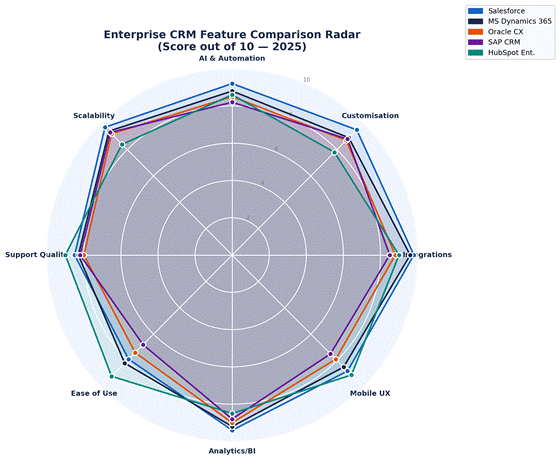
The radar chart below visualises how the top 5 enterprise CRM platforms compare across eight critical capability dimensions. The scoring is based on analyst assessments, G2 user data, and our own product evaluations.
Figure 2: Enterprise CRM Feature Comparison Radar — AI, Customisation, Integrations, UX, Analytics and More (2026)
Feature
Salesforce
MS Dynamics
Oracle CX
SAP CRM
HubSpot Ent.
AI / Automation
✅ Einstein AI
✅ Copilot AI
✅ Oracle AI
✅ SAP AI
✅ Breeze AI
No-Code Builder
✅ Flow
✅ Power Apps
⚡ Partial
⚡ Partial
✅ Full
Marketing Automation
✅ Mktg Cloud
✅ Customer Ins
✅ Eloqua
✅ C/4HANA
✅ Marketing Hub
Customer Service Module
✅ Service Cloud
✅ Dynamics CS
✅ Oracle Svc
⚡ Partial
✅ Service Hub
E-commerce Integration
✅ Commerce Cld
✅ Dynamics Com
⚡ Partial
✅ Commerce
⚡ Via HubSpot
SAP / ERP Integration
⚡ 3rd party
✅ Native AX
✅ Oracle ERP
✅ Native
⚡ Connector
Mobile App Quality
⭐⭐⭐⭐½
⭐⭐⭐⭐
⭐⭐⭐½
⭐⭐⭐
⭐⭐⭐⭐⭐
Implementation Timeline
3-9 months
3-8 months
4-12 months
6-18 months
1-3 months
Customer Support
24/7 Premier+
24/7 w/ plan
24/7 Premier
24/7 Ent.
24/7 all tiers
Free Trial Available
30 days
30 days
30 days
❌ No
✅ Free tier
Table 2: Enterprise CRM Feature Comparison Matrix — Top 5 Platforms (✅ Full Support ⚡ Partial ❌ Not Available)
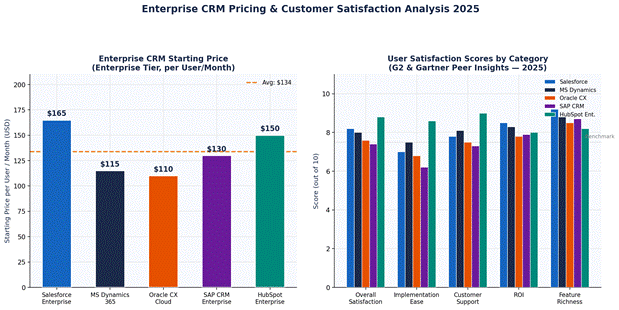
Price is only one part of the CRM total cost equation. Implementation, training, customisation, integrations, and ongoing admin costs can multiply the per-user licence price by a factor of 3–10x. The chart below compares starting enterprise licence costs alongside real user satisfaction scores from G2 and Gartner Peer Insights.
Figure 3: Enterprise CRM Pricing (per User/Month) and Customer Satisfaction Scores by Category — 2025
💰 TCO Warning: Salesforce enterprise deployments with integrations, customisations and premium support typically cost $2,000–$8,000 per user per year (total), not just the $165/user/month licence price. Always model the full 3-year TCO before signing.
How to Choose the Right Enterprise CRM: Decision Framework
There is no single best enterprise CRM — the right choice depends on your company’s existing technology ecosystem, industry, budget, and implementation capacity. Use this decision framework to narrow your shortlist:
Need fast ROI < 90 days → HubSpot or Freshsales Complex multi-country rollout → Salesforce or SAP
6. AI Capabilities
Leading AI: Salesforce Einstein > Dynamics Copilot > Oracle AI For NLP: Salesforce > HubSpot
7. Customisation
Maximum flex → Salesforce or Creatio Low/no-code → HubSpot Power Platform Open source → SugarCRM
8. Support Quality
Highest user-rated: HubSpot > Freshsales > Salesforce For 24/7 premium: all top 5 offer this
Table 3: Enterprise CRM Selection Framework — Match Platform to Your Company Profile
The 5 Questions to Ask Every CRM Vendor
Before signing any enterprise CRM contract, demand clear answers to these five questions:
What is the all-in implementation cost for our company size and complexity? (Not just licence fees)
What is the average go-live timeline for companies similar to ours, and what are the most common project delays?
What data migration support do you provide and how does it integrate with our existing ERP and data warehouse?
What is included in enterprise support and what additional premium support contracts are available (and at what cost)?
What are your AI roadmap commitments for the next 24 months and how are new AI features priced — included or add-on?
Enterprise CRM Trends to Watch in 2026–2027
The enterprise CRM market is undergoing the most significant transformation since the move to SaaS a decade ago. These are the trends reshaping purchasing decisions:
AI Agents (Agentic AI): Salesforce Agentforce and Microsoft Copilot Studio are pioneering autonomous AI agents that can autonomously complete multi-step CRM tasks — from qualifying leads to resolving service tickets — without human intervention.
Unified Customer Data Platforms: CRM vendors are acquiring or building native CDPs to unify real-time customer signals from CRM, web, mobile, and offline touchpoints. Salesforce Data Cloud and Adobe Real-Time CDP are leading this convergence.
Composable CRM Architecture: Large enterprises increasingly resist monolithic CRM suites in favour of best-of-breed point solutions connected via iPaaS middleware (MuleSoft, Boomi). This modular approach offers flexibility but increases integration complexity.
Vertical-Specific CRM Clouds: Vendors are launching industry-specific CRM products for healthcare (Salesforce Health Cloud), financial services (Salesforce Financial Services Cloud), automotive, energy, and manufacturing with pre-built data models and compliance features.
Outcome-Based Pricing: Some vendors are piloting usage-based and outcome-based pricing models, moving away from per-seat pricing — a trend that could reshape CRM cost structures by 2026.
Frequently Asked Questions (FAQ)
Frequently Asked Question
Expert Answer
Q1: What is the best enterprise CRM in 2026?
Salesforce leads overall for large enterprises. Microsoft Dynamics 365 is best for Microsoft-stack organisations. HubSpot Enterprise is top-rated for ease of use and customer satisfaction.
Q2: How much does enterprise CRM cost?
Enterprise CRM typically starts at $57–$165 per user per month for the base enterprise tier. Total cost including implementation, training and customisation can range from $50K to $5M+ depending on company size and complexity.
Q3: How long does enterprise CRM implementation take?
HubSpot: 1–3 months. Salesforce: 3–9 months. Oracle/SAP: 6–18 months. Timeline depends on data migration complexity, customisation requirements, and number of integrations.
Q4: Can I integrate CRM with SAP ERP?
Yes. SAP CRM integrates natively with SAP ERP. Salesforce offers pre-built SAP connectors and middleware. Microsoft Dynamics 365 connects via Azure Integration Services. Always validate your integration requirement before choosing a vendor.
Q5: Which CRM has the best AI features?
Salesforce Einstein AI leads with predictive lead scoring, automated insights and generative AI. Microsoft Dynamics Copilot is a strong runner-up, especially for Microsoft 365 users. HubSpot Breeze AI offers the easiest AI setup for non-technical teams.
Q6: Is Salesforce worth the high price for enterprise?
For enterprises with 1,000+ users needing deep customisation, multi-cloud integration and global support, yes — Salesforce delivers strong ROI. Mid-market companies may find HubSpot or Dynamics delivers better value at lower cost.
Table 4: Top CRM Questions Answered — Sourced from Real Buyer Research and Analyst Interviews
Conclusion: Which Enterprise CRM Should You Choose in 2026?
The enterprise CRM market in 2026 offers more capable, more AI-powered, and more specialised platforms than at any point in history. But greater choice also means greater complexity in the decision.
Our recommendation summary:
Choose Salesforce if: you need the most feature-complete, AI-advanced, globally scalable enterprise CRM and can invest the time and budget for a proper implementation.
Choose Microsoft Dynamics 365 if: your organisation is Microsoft-first and you want deep native integration with Teams, Azure, Power BI and Microsoft 365.
Choose Oracle CX Cloud if: you run Oracle ERP and need complex CPQ, subscription billing, or industry-specific data models in finance, telecom or utilities.
Choose SAP CRM if: you are an SAP ERP customer in manufacturing, process industries or utilities needing native ERP-CRM data integration.
Choose HubSpot Enterprise if: you prioritise user experience, fast deployment, high adoption rates, and transparent pricing over maximum customisability.