

The information and communications technology (ICT) sector accounts for an estimated 2–3% of global greenhouse gas emissions — broadly comparable to the aviation industry — and that share is growing as organisations digitalise faster than they decarbonise. According to the International Energy Agency (IEA), global data centres alone consumed approximately 200–250 TWh of electricity in 2022, and network infrastructure consumed a further 260–340 TWh.
Green IT — also called sustainable IT or eco-friendly computing — is a set of practices, policies, and procurement decisions that reduce the environmental impact of technology systems while, in many cases, also reducing operating costs. This guide covers what Green IT is, why it matters commercially, how to measure your current IT carbon footprint, and practical steps businesses of all sizes can take.
| 📌 Data Sources: Figures in this article are drawn from: IEA (World Energy Outlook 2023), Gartner IT Sustainability Reports, Uptime Institute Annual Data Centre Survey 2023, EPA ENERGY STAR, GeSI SMARTer2030 Report, Science Based Targets initiative (SBTi), and CDP Climate Disclosure Data. Sources are cited per section. |
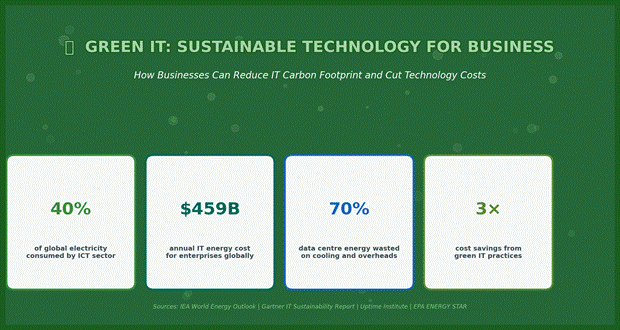
Green IT: Industry Key Statistics — ICT Energy Consumption, Cost and Efficiency Potential (Source: IEA 2023; Gartner; Uptime Institute)
What Is Green IT?
Green IT refers to the design, manufacture, use, and disposal of computers, servers, networking equipment, and associated systems in a manner that minimises environmental impact. It encompasses four lifecycle stages: manufacturing, operation, disposal, and the enabling of sustainability in other sectors through technology.
| Green IT Dimension | What It Covers | Business Relevance |
| Energy-Efficient Hardware | Choosing equipment with lower power draw: servers, laptops, monitors, networking gear with ENERGY STAR or EPEAT ratings | Reduces electricity bills directly; typical server power optimisation saves 20–40% on energy spend |
| Data Centre Efficiency | Improving Power Usage Effectiveness (PUE), cooling systems, hot/cold aisle containment, and server utilisation rates | Average enterprise data centre operates at PUE 2.0; improving to 1.5 can halve cooling energy costs |
| Virtualisation and Cloud | Consolidating physical servers using virtualisation; migrating workloads to cloud providers with higher hardware utilisation | Server virtualisation typically reduces hardware count by 10:1; cloud migration can cut energy use by 65–80% per workload |
| Software and Code Efficiency | Writing leaner code, optimising queries, reducing unnecessary compute cycles, retiring legacy applications | Inefficient software can consume 10–100x more energy than well-optimised equivalents for the same task |
| Responsible E-waste Management | Extending device lifespan, donating or refurbishing equipment, using certified e-waste recyclers (e.g., R2, e-Stewards) | Global e-waste reached 62 million tonnes in 2022 (UN Global E-waste Monitor 2024); proper disposal avoids legal liability |
| Sustainable IT Procurement | Selecting suppliers with credible environmental policies; using eco-labels (EPEAT Gold, TCO Certified, ENERGY STAR) | Green procurement criteria increasingly required for government and enterprise supply chain compliance |
| Renewable Energy for IT | Powering data centres and offices with renewable electricity via Power Purchase Agreements (PPAs), RECs, or on-site generation | Major cloud providers — Google, Microsoft, Amazon — commit to 100% renewable matching; PPAs now accessible to mid-market firms |
Table 1: Green IT Dimensions — Scope, Practices and Business Relevance
ICT Sector Carbon Footprint: The Scale of the Problem
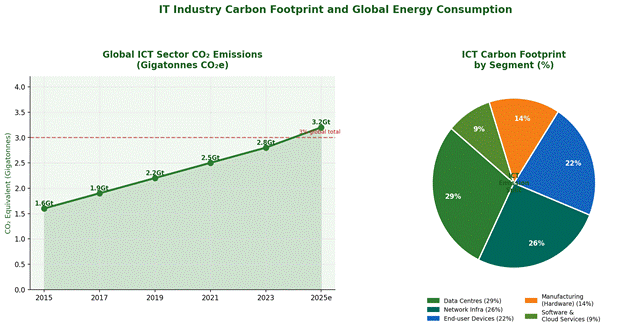
Figure 1: Global ICT Sector CO₂ Emissions (Gigatonnes, 2015–2025 estimated) and Emissions by ICT Segment (Source: IEA World Energy Outlook 2023; GeSI SMARTer2030)
The ICT sector’s carbon footprint is distributed unevenly across its components. Data centres account for approximately 29% of ICT emissions, network infrastructure 26%, end-user devices 22%, hardware manufacturing 14%, and software and cloud services 9%, according to estimates compiled from IEA and GeSI research. These proportions vary by company type — a bank with large on-premise server infrastructure will have a different emission profile than a software company whose primary footprint is employee laptops.
Why Green IT Matters for Business: Commercial and Regulatory Drivers
| Driver | Description | Trend |
| Energy Cost Reduction | IT infrastructure is one of the largest controllable operating costs for organisations. A 30–40% reduction in data centre energy spend is achievable with mature Green IT practices, translating to £100K–£5M+ in annual savings depending on scale. | Energy prices volatile; efficiency gains are permanent |
| Regulatory Compliance | The EU Corporate Sustainability Reporting Directive (CSRD) requires large companies to report Scope 1, 2, and 3 emissions from 2025. The SEC climate disclosure rules (USA, phased) and UK TCFD requirements create mandatory reporting obligations for public companies. | Mandatory for large firms; voluntary becoming expected for SMBs |
| Customer and Supply Chain Requirements | Large enterprises increasingly require suppliers to complete CDP questionnaires, meet Science Based Targets (SBT), or achieve ISO 14001 certification. Failing to do so can disqualify organisations from tenders. | Growing — particularly in financial services, retail, and automotive |
| Investor ESG Scrutiny | ESG-focused investors now manage over $35 trillion in assets globally (GSIA 2022). Poor environmental performance increases cost of capital and reduces access to ESG-indexed funds. | ESG integration accelerating; MSCI, FTSE Russell ESG indices now mainstream |
| Talent Attraction | A 2023 IBM Institute for Business Value survey found that 71% of employees prefer working for environmentally sustainable companies. IT professionals increasingly factor sustainability into employer choice. | Significant for engineering and technology talent acquisition |
| Carbon Taxes and Offset Costs | Carbon taxes now cover 23% of global emissions (World Bank Carbon Pricing Report 2023). Companies facing carbon taxes benefit directly from reducing IT energy consumption and associated emissions. | Expanding coverage; EU ETS prices have reached €60–€90/tonne |
Table 2: Business Drivers for Green IT Adoption — Commercial, Regulatory and Reputational (Sources: CSRD; CDP; GSIA; IBM IBV 2023; World Bank)
The 6 Pillars of Green IT
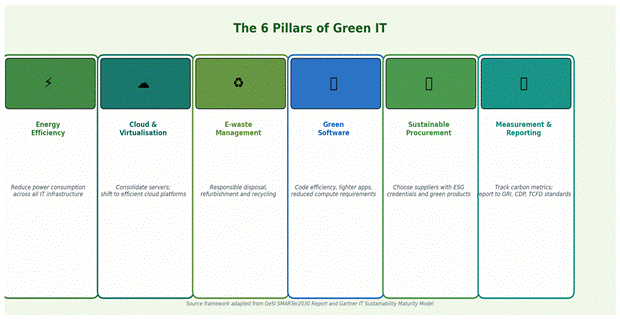
Figure 2: The 6 Pillars of Green IT — Framework adapted from GeSI SMARTer2030 and Gartner IT Sustainability Maturity Model
Green IT Business Benefits: Impact and Cost Savings
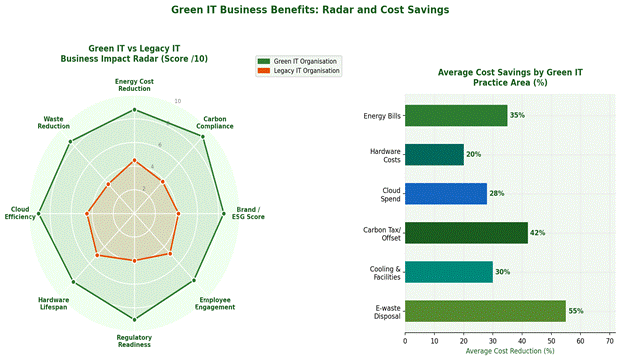
Figure 3: Green IT vs Legacy IT — Business Impact Radar and Average Cost Savings by Practice Area (Source: Gartner; Uptime Institute; EPA ENERGY STAR programme data)
Organisations that have implemented mature Green IT programmes report measurable cost reductions across multiple categories. The figures in Figure 3 are averages drawn from Gartner’s IT Cost Optimisation benchmarks and Uptime Institute’s data centre efficiency reports. Individual results vary significantly based on starting infrastructure, industry, and programme scope.
Practical Green IT Practices: What to Do
1. Measure Your IT Carbon Footprint First
Before implementing Green IT practices, organisations need a baseline. The Greenhouse Gas Protocol (GHGP) provides the internationally recognised framework for measuring Scope 1 (direct), Scope 2 (purchased energy), and Scope 3 (value chain) emissions. For IT specifically, this involves auditing data centre energy use, employee device energy consumption, cloud provider emissions data, and hardware manufacturing footprints.
| Measurement Tool / Standard | What It Covers | Access |
| GHG Protocol Corporate Standard | Framework for Scope 1, 2, 3 emissions calculation across all operations | Free — ghgprotocol.org |
| CDP Climate Questionnaire | Structured annual climate disclosure with IT emissions as a component | Required for major enterprise supply chain participation |
| Green Software Foundation Carbon Intensity API | Measures real-time carbon intensity of cloud compute by region | Open source — greensoftware.foundation |
| Cloud Carbon Footprint (open source tool) | Estimates cloud emissions across AWS, Azure, Google Cloud from billing data | Free — cloudcarbonfootprint.org |
| Uptime Institute PUE Calculator | Benchmarks data centre power efficiency against global norms | Free — uptimeinstitute.com |
| ISO 14064 | International standard for quantifying and reporting GHG emissions | Auditable certification — ISO.org |
Table 3: IT Carbon Footprint Measurement Tools and Standards (All sources publicly verifiable)
2. Data Centre Efficiency: Understanding PUE
Power Usage Effectiveness (PUE) is the primary metric for data centre energy efficiency. It is calculated as total facility energy divided by IT equipment energy. A PUE of 1.0 is perfect; most legacy enterprise data centres operate between 1.8 and 2.5, meaning 45–60% of energy is consumed by cooling, power conversion, and lighting rather than actual computing.
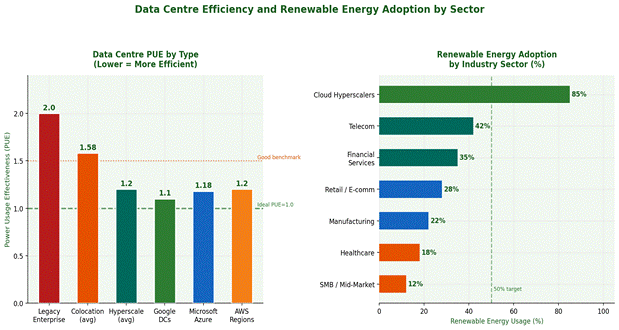
Figure 4: Data Centre PUE by Type (Lower is more efficient) and Renewable Energy Adoption by Industry Sector (Source: Uptime Institute Annual Survey 2023; IEA; company sustainability reports)
| PUE Range | Rating | Typical For | Improvement Actions |
| 1.0–1.2 | Exceptional | Hyperscale cloud providers (Google avg 1.10, Microsoft avg 1.18) | Liquid cooling, AI-driven workload management, on-site renewables |
| 1.2–1.5 | Efficient | Modern colocation facilities; tier-3+ enterprise data centres | Hot/cold aisle containment, variable speed cooling, server virtualisation |
| 1.5–1.8 | Average | Well-managed enterprise data centres built post-2010 | Airflow optimisation, power strip monitoring, server refresh programme |
| 1.8–2.0 | Below Average | Older enterprise data centres; mixed equipment generations | Decommission unused servers, improve UPS efficiency, lighting upgrades |
| >2.0 | Poor | Legacy data centres; unmanaged server rooms | Consider cloud migration or colocation; full infrastructure audit required |
Table 4: Data Centre PUE Rating Scale — What Each Range Means and Priority Improvement Actions
3. Cloud Migration and Virtualisation
Migrating workloads from on-premise infrastructure to public cloud platforms is one of the highest-impact Green IT actions available to most organisations. A 2020 Accenture/WSP study found that migrating to the public cloud can reduce an organisation’s IT carbon footprint by up to 84% for equivalent workloads, primarily because hyperscale providers achieve much higher server utilisation rates (65–75% vs 15–20% for typical enterprise servers) and have larger renewable energy procurement programmes.
| Cloud Provider | Renewable Energy Commitment | Carbon Neutrality Target | Data Source |
| Google Cloud | 100% renewable matched since 2017; targeting 24/7 carbon-free by 2030 | Carbon neutral since 2007; carbon-free operations by 2030 | Google Environmental Report 2023 |
| Microsoft Azure | 100% renewable by 2025; 24/7 carbon-free by 2030 for all campuses | Carbon negative by 2030; remove historical carbon by 2050 | Microsoft Environmental Sustainability Report 2023 |
| Amazon AWS | 100% renewable energy by 2025 (achieved ahead of schedule in 2023) | Net-zero carbon across operations by 2040 | AWS Sustainability Report 2023 |
| Google Cloud (Carbon Data) | Provides per-region carbon intensity data to customers | Region selection tool available in GCP console | Google Carbon Footprint Tool |
| Microsoft (Carbon Data) | Emissions Insights tool available in Azure portal for Scope 1/2/3 | Customer scope 3 reporting in preview | Azure Sustainability Calculator |
| AWS (Carbon Data) | Customer Carbon Footprint Tool available in AWS Cost Explorer | Covers purchased electricity emissions per service | AWS Customer Carbon Footprint Tool |
Table 5: Major Cloud Provider Renewable Energy Commitments and Customer Carbon Reporting Tools (Source: Provider Sustainability Reports 2023)
4. Sustainable Hardware Procurement
The manufacturing of IT hardware accounts for 70–80% of a device’s lifetime carbon footprint for laptops, and approximately 50% for servers. Extending device lifespans, selecting equipment with recognised eco-labels, and returning devices to manufacturer take-back schemes are practical ways to reduce hardware-related emissions.
| Eco-Label / Standard | Scope | Key Criteria | Applicable Products |
| ENERGY STAR | Energy efficiency in use | Meets EPA energy consumption thresholds for each product category | PCs, laptops, monitors, servers, printers, data centre equipment |
| EPEAT (Electronic Product Environmental Assessment Tool) | Lifecycle environmental performance | Criteria across 8 environmental categories: materials, energy, end of life | PCs, tablets, mobile phones, servers, imaging equipment |
| TCO Certified | Comprehensive — people, planet, society | Covers chemical restrictions, display quality, ergonomics, factory conditions | Laptops, desktops, monitors, headsets, displays |
| EU Ecodesign Regulation | Energy and circularity for EU-sold products | Minimum energy efficiency; repairability; spare parts availability (7 years) | Servers (from 2025); displays; network equipment |
| ISO 14001 | Environmental management system | Organisation-level standard for environmental management processes | Supplier qualification — not product-specific |
| R2 / e-Stewards Certification | Responsible electronics recycling | Standards for safe, traceable, responsible e-waste handling | E-waste recyclers and refurbishers — supply chain qualification |
Table 6: IT Eco-Labels and Standards — Scope, Criteria and Applicable Product Categories
5. Green Software Engineering
Software efficiency is an emerging but increasingly important dimension of Green IT. The Green Software Foundation — a Linux Foundation project backed by Accenture, GitHub, Microsoft, and others — defines green software as software that is carbon-efficient, energy-efficient, and hardware-efficient. Their Green Software Practitioner course and Software Carbon Intensity (SCI) specification provide a framework for developers to measure and reduce the carbon impact of code.
| Green Software Practice | What It Involves | Estimated Impact |
| Optimise compute intensity | Profile and refactor code to reduce unnecessary processing cycles | 10–70% reduction in CPU utilisation for same output in well-optimised cases |
| Workload time-shifting | Schedule batch compute during low-carbon-intensity grid periods (e.g. daytime solar hours) | 15–30% reduction in carbon intensity for batch workloads with no change to output |
| Select carbon-efficient cloud regions | Deploy in cloud regions powered by higher proportions of renewable energy | Up to 40x difference in carbon intensity between highest and lowest carbon cloud regions (Google Carbon Data) |
| Retire legacy applications | Identify and decommission applications with low or zero utilisation | Unused servers often consume 25–60% of peak power even idle (Dell/EPA research) |
| Reduce data transfer | Compress assets, use CDNs, reduce API payload sizes, use efficient protocols | Network data transfer accounts for a measurable share of end-user device energy; compression reduces this proportionally |
| Right-size cloud resources | Match cloud instance size to actual workload; use auto-scaling | Cloud resource over-provisioning is a documented problem — AWS estimates 30–40% of cloud spend is wasted |
Table 7: Green Software Engineering Practices — Methods and Estimated Carbon/Energy Impact
6. E-waste Management
The United Nations University Global E-waste Monitor 2024 reported that 62 million tonnes of e-waste were generated globally in 2022, with only 22.3% documented as formally collected and recycled. For organisations, responsible e-waste management involves: extending device lifespans, using manufacturer take-back programmes, donating functional equipment to schools and charities, and contracting R2 or e-Stewards certified recyclers for end-of-life processing.
Green IT Implementation Roadmap
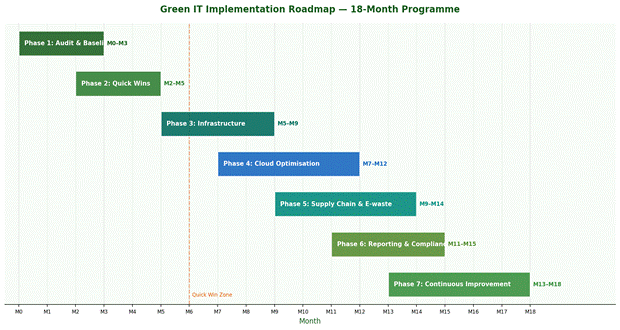
Figure 5: Green IT 18-Month Implementation Roadmap — Phase Sequencing from Audit to Continuous Improvement
| Phase | Timeline | Key Activities | Expected Outcome |
| Phase 1: Audit and Baseline | Months 1–3 | Inventory all IT assets; measure energy consumption; calculate current IT carbon footprint using GHG Protocol; establish KPIs | Documented baseline; Scope 1, 2, 3 IT emissions quantified; priority areas identified |
| Phase 2: Quick Wins | Months 2–6 | Power management settings on all devices; decommission unused servers; LED lighting in server rooms; optimise cooling setpoints; virtualise underutilised servers | Typical 10–20% energy reduction achievable within 6 months with minimal capital spend |
| Phase 3: Infrastructure Upgrade | Months 5–9 | Server refresh to energy-efficient models; hot/cold aisle containment; UPS upgrade; PUE improvement programme; network equipment rationalisation | PUE improvement from >2.0 towards 1.5–1.7 range; measurable kWh reduction |
| Phase 4: Cloud Optimisation | Months 7–12 | Right-size cloud instances; select lower-carbon cloud regions; implement auto-scaling; retire legacy on-premise workloads; adopt cloud provider carbon reporting tools | 30–60% reduction in cloud-related emissions for migrated workloads; cost reduction from right-sizing |
| Phase 5: Supply Chain and E-waste | Months 9–14 | Implement green procurement policy; require EPEAT/ENERGY STAR for new hardware; contract certified e-waste recyclers; launch device donation programme | Scope 3 supply chain emissions reduced; measurable e-waste diversion from landfill |
| Phase 6: Reporting and Compliance | Months 11–15 | Set up CDP reporting; prepare CSRD/TCFD disclosures; obtain ISO 14001 or equivalent if required; communicate progress to stakeholders | Regulatory compliance achieved; investor and customer-facing reporting in place |
| Phase 7: Continuous Improvement | Month 13 onwards | Integrate carbon metrics into IT procurement; set Science Based Targets for IT; automate carbon reporting; run annual Green IT review cycle | Programme becomes embedded; targets aligned with SBTi or equivalent science-based framework |
Table 8: Green IT 18-Month Implementation Roadmap — Phases, Activities and Outcomes
Relevant Standards, Frameworks and Reporting Requirements
| Standard / Framework | Issuing Body | What It Requires | Who It Applies To |
| GHG Protocol Corporate Standard | World Resources Institute (WRI) / WBCSD | Scope 1, 2, 3 emissions calculation and reporting methodology | Voluntary; underpins most mandatory frameworks |
| EU Corporate Sustainability Reporting Directive (CSRD) | European Commission | Mandatory climate-related disclosures including IT energy and emissions data from FY2024 (large listed companies); FY2025 onwards for large private companies | Large EU-based companies and non-EU companies with significant EU revenue |
| Task Force on Climate-related Financial Disclosures (TCFD) | Financial Stability Board | Climate risk governance, strategy, risk management, and metrics/targets including ICT-related risks | Mandatory for UK listed companies; increasingly adopted globally |
| Science Based Targets initiative (SBTi) | CDP / WWF / WRI / UN Global Compact | Corporate emissions reduction targets aligned with 1.5°C Paris Agreement pathway | Voluntary commitment; increasingly expected by investors and large corporate customers |
| ISO 14001 | International Organisation for Standardisation | Environmental Management System (EMS) certification covering all aspects of environmental impact | Often required in supplier qualification; auditable certification |
| EU Ecodesign for Sustainable Products Regulation (ESPR) | European Commission | Minimum design requirements for energy efficiency, repairability, and recyclability of IT products sold in EU | IT hardware manufacturers and EU market participants |
| Green Software Foundation SCI Specification | Green Software Foundation (Linux Foundation project) | Software Carbon Intensity (SCI) metric for measuring software carbon footprint | Software developers and technology teams seeking to quantify code carbon impact |
Table 9: Green IT Regulatory Frameworks and Voluntary Standards — Scope and Applicability
Key Metrics to Track in a Green IT Programme
| Metric | Definition | Target / Benchmark | Data Source |
| Power Usage Effectiveness (PUE) | Total facility power ÷ IT equipment power. Lower is better. | Best practice: <1.5; hyperscale: <1.2 | Data centre power management system; smart PDUs |
| Carbon Usage Effectiveness (CUE) | Total CO₂ emissions from data centre ÷ IT equipment energy. Lower is better. | Target: <0.4 kg CO₂/kWh for renewable-powered facilities | Energy supplier invoice + IEA grid carbon intensity data |
| Server Utilisation Rate | % of CPU and memory capacity in active use on average | Best practice: >65%; many enterprise servers run at 15–25% | Monitoring tools: Datadog, Grafana, vSphere, AWS CloudWatch |
| Device Energy Consumption (kWh) | Total energy consumed by end-user devices per year | Benchmark against ENERGY STAR rated equivalents | Endpoint management platforms; building energy management systems |
| E-waste Diversion Rate | % of end-of-life IT assets diverted from landfill (recycled, donated, refurbished) | Target: >90% diversion rate | IT asset disposition (ITAD) vendor reports |
| Renewable Energy % | % of electricity consumed by IT infrastructure sourced from renewables | Target: 100% for Scope 2 market-based; match to 24/7 CFE longer term | Energy invoices; Green Tariff agreements; RECs / GOs purchased |
| IT Carbon Intensity (kgCO₂/£ revenue) | Total IT-related emissions relative to revenue, normalising for business growth | Year-on-year reduction target; benchmark vs sector peers | GHG Protocol Scope 1+2+3 IT calculation |
| Cloud Carbon per Workload | CO₂e per application workload or service run | Track trending down with region selection and right-sizing | Cloud provider carbon tools (AWS CCF, Azure Emissions Insights, GCP Carbon Footprint) |
Table 10: Green IT Key Performance Metrics — Definition, Target and Data Source
Frequently Asked Questions
| Frequently Asked Question | Expert Answer |
| What is Green IT in simple terms? | Green IT means using, buying, and disposing of technology in ways that reduce environmental harm — primarily by consuming less energy, generating less e-waste, and sourcing electricity from renewable sources. It covers everything from data centres to employee laptops to how code is written. |
| Is Green IT expensive to implement? | Many Green IT actions reduce costs rather than increase them. Power management settings, server virtualisation, and cloud right-sizing typically reduce operating expenses. Higher-cost actions — such as data centre infrastructure upgrades or renewable energy PPAs — require capital investment but usually have positive ROI within 2–5 years. The EU Commission estimates organisations that implement Green IT best practices can reduce IT energy costs by 30–40%. |
| What is a good PUE for a data centre? | The Uptime Institute reports an average global PUE of 1.58 for 2022. A PUE below 1.5 is considered efficient; below 1.2 is exceptional and characteristic of hyperscale cloud providers. Legacy enterprise data centres often operate above 2.0, meaning more than half of energy is consumed by cooling and power conversion rather than computing. |
| Do businesses have to report IT carbon emissions? | Requirements vary by jurisdiction and company size. EU companies subject to the CSRD must report Scope 1, 2, and 3 emissions — which include IT — from FY2024 or FY2025 depending on company size. UK-listed companies must comply with TCFD requirements. US public companies face SEC climate disclosure rules (phased implementation). Many companies face informal requirements through customer and investor questionnaires even where regulatory mandates do not yet apply. |
| What is the difference between Scope 1, 2, and 3 emissions for IT? | Scope 1: Direct emissions from company-owned generator fuel. Scope 2: Indirect emissions from purchased electricity (data centres, offices). Scope 3: All other indirect emissions — including cloud service provider emissions (upstream), hardware manufacturing (upstream), and employee device use at home (downstream). For most IT organisations, Scope 2 is the largest category, but Scope 3 hardware manufacturing can be significant for device-heavy businesses. |
| What is the Green Software Foundation? | The Green Software Foundation is a non-profit Linux Foundation project — members include Accenture, GitHub, Microsoft, and others — focused on reducing the carbon emissions of software. It publishes the Software Carbon Intensity (SCI) specification for measuring software carbon footprint and provides a free Green Software Practitioner certification course at learn.greensoftware.foundation. |
Summary: Getting Started with Green IT
Green IT is not a single project — it is an ongoing operational discipline that touches procurement, infrastructure, software development, and supplier management. The most practical starting point for most organisations is a baseline carbon audit using the GHG Protocol, followed by the quick wins that reduce energy consumption without significant capital spend: power management, server virtualisation, and retiring unused infrastructure.
| Priority | Action | Typical Effort | Expected Benefit |
| Start here | Conduct IT carbon baseline audit using GHG Protocol or equivalent | 2–6 weeks with existing team | Identifies where emissions and energy costs are concentrated |
| Quick win | Enable power management on all desktops, monitors, and servers | 1–2 days via IT policy / endpoint management tool | 5–15% reduction in device and server energy consumption |
| Quick win | Decommission servers with <10% CPU utilisation | 1–4 weeks audit + migration | Each decommissioned server saves ~500–1,500 kWh per year |
| Medium term | Virtualise remaining physical servers; target >65% utilisation | 2–6 months | Typically reduces server count by 5–10:1; proportional energy reduction |
| Medium term | Right-size cloud instances and enable auto-scaling | 1–3 months with cloud engineering | AWS estimates 30–40% of cloud spend (and associated emissions) is avoidable waste |
| Longer term | Obtain renewable electricity for data centres via PPA or green tariff | 3–12 months procurement | Eliminates Scope 2 market-based emissions for data centre operations |
| Ongoing | Report annually to CDP; align targets with SBTi; track metrics monthly | Ongoing — integrate into IT governance | Builds regulatory compliance, investor confidence, and customer ESG credentials |
Table 11: Green IT Priority Actions — Effort vs Benefit Guide for Businesses
Sources and References
| # | Source | Reference |
| 1 | IEA World Energy Outlook 2023 | iea.org — Data Centres and Data Transmission Networks |
| 2 | UN Global E-waste Monitor 2024 | itu.int/en/ITU-D/Environment — Global E-waste Statistics Partnership |
| 3 | Gartner IT Sustainability Research | Gartner — Sustainability Imperative Research 2023 |
| 4 | Uptime Institute Annual Data Centre Survey 2023 | uptimeinstitute.com — Annual Global Data Centre Survey |
| 5 | GeSI SMARTer2030 Report | gesi.org — ICT Solutions for 21st Century Challenges |
| 6 | GHG Protocol Corporate Standard | ghgprotocol.org — Corporate Accounting and Reporting Standard |
| 7 | EPA ENERGY STAR Programme | energystar.gov — Buildings and Plants / IT Equipment |
| 8 | Google Environmental Report 2023 | sustainability.google — Environmental Report 2023 |
| 9 | Microsoft Environmental Sustainability Report 2023 | microsoft.com/en-us/corporate-responsibility/sustainability |
| 10 | AWS Sustainability Report 2023 | sustainability.aboutamazon.com — AWS Sustainability |
| 11 | Science Based Targets Initiative (SBTi) | sciencebasedtargets.org |
| 12 | EU CSRD Directive | ec.europa.eu/finance — Sustainable Finance / CSRD |
| 13 | Green Software Foundation / SCI Specification | greensoftware.foundation; sci-guide.greensoftware.foundation |
| 14 | World Bank Carbon Pricing Report 2023 | worldbank.org/en/programs/pricing-carbon |
| 15 | GSIA Global Sustainable Investment Review 2022 | gsi-alliance.org |
| 16 | IBM Institute for Business Value — ESG Survey 2023 | ibm.com/thought-leadership/institute-business-value |
| 17 | Accenture / WSP — Cloud Carbon Study 2020 | accenture.com — The Green Behind the Cloud |
| 18 | EPEAT — Electronic Product Environmental Assessment Tool | epeat.net |
Table 12: Complete Sources and References (All publicly verifiable)
read more article-https://gokuldhamodaran.com/blog