The short answer
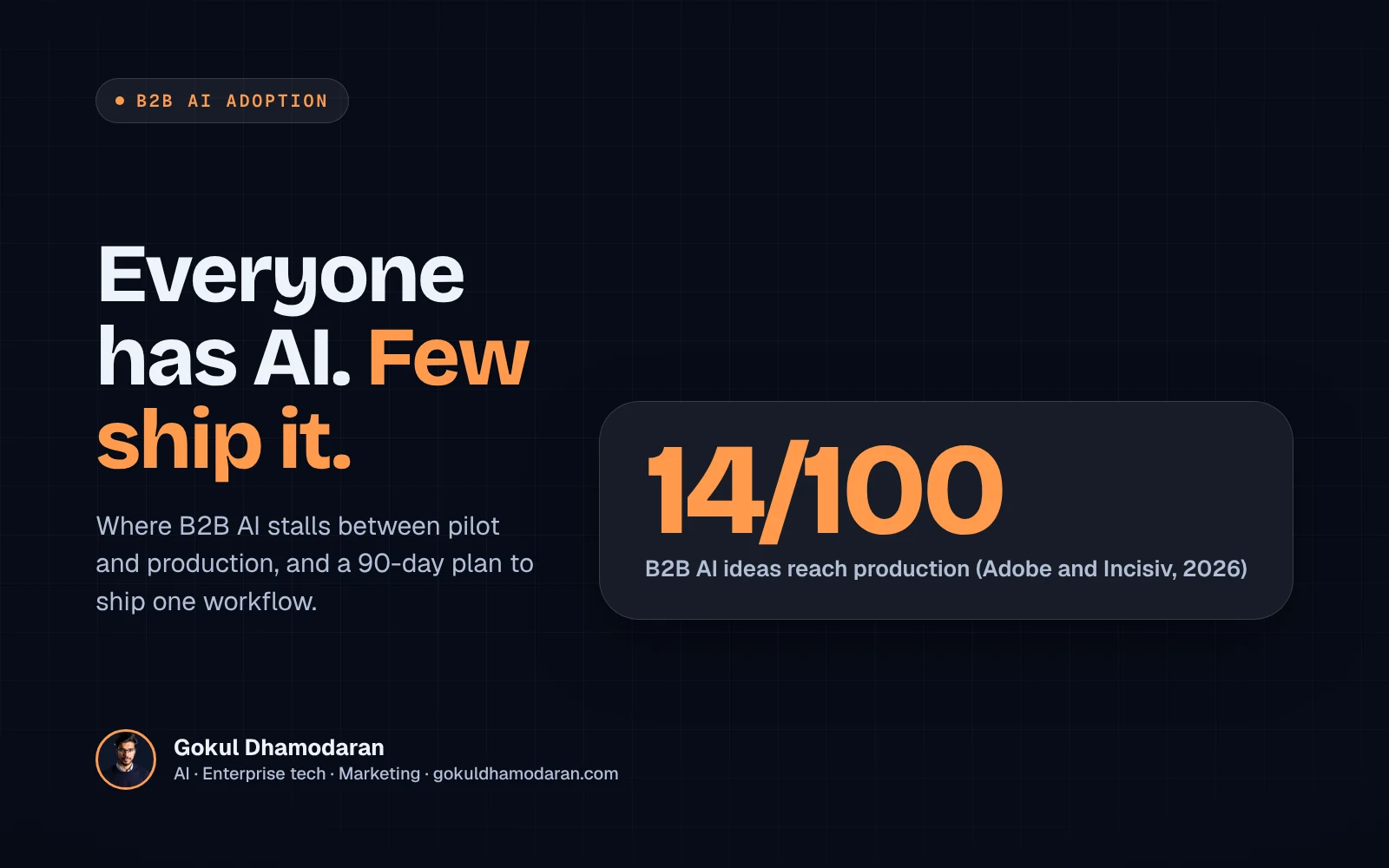
AI adoption in B2B companies is wide but shallow in 2026. Only 22% of B2B firms have fully implemented gen AI (McKinsey), and about 14 in 100 AI ideas reach production (Adobe and Incisiv). Most stall on five things: no owner, messy data, late reviews, unchanged workflows and activity metrics.
Key takeaways
- 22% of B2B firms have fully implemented gen AI. Market leaders: 44%. Laggards: 22% (McKinsey, May 2026).
- Only about 14 in 100 B2B AI ideas reach production. The steepest drop is IT evaluation, then security review.
- Europe runs two speeds: 42% of Danish firms use AI, 8.4% of Polish firms (Eurostat, 2025).
- The five stall points: no owner, data that disagrees, late reviews, the old workflow, activity metrics.
- Don't run ten pilots. Move one workflow into production in 90 days, with one owner and one metric.
In May 2026, McKinsey asked nearly 4,000 B2B decision-makers in 13 countries whether they had fully implemented generative AI. Twenty-two percent said yes. Among market leaders, the companies growing share by more than 10% a year, it was 44%. That gap is the real story of AI adoption in B2B companies this year.
Almost everyone has started. Few have finished. A study Adobe and Incisiv published in September found that only about 14 of every 100 B2B AI ideas reach production. This guide shows where the other 86 stall, what that looks like in a European company, and a 90-day plan to move one workflow from pilot to production.
What does AI adoption in B2B companies look like in 2026?
AI adoption in B2B companies in 2026 is wide but shallow. Nearly nine in ten firms use AI in at least one function, but far fewer run it inside core workflows. In McKinsey’s State of AI 2026 survey, 44% of respondents say AI is scaling across their enterprise, up from 38% a year earlier. Only 37% say AI has added to EBIT.
The B2B-specific numbers come from McKinsey’s 2026 Global B2B Pulse Survey (May 28, 2026) and its State of AI survey of 1,719 people in 97 countries (fielded May to June 2026):
- 22% of B2B organizations have fully implemented gen AI, up from 19% a year earlier. Another 31% are actively adopting it.
- 44% vs 22%: market leaders are twice as likely as laggards to have fully implemented gen AI.
- 71% vs 25%: leaders are far more likely to have raised AI investment by double digits year over year.
- 54% vs a third: organizations with more than $1 billion in revenue are much more likely to report AI scaling than smaller ones.
- 40% of large organizations now scale AI agents in at least one function, up from 27%. Among smaller firms the share is flat at 22%.
Leaders are twice as far into gen AI
Market leadersLaggards
- Fully implemented gen AI44%22%2x
- AI budget up double digits71%25%46 pts
gokuldhamodaran.com
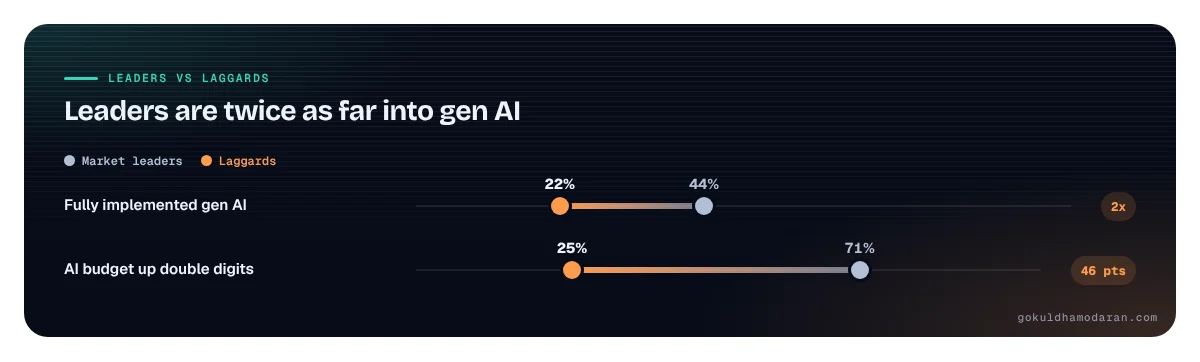
My read: the divide isn’t access to models. Every company in those surveys can buy the same models through the same clouds. The divide is what happens after the demo, and it compounds, because leaders reinvest what the first workflow saves into the second one.
How far along are European B2B companies?
Europe is adopting fast from a low base, with a wide spread between countries. Eurostat reports that 20.0% of EU enterprises with 10 or more employees used AI in 2025, up from 13.5% in 2024 and 8.1% in 2023. Adoption more than doubled in two years, yet four in five firms still don’t use it.
The spread inside the EU is the part most group-level plans miss:
- Highest: Denmark 42.0%, Finland 37.8%, Sweden 35.0%.
- Lowest: Romania 5.2%, Poland 8.4%, Bulgaria 8.5%.
- Most common use: analysing written language (11.8% of firms), ahead of generating images, video or audio (9.5%) and generating written or spoken text (8.8%).
EU firms using AI more than doubled in two years
Denmark 42.0%, Poland 8.4% in 2025
gokuldhamodaran.com
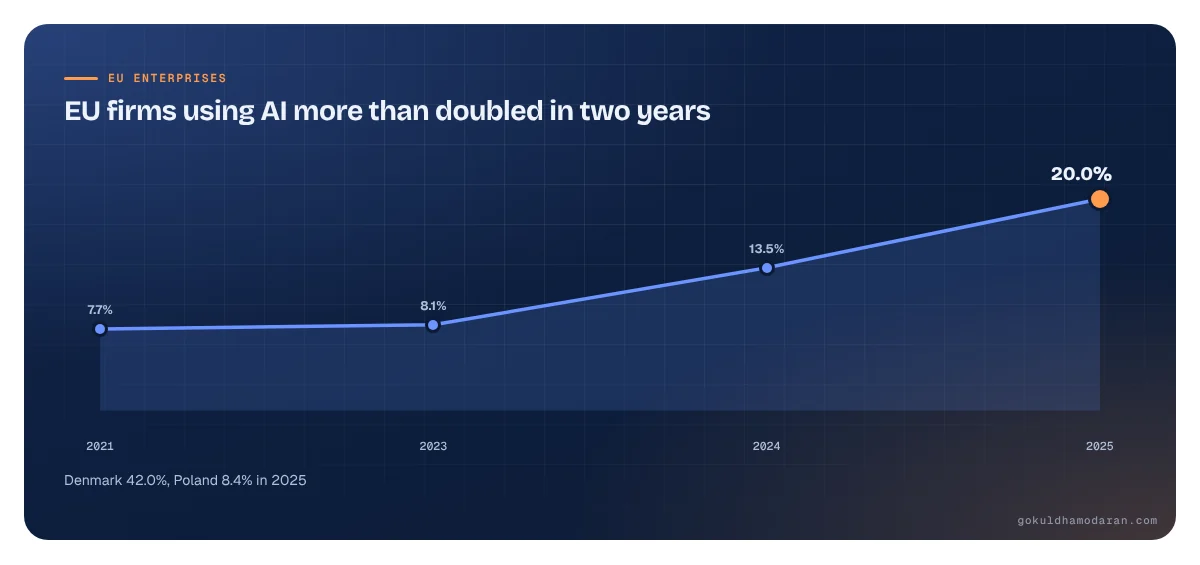
If you run a group with teams in Copenhagen and Warsaw, you run two adoption curves inside one company. A pilot that works in the Danish team can land on a team that has never used AI at work. Plan training and change management by country, not by group average.
European rollouts also carry review steps a US rollout often doesn’t: a GDPR data protection review for any workflow that touches personal data, and the EU AI Act’s phased obligations for some uses. Put those reviews in the plan from day one instead of discovering them in week six, and check the details with your legal team. For North American readers with European subsidiaries, this spread is a preview of your own rollout.
Why does AI adoption stall after the pilot?
AI adoption stalls after the pilot because pilots skip the work production needs: an owner with a budget, data that agrees with itself, IT and security review, a redesigned workflow and an outcome metric. Adobe and Incisiv’s State of AI Readiness in B2B Industries (Sep 3, 2026, 1,501 senior B2B executives) calls the stuck stage “The Frozen Middle”. More than half of B2B firms sit there, piloting or deploying but not running.
The same study traced B2B AI ideas from proposal to production. About 14 in every 100 made it. The steepest drop came at IT evaluation, and security review was the next big one.
Only 14 in 100 B2B AI ideas reach production
In every 100 B2B AI ideas
- 14reach production
- 86stall, mostly at IT evaluation and security review
The steepest drop is IT evaluation, then security review.
gokuldhamodaran.com
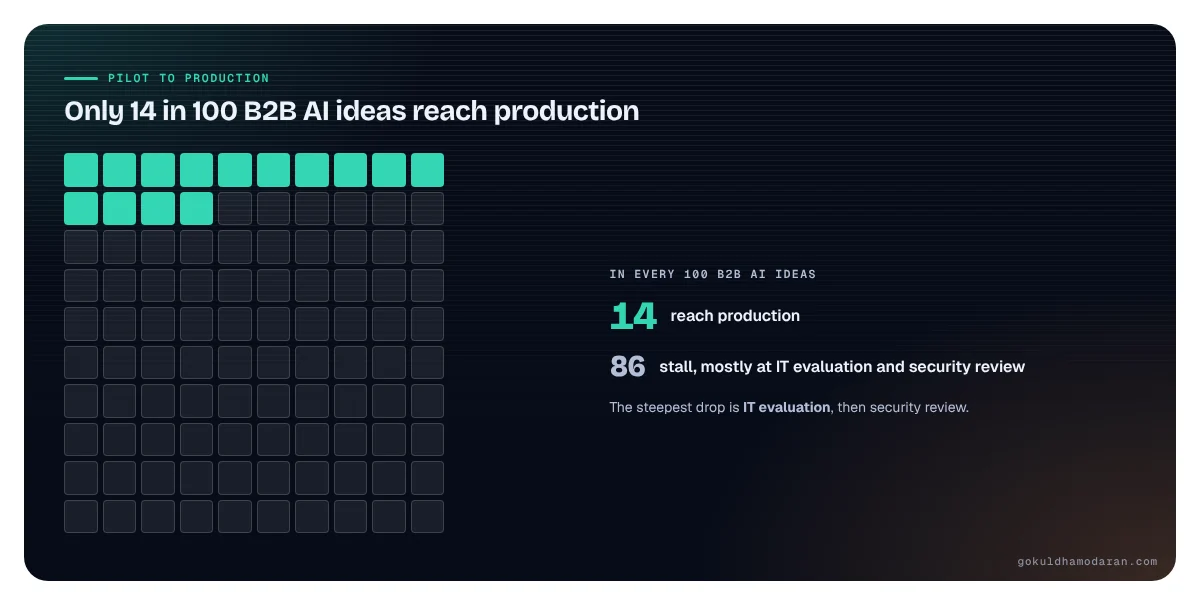
That detail matters. Most B2B AI ideas don’t die because the model got the answer wrong. They die in a queue, waiting for reviews nobody planned for when the pilot started. The study’s own headline says it well: AI readiness in B2B is an operating model question, not a question of models or of how many pilots are running. I covered the agent version of this problem in why agentic AI projects fail.
The five stall points between pilot and production
Put the 2026 studies side by side and the same five stall points come up. I call them the Five Stalls. Each one has a fix you can start this quarter.
1. No owner with a budget
Only 15% of B2B firms have a formal AI owner with budget authority, according to Adobe and Incisiv. The leader group in that study has one at more than five times that rate, and the researchers call ownership the largest single gap. Only about 1 in 18 B2B firms combines formal AI ownership, a working business and IT partnership, and full ROI measurement.
Fix: name one business owner per AI pilot and workflow, with a budget line, one target metric and the right to stop it. IT supports the owner. A steering group doesn’t count.
2. Data that disagrees with itself
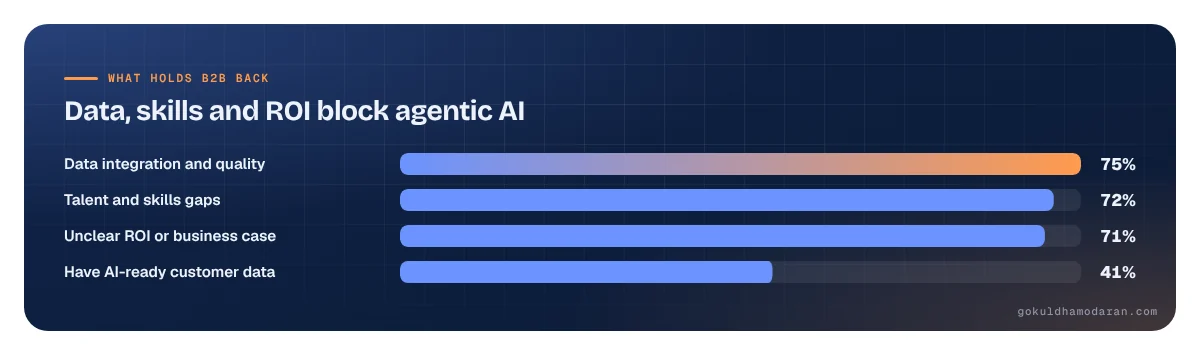
Adobe’s 2026 AI and Digital Trends in B2B report (fielded by Oxford Economics, Oct to Nov 2025) found that only 41% of B2B organizations have a unified customer data foundation that can support AI at scale. Three-quarters say data integration and quality is their biggest struggle with agentic AI. McKinsey found laggards held back by fragmented data, legacy technology and employee hesitation.
I ran an account-based marketing program for SAP-focused enterprise solutions on HubSpot, Demandbase, ZoomInfo and Apollo, and it contributed to a 35% increase in qualified pipeline. My read from that work: the tools are rarely the bottleneck. One trusted view of the account, shared by sales and marketing, is. AI raises the stakes, because a model will act on the wrong record with total confidence.
Fix: don’t start a data lake program. Pick a workflow whose data you can clean in weeks, and fix only the fields that workflow reads. Our account-based marketing program guide shows what one shared account view looks like.
3. Reviews that arrive late
IT evaluation and security review are where the funnel narrows most. In Europe, add the data protection officer. These reviews are not the enemy. They are where production standards live. The problem is that most AI pilots meet them only at the end, after the business has already promised a launch date.
Fix: bring IT, security and the data protection officer in during week one with a one-page intake: what data the workflow touches, which systems it writes to, who approves its output and how you’d switch it off. Pre-approve a few patterns (read-only, internal data, human review before anything leaves the company) so the next idea moves faster.
4. The old workflow with AI bolted on
Nearly three-quarters of AI high performers in McKinsey’s State of AI 2026 survey say they fundamentally redesigned workflows because of AI, up from 55% a year earlier. About a quarter of everyone else did. Adding a chat window to an unchanged process saves minutes. Changing who does what, and when a human approves, is what moves the numbers.
Fix: draw the workflow before and after on one page. Mark every step the AI does, every step a person checks, and every approval. If the after picture looks the same as the before picture, you have a tool rollout, not adoption.
5. Counting activity instead of outcomes
Adobe and Incisiv found B2B measurement dominated by activity numbers: adoption, usage, time saved. Those don’t show an effect on deal speed, conversion, retention or rework. In Adobe’s trends report, only 39% have a framework to measure gen AI ROI, 30% have one for agentic AI, and 71% name unclear ROI as a key barrier.
Fix: before launch, record a baseline for one business metric the owner already reports, such as quote turnaround time, first-response time or rework rate. Usage numbers can sit underneath it, never in its place.
What do B2B market leaders do differently with AI?
B2B market leaders put AI into revenue-linked workflows and change the work around it, instead of running separate pilots. McKinsey’s B2B Pulse lists the pattern: leaders tell a clear executive story and role-model use, prioritize revenue-linked use cases, embed AI into daily workflows, align functions early and reinvest the gains.
One finding stands out. Leaders name risk and legal considerations as their main constraint, while laggards name fragmented data and legacy technology. McKinsey reads that as a sign of maturity, and I agree. Leaders have moved past the data problem in gen AI and are now working on governance, which is a better problem to have.
Alignment is the other gap. In Adobe’s trends report, only 23% of B2B organizations say executives and practitioners are very aligned on AI priorities, and 28% say they’re misaligned. Here is how the two modes compare in practice:
| Question | Pilot mode | Production mode |
|---|---|---|
| Who owns it? | An innovation team or a vendor | A business owner with a budget |
| What data does it use? | A clean sample export | Live systems, with fixed fields |
| When do IT and security see it? | At the end | In week one |
| What changes in the work? | Nothing; AI is an extra tab | Steps, roles and approvals |
| How is success measured? | Logins and time saved | One business metric vs baseline |
| What happens at day 90? | Another pilot | Scale, fix or stop |
How do you move one AI workflow into production in 90 days?
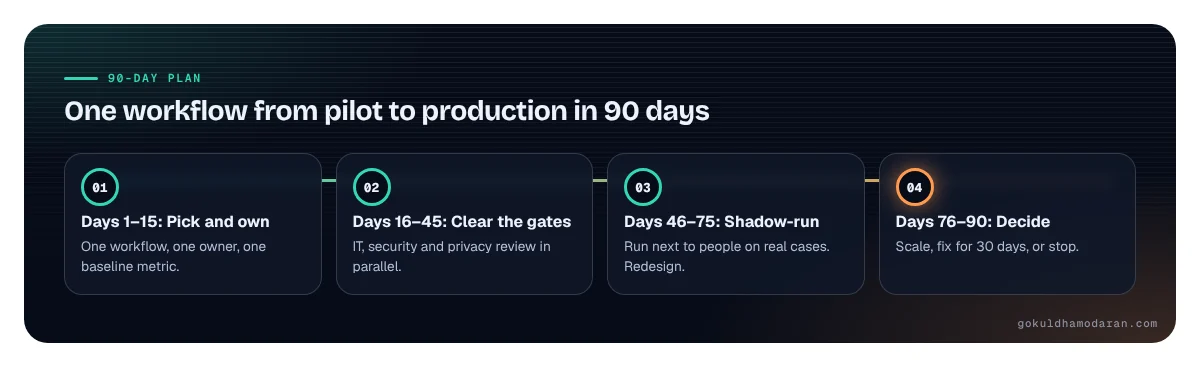
To move one AI workflow into production in 90 days, pick a single workflow, give it one owner and one metric, clear IT, security and privacy reviews in parallel during the first half, then shadow-run it against real cases and decide at day 90 whether to scale, fix or stop. One workflow moved from pilot to production teaches more than ten pilots.
- Days 1 to 15: pick and own. Choose a workflow that is high volume, tied to revenue or cost, low risk if wrong and fed by data you control. Name the owner, record the baseline and write down what would make you stop.
- Days 16 to 45: clear the gates in parallel. Submit the one-page intake to IT, security and the data protection officer on day 16, not day 80. While they review, fix only the data fields this workflow reads.
- Days 46 to 75: redesign and shadow-run. Run the AI next to the people who do the work today, on real cases. Compare accuracy, time and rework. Change the steps and approvals based on what you see.
- Days 76 to 90: measure and decide. Report the business metric against the baseline and the cost per task. Then make one of three calls: scale, fix for another 30 days, or stop.
One workflow from pilot to production in 90 days
- 01Days 1–15: Pick and ownOne workflow, one owner, one baseline metric.
- 02Days 16–45: Clear the gatesIT, security and privacy review in parallel.
- 03Days 46–75: Shadow-runRun next to people on real cases. Redesign.
- 04Days 76–90: DecideScale, fix for 30 days, or stop.
gokuldhamodaran.com
Good first workflows in B2B companies share a shape: lots of repetitive text, a clear right answer and a person who already checks the result. Examples:
- Order and quote email triage: classify incoming customer emails and draft the reply for a sales coordinator to approve.
- RFP and tender first drafts: draft answers from approved past responses, with a person reviewing every claim. Public tenders in the EU make this a high-volume job.
- Invoice and order exceptions: explain why a document failed matching in the ERP, so a clerk fixes it faster. Our guide to AI agents in ERP covers what’s in production there.
- Service ticket routing: read the ticket, pick the queue and draft the first response.
For high-volume, narrow tasks like these, a smaller model is often enough and cheaper to run. See small language models for enterprise for when that trade works.
How should CIOs measure AI adoption?
CIOs should measure AI adoption by the business outcome of each workflow in production, not by licenses or logins. Track the number of workflows that passed from pilot to production, and for each one a business metric against its baseline, the cost per task and the share of cases handled without a person redoing the work.
A short scorecard for the quarterly review:
- Workflows in production: the count that passed all reviews and run on live data.
- Outcome vs baseline: one metric per workflow, owned by the business.
- Cost per task: model, tooling and review time, divided by tasks done.
- Rework rate: how often a person has to redo the AI’s output.
- Time to production: days from intake to launch, which shows whether your reviews are getting faster.
AI adoption and usage numbers still matter, as early signals. They belong under the outcome, not on the slide in its place.
What should European B2B leaders do this quarter?
The change is clear: AI use in EU firms jumped from 8.1% to 20.0% in two years, and the leaders worldwide are twice as far into full implementation as everyone else. The consequence is that the gap compounds. Firms that ship one workflow learn how to ship the next one faster.
 Where production livesProduction AI runs where IT already keeps watch
Three moves for this week:
- List every AI pilot running in your company, with its owner and the business metric it’s meant to move. Any AI pilot with neither goes on a stop-or-own list.
- Pick one workflow for the 90-day plan above and name its owner by Friday.
- Book a 30-minute session with IT, security and your data protection officer to agree on the one-page intake.
If you’re also choosing which AI work tools to standardize on, my comparison of Claude vs Microsoft 365 Copilot covers the governance questions to ask first.
My read: 2026 is the year B2B companies stop counting pilots and start counting workflows in production. The model is the easy part. The owner, the data, the reviews and the redesigned work are the job. I write about this every week in my newsletter.
Frequently asked questions
What percentage of B2B companies use AI?
Most B2B companies use AI somewhere, but few have finished. McKinsey's 2026 B2B Pulse found 22% have fully implemented gen AI and another 31% are actively adopting it. In the EU, Eurostat counts 20.0% of enterprises with 10 or more employees using AI in 2025, from 42.0% in Denmark to 5.2% in Romania.
Why do AI pilots fail to reach production?
Pilots rarely fail on the model. They stall because nobody owns the outcome with a budget, the data doesn't agree across systems, IT and security see the project too late, the workflow isn't redesigned and success is measured in usage. Adobe and Incisiv found only about 14 of every 100 B2B AI ideas reach production.
Which AI use case should a B2B company start with?
Start with a high-volume text workflow that already has a person checking the result and data you control. Good examples are order and quote email triage, RFP first drafts from approved answers, ERP invoice exception notes and service ticket routing. Avoid starting with anything that sends output to customers without human review.
How long does it take to move an AI pilot into production?
One well-chosen workflow can reach a scale, fix or stop decision in about 90 days if reviews run in parallel. Spend the first two weeks on owner and baseline, the next month on IT, security and privacy review plus data fixes, a month shadow-running on real cases, and the last two weeks measuring.
Does the EU AI Act slow AI adoption in European B2B companies?
It adds review steps for some uses, alongside existing GDPR duties for personal data. The bigger brakes in the 2026 surveys are ownership, data quality and skills. Plan legal and privacy review into the first month instead of the last, and check which obligations apply to your use case with your legal team.
Sources
- McKinsey: The surprising economics of B2B growth (2026 Global B2B Pulse, May 28, 2026)
- McKinsey: The state of AI in 2026: On the road to ROI (Aug 25, 2026)
- Adobe: 2026 AI and Digital Trends in B2B Journey Orchestration (May 2026)
- Adobe and Incisiv: The State of AI Readiness in B2B Industries (Sep 3, 2026)
- Eurostat: 20% of EU enterprises use AI technologies (Dec 11, 2025)

Gokul Dhamodaran
I turn what is happening at the AI frontier into what it means for enterprise systems, and I build AI products myself (Euliv Analytics, Vantage). I write Leading Indicator every Friday: the AI and enterprise tech moves that matter, and what they mean for you.
Views are my own and do not represent any employer or client. Graphics are original; sources are linked.