The short answer
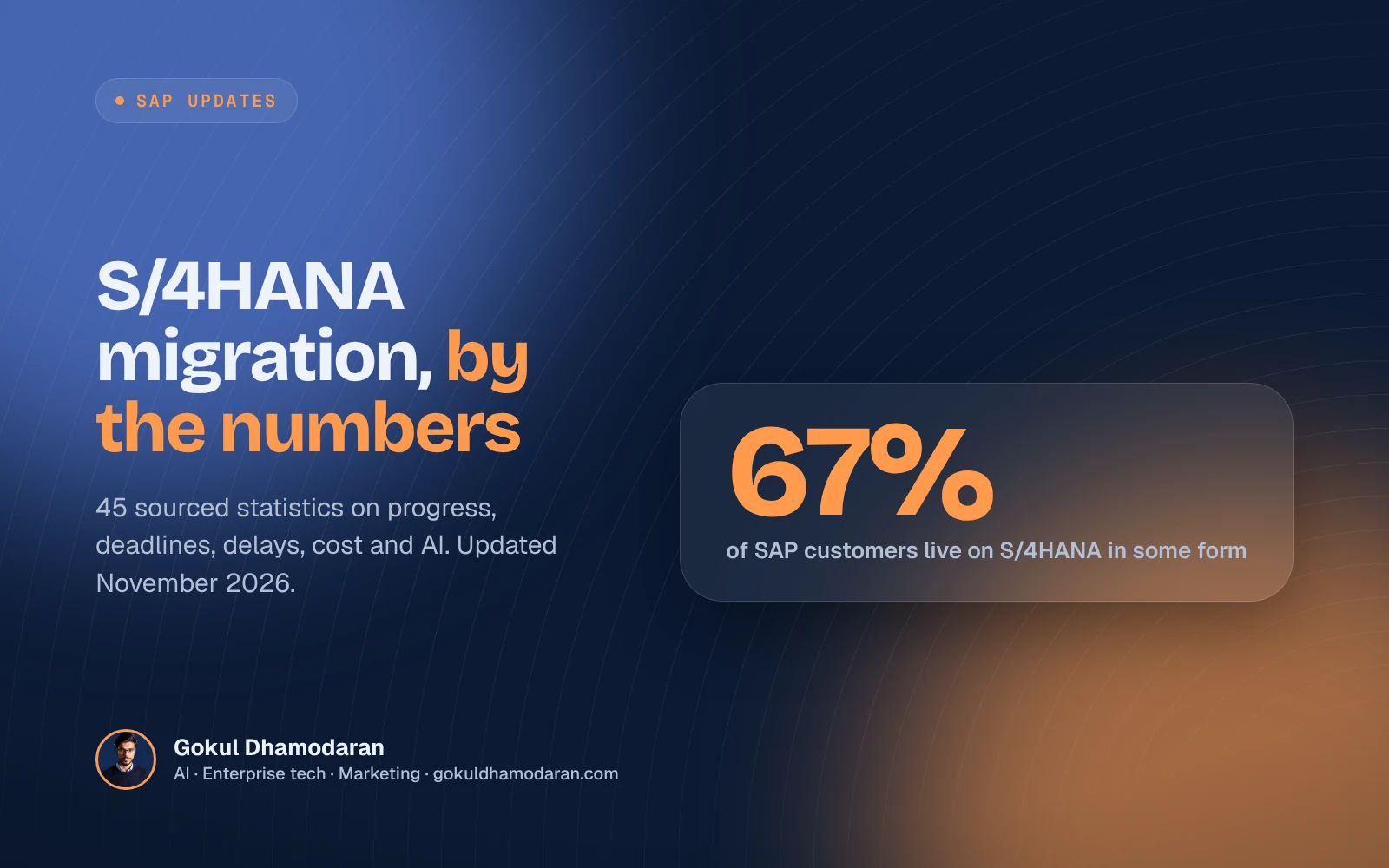
SAP S/4HANA migration statistics for 2026: 67% of SAP customers are fully or partially live on S/4HANA (Precisely and ASUG), but only 34% have fully switched (SAPinsider). Nearly 60% of migrations run late and over budget (ISG), and SAP ECC mainstream maintenance ends on December 31, 2027.
Key takeaways
- 67% of SAP customers are live on S/4HANA in some form. Only 34% have fully switched.
- Nearly 60% of SAP migrations run late and over budget. Just 15% land on both.
- Partners and integrators take the biggest slice of the budget: 37%.
- AI has overtaken the deadline as the top outside force on SAP plans: 43% vs 39%.
- Gartner expects nearly half of ECC customers to still be on ECC in 2027.
Updated November 2026. Every number below links to the study that produced it. Free to cite with a link to this page.
SAP S/4HANA migration statistics in one line: most SAP customers have now started, far fewer have finished, and most projects still run late and over budget. About two-thirds of SAP customers are live on S/4HANA in some form, yet only about a third have moved all their operations. With mainstream maintenance for SAP ECC ending on December 31, 2027, these are the numbers enterprise leaders, analysts and journalists keep asking for.
I have planned campaigns for SAP-focused enterprise solutions across North America, Europe and APAC, and the same question comes up in every region: “Where are companies like us?” This page answers it with the latest research from ASUG, Precisely, SAPinsider, ISG, Horváth, Gartner and SAP’s own results, grouped by the question you are probably trying to answer.
Key SAP S/4HANA migration statistics for 2026
These are the ten numbers that matter most right now. Each is explained, with its source and sample, further down the page.
| Statistic | Number | Source |
|---|---|---|
| SAP customers fully or partially live on S/4HANA | 67% | Precisely and ASUG, Nov 2026 |
| Organizations that have fully switched to S/4HANA | 34% | SAPinsider, Apr 2026 |
| SAP migrations behind schedule and over budget | Nearly 60% | ISG, Feb 2026 |
| SAP migrations on time and on budget | 15% | ISG |
| S/4HANA go-lives that ran on time in 2026 | 61% | ASUG, Oct 2026 |
| Average time to go live | About 1.4 years | ASUG, Oct 2026 |
| Share of migration budget spent on partners and integrators | 37% | ASUG, Oct 2026 |
| SAP customers naming budget constraints as their top challenge | 61% | ASUG Pulse, May 2026 |
| Top migration barrier: handling ECC customizations | 53% | Precisely and ASUG, Nov 2026 |
| SAP Cloud ERP Suite revenue growth, Q3 2026 | 29% | SAP, Oct 2026 |
One caution before you quote them: surveys ask different people different questions. A user group’s members are more engaged than the average SAP customer, so their adoption numbers run higher than Gartner’s estimates for the whole installed base. Read each number with its source.
How many SAP customers have migrated to S/4HANA?
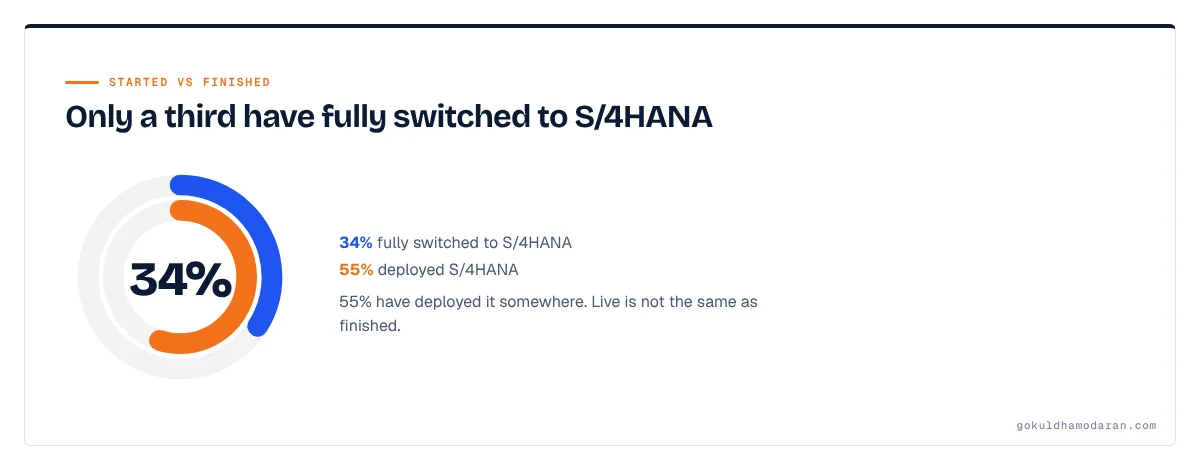
About two-thirds of SAP customers in user-group surveys are now live on S/4HANA or migrating, but only about a third have moved everything. Precisely and ASUG found 67% fully or partially live in November 2026, up from 59% a year earlier, while SAPinsider found that 55% had deployed S/4HANA but only 34% had fully switched.
SAP customers live on S/4HANA, 2024 to 2026
Fully or partially live
gokuldhamodaran.com
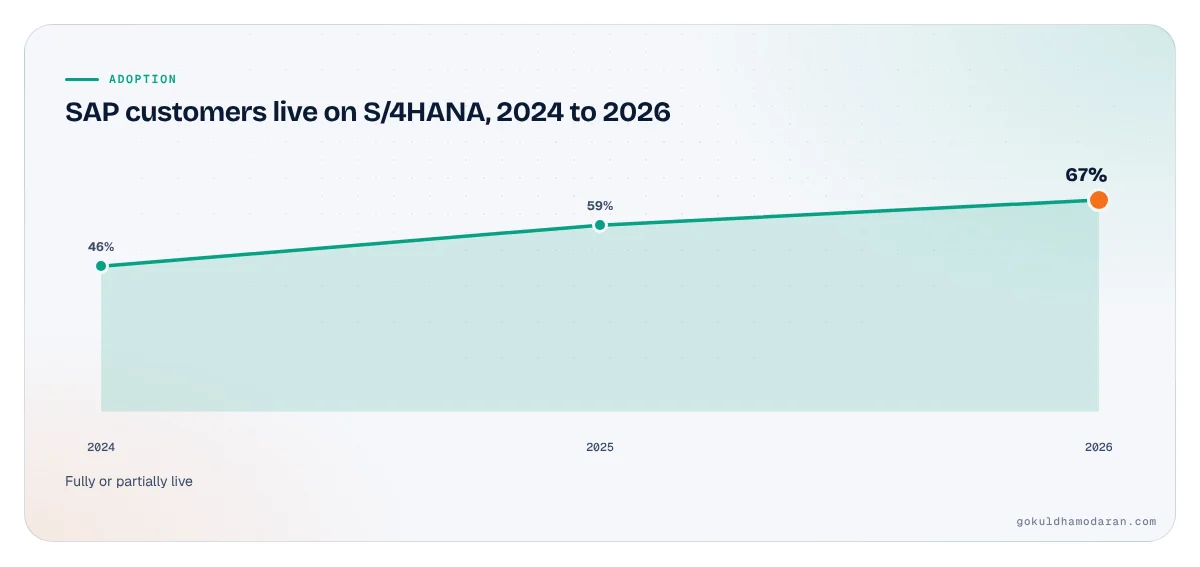
- 67% of organizations are fully or partially live on SAP S/4HANA, up from 59% in 2025. Only 1% have no plans to migrate. (Precisely and ASUG, Nov 2026, 169 SAP stakeholders)
- 59% were fully or partially live in late 2025, up 13 percentage points from 2024, which puts the 2024 figure at 46%. (Precisely and ASUG, Nov 2025, 173 stakeholders)
- 68% of ASUG members are live or in the process of moving from SAP ECC to S/4HANA, and 62% of those live are newcomers with less than three years on the system. (ASUG, Oct 2026, 194 members)
- 56% of SAP customers are live on S/4HANA or have begun migrating, up from 45% in 2024. (ASUG Pulse of the SAP Customer, via CIO, May 2026)
- 55% of SAPinsider respondents deployed S/4HANA or S/4HANA Cloud over the past year, but only 34% have fully transitioned all operations. (SAPinsider, Apr 2026)
- 39% of SAP’s roughly 35,000 ECC customers, about 14,000, had migrated to S/4HANA by the end of 2024, according to Gartner. (Gartner, via CIO, Jun 2025)
- 9% of SAP customers planned to wait more than two years to migrate in 2025, down from 22% in 2023. (ASUG Pulse, via CIO, May 2026)
The gap between “started” and “finished” is the real story. A company that is live in finance but still runs logistics on ECC counts as live in most surveys. If you are benchmarking your own program, compare against the fully switched number, not the headline.
Only a third have fully switched to S/4HANA
- 34% fully switched to S/4HANA
- 55% deployed S/4HANA
55% have deployed it somewhere. Live is not the same as finished.
gokuldhamodaran.com
When does SAP ECC support end? The 2027, 2030 and 2033 deadlines
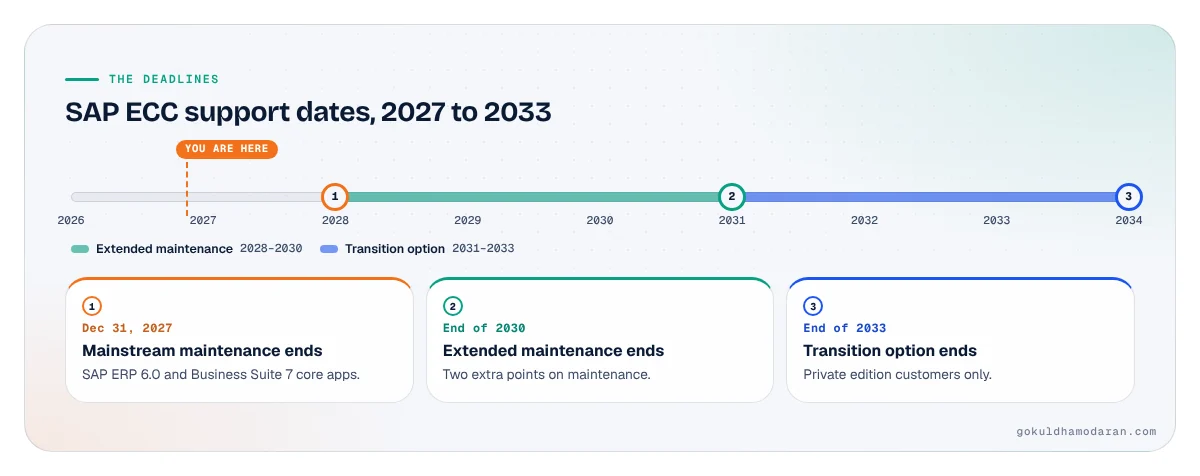
SAP ends mainstream maintenance for SAP ERP 6.0 (ECC) and the other Business Suite 7 core applications at the end of 2027. Extended maintenance runs from 2028 to the end of 2030 at two extra percentage points on the maintenance basis, and the SAP ERP, private edition, transition option stretches to 2033 for customers who move to a HANA-based private edition before the end of 2030.
- December 31, 2027: mainstream maintenance ends for SAP ERP 6.0 and other Business Suite 7 core applications, including CRM, SCM and SRM. (SAPinsider)
- 2028 to 2030: optional extended maintenance at a premium of two percentage points on the maintenance basis. (SAPinsider)
- 2031 to 2033: the SAP ERP, private edition, transition option, a subscription SAP says is not a maintenance extension, for systems moved to private edition before the end of 2030. (SAPinsider)
SAP ECC support dates, 2027 to 2033
- Extended maintenance 2028–2030
- Transition option 2031–2033
- 1Mainstream maintenance endsSAP ERP 6.0 and Business Suite 7 core apps.
- 2Extended maintenance endsTwo extra points on maintenance.
- 3Transition option endsPrivate edition customers only.
gokuldhamodaran.com
For the full plain-English breakdown of what stops and which bridge fits, read my guide to the SAP ECC end of maintenance 2027.
How many companies will miss the 2027 deadline?
Analysts expect roughly 40% to half of ECC customers to still run ECC after 2027. Gartner projects about 17,000 holdouts, nearly half the ECC base, by 2027 at the current pace, and more than a third, about 13,000, still on ECC in 2030. IDC and Forrester both put the share beyond 2027 at 40% or more.
- 17,000 ECC customers, nearly half the base, will still be holdouts by 2027 at the current migration rate, Gartner estimates. (Gartner, via CIO, Jun 2025)
- 13,000 ECC customers, more than a third, will remain on the legacy ERP in 2030, by the same estimate. (Gartner, via CIO)
- 40% to 45% of ECC users will remain on the older ERP through 2027, according to IDC. Forrester projects more than 40% beyond 2027. (IDC and Forrester, via CIO)
- 20,000 to 25,000 legacy SAP ERP customers are likely still unlicensed for S/4HANA, SAPinsider estimates. (SAPinsider, Apr 2026)
How many SAP migrations run over budget or behind schedule?
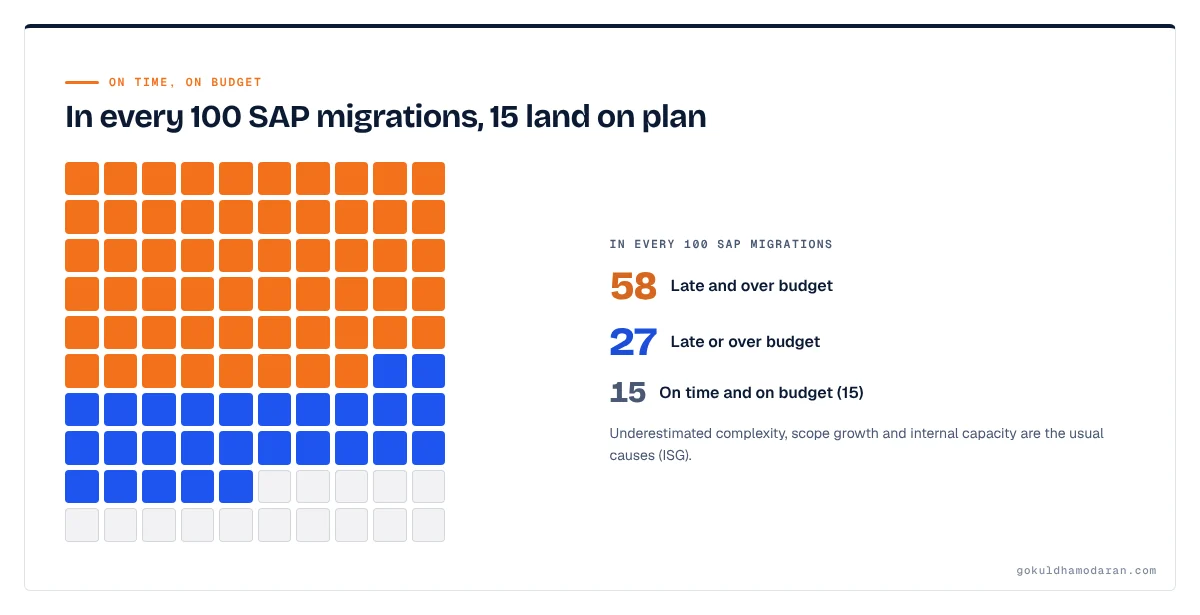
Most of them. ISG found that nearly 60% of SAP migrations are behind schedule and over budget, and only 15% land on time and on budget. Horváth found that projects take 30% longer than planned on average, and that fewer than one in ten completed projects stayed on schedule.
In every 100 SAP migrations, 15 land on plan
In every 100 SAP migrations
- 58Late and over budget
- 27Late or over budget
- 15On time and on budget (15)
Underestimated complexity, scope growth and internal capacity are the usual causes (ISG).
gokuldhamodaran.com
- Nearly 60% of SAP migrations are behind schedule and over budget, most often because of underestimated complexity, scope growth and internal capacity limits. (ISG, Feb 2026, 200+ senior decision-makers)
- 15% of SAP migrations are on time and on budget; 58% are over budget and behind schedule, and 27% are one or the other. (ISG Index Insider)
- 30% longer than planned: the average S/4HANA project overrun on schedule. (Horváth, Q1 2025, 200 companies)
- Fewer than 1 in 10 companies that completed the move stayed on schedule. (Horváth)
- 65% report strong to very strong quality deficits in the result. (Horváth)
- 61% of S/4HANA go-lives ran on time in 2026, up from 56% in 2025, among ASUG members. (ASUG, Oct 2026)
- 36% of ASUG members experienced delays. The top causes: business changes (55%), implementation complexity (45%), scope creep (42%), testing (37%) and data issues (34%). (ASUG, Oct 2026)
The two views fit together. Large, complex programs (ISG and Horváth sample big companies) slip far more often than the average user-group member’s project. The pattern behind the slips is the same in every study: scope and complexity found late.
How much does an SAP S/4HANA migration cost?
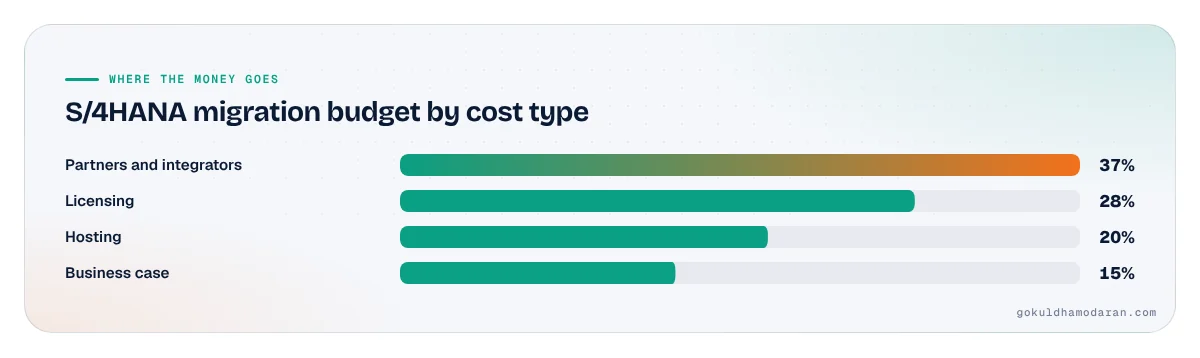
An S/4HANA migration can cost as little as $2 million or as much as $1 billion for a large, complex enterprise, according to Gartner. The biggest share of the budget goes to partners and systems integrators (37%), then licensing (28%), hosting (20%) and building the business case (15%), according to ASUG members.
- $2 million to $1 billion: the range of S/4HANA migration cost Gartner sees, from simple to large and complex enterprises. (Gartner, via CIO)
- 37% of the migration budget goes to partners and systems integrators, 28% to licensing, 20% to hosting and 15% to the business case. (ASUG, Oct 2026)
- 35% of ASUG members say costs are in line with expectations, 42% among newcomers. Only 3% are under budget. (ASUG, Oct 2026)
- 61% of SAP customers name budget constraints as their top challenge, 7 points more than a year earlier, and ASUG ties the pressure to S/4HANA projects. (ASUG Pulse, via CIO, May 2026)
- A quarter of transformed organizations heavily exceeded their budget, and another 40% strongly exceeded it. (Horváth)
Brownfield or greenfield: which approach are companies choosing?
Brownfield, converting the existing system, is the most common route. Among ASUG members, 47% chose brownfield, averaging 15.8 months, and 30% chose greenfield, averaging 20.2 months. ISG adds that fewer than one in five organizations truly re-implement their processes, and 49% do little or no re-engineering.
- 47% chose a brownfield conversion, averaging 15.8 months; 30% chose greenfield, averaging 20.2 months. (ASUG, Oct 2026)
- About 1.4 years is the average time to go live, and ROI arrives in just under 7 months after that. (ASUG, Oct 2026)
- Fewer than 1 in 5 organizations re-implement SAP processes and technology when they move. (ISG, Feb 2026)
- 49% carry out little or no re-engineering, keeping legacy processes and data. (ISG, Feb 2026)
That last pair matters for anyone counting on AI later. Agents and automation need clean processes and data; a lift-and-shift moves the old mess to a new address. I unpack what that means in practice in AI agents in ERP.
RISE with SAP and cloud: where are companies hosting S/4HANA?
Most migrations now run in the cloud, and RISE with SAP private edition is the most common subscription. Among ASUG members, 42% use RISE private edition, 9% RISE public edition and 9% GROW with SAP, and Horváth found that 75% of transformations rely on cloud hosting.
- 42% use RISE with SAP private edition, 9% RISE public edition and 9% GROW with SAP. (ASUG, Oct 2026)
- 37% host in a private cloud, 33% in a managed private cloud and 13% hybrid, down from 18% in 2025. (ASUG, Oct 2026)
- 50% run on Microsoft Azure, 46% on AWS (up 11% year over year), and 43% use a mix of hyperscalers. (ASUG, Oct 2026)
- 75% of S/4HANA transformations rely on cloud hosting: almost half private cloud, around 30% public cloud. (Horváth)
- 26% of SAPinsider respondents use S/4HANA Cloud, public or private edition. (SAPinsider, Apr 2026)
- 28% of SAP customers remain in hybrid cloud and on-premises scenarios. (ASUG Pulse, via CIO)
How is AI changing SAP S/4HANA migration plans?
AI has overtaken the deadline as the top outside force on SAP plans. In SAPinsider’s 2026 benchmark, 43% named SAP’s AI announcements as the main external factor shaping their ERP strategy, ahead of the 2027 maintenance deadline at 39%. Among ASUG members, 48% say AI is shaping their S/4HANA strategy.
- 43% named SAP’s AI announcements as the primary external factor affecting their ERP strategy; the 2027 deadline came second at 39%. (SAPinsider, Apr 2026)
- 48% say AI is shaping their S/4HANA strategy, and 22% call it a major factor in the business case or roadmap. (ASUG, Oct 2026)
- 31% are discussing SAP AI “without any meaningful strategy behind it.” (ASUG, Oct 2026)
- 46% feel very or somewhat prepared for AI in S/4HANA, 20% are still assessing and 23% feel unprepared. (ASUG, Oct 2026)
- 83% of organizations use some AI interface alongside SAP ERP processes (only 17% use none), led by Microsoft Copilot at 60%. Only 3% run fully automated, AI-driven processes. (Precisely and ASUG, Nov 2026)
Reading these together: AI is now a reason to move, but most companies have not yet decided what AI should do once they arrive. If that is your company, my explainer on SAP Joule is a good starting point.
What are the biggest SAP S/4HANA migration challenges?
Custom code and data are the hardest parts. Handling ECC customizations is the top migration challenge for 53% of SAP stakeholders, and 83% say master data cleansing is important to the migration. Business process change and integration follow close behind.
- 53% cite handling ECC customizations as their top migration challenge. (Precisely and ASUG, Nov 2026)
- 83% consider SAP master data cleansing important to migration. (Precisely and ASUG, Nov 2026)
- 49% named business process change as a major hurdle in the prior year’s survey. (Precisely and ASUG, Nov 2025)
- 48% of SAP customers cite integration as a challenge, and 35% struggle to get actionable insights from their data, up 8 points. (ASUG Pulse, via CIO)
- 37% say changing European compliance requirements are actively dictating their timelines. (SAPinsider, Apr 2026)
SAP’s own numbers: how fast is the cloud ERP business growing?
SAP’s results show the migration wave in its revenue. In the third quarter of 2026, Cloud ERP Suite revenue grew 29% to €5.92 billion, and the current cloud backlog, contracted cloud revenue for the next 12 months, rose 28% to €24.1 billion.
- €5.92 billion Cloud ERP Suite revenue in Q3 2026, up 29% (28% at constant currencies). (SAP Q3 2026 results)
- €24.1 billion current cloud backlog, up 28% (26% at constant currencies). (SAP Q3 2026 results)
- 89% of SAP’s cloud revenue now comes from the Cloud ERP Suite, according to its CFO. (SAP Q3 2026 earnings call)
What do these SAP S/4HANA migration statistics mean for your plan?
Three things stand out. First, you are not late if you have not finished: two-thirds of peers have not either. Second, the budget risk is real, and it sits mostly with partners and scope, so lock scope and partner capacity early. Third, decide what AI should do on the new system before you choose brownfield or greenfield, because that choice decides how much legacy you carry into it.
How we compiled these statistics
We include only numbers we could open at the original publisher or in a named trade report of it, published from 2025 onward, and we name the sample where the source gives one. Surveys from user groups (ASUG, SAPinsider) reflect engaged SAP customers; analyst estimates (Gartner, IDC, Forrester) cover the whole installed base. We update this page as new research lands. Spot a newer number? Tell me on the contact page.
Frequently asked questions
What percentage of SAP customers have migrated to S/4HANA?
It depends on who you ask. User-group surveys put it at about two-thirds live in some form: 67% fully or partially live (Precisely and ASUG, November 2026). Only about a third have moved everything: 34% fully switched (SAPinsider, 2026). Gartner estimated 39% of the roughly 35,000 ECC customers had migrated by the end of 2024.
How many SAP S/4HANA migrations fail or go over budget?
ISG found that nearly 60% of SAP migrations are behind schedule and over budget, and only 15% are on time and on budget. Horváth found projects take 30% longer than planned on average, and 65% of companies report strong quality deficits in the result. Few migrations fail outright; most finish late and cost more.
How long does an SAP S/4HANA migration take?
About 1.4 years on average to go live among ASUG members in 2026. Brownfield conversions averaged 15.8 months and greenfield implementations 20.2 months. Large, complex programs take longer: Gartner has seen migration plans of three to seven years.
What is the biggest cost in an S/4HANA migration?
Partners and systems integrators. ASUG members spend 37% of their migration budget on them, followed by licensing (28%), hosting (20%) and building the business case (15%). Gartner puts total costs between about $2 million and $1 billion, depending on size and complexity.
Is it too late to start an SAP S/4HANA migration before 2027?
For a full migration, finishing before December 31, 2027 is unlikely if you have not started, since go-lives average about 1.4 years. Extended maintenance to 2030, at two extra points on maintenance, and the 2031 to 2033 transition option for private edition give you a bridge. Choose it deliberately rather than by default.
Sources
- Precisely and ASUG: SAP automation trends for 2027 (Nov 4, 2026)
- Precisely and ASUG: 2026 trends in SAP automation, modernization and BTP adoption (Nov 2025)
- ASUG via diginomica: Navigating SAP S/4HANA, progress, opportunities and the path to value (Oct 6, 2026)
- CIO: SAP customers say migration is eating their budgets (ASUG Pulse 2026, May 12, 2026)
- SAPinsider: SAP S/4HANA ERP migration trends 2026 (Apr 2, 2026)
- SAPinsider: SAP support deadlines 2027, 2030 and 2033
- ISG: Firms moving to SAP S/4HANA prioritize short-term stability (Feb 2, 2026)
- ISG Index Insider: Only 15% of SAP migrations are on time and on budget
- Horváth: SAP S/4HANA transformations rarely go as planned (survey Q1 2025)
- CIO: Nearly half of SAP ECC customers may stick with legacy ERP beyond 2027 (Gartner, IDC, Forrester; Jun 4, 2025)
- SAP: Q3 2026 results (Oct 21, 2026)
- SAP Q3 2026 earnings call transcript (Oct 21, 2026)

Gokul Dhamodaran
I turn what is happening at the AI frontier into what it means for enterprise systems, and I build AI products myself (Euliv Analytics, Vantage). I write Leading Indicator every Friday: the AI and enterprise tech moves that matter, and what they mean for you.
Views are my own and do not represent any employer or client. Graphics are original; sources are linked.