The short answer
The SAP ECC end of maintenance 2027 deadline means SAP stops mainstream maintenance for ECC 6.0 (enhancement packages 6 to 8) on December 31, 2027. The system keeps running. After that you can pay about two extra points for extended maintenance to 2030, convert to S/4HANA, move with RISE with SAP, or fall into customer-specific maintenance with no legal updates.
Key takeaways
- On Dec 31, 2027 ECC keeps running. Legal updates and new fixes are what stop.
- A typical S/4HANA migration takes 15 to 20 months. Not started? You need a bridge.
- Extended maintenance to 2030 costs two extra points on your maintenance fee.
- The 2031–2033 RISE transition option is for very large landscapes only.
- The deadline rarely stalls. Unowned decisions do. Name an owner for each one.
The SAP ECC end of maintenance 2027 deadline is not a shutdown. On December 31, 2027, nothing switches off. What ends is SAP’s mainstream maintenance, and with it the legal updates and fixes that finance, payroll and supply chain teams take for granted. So the real question is not “migrate or not.” It is which bridge you stand on while you get there.
I have planned campaigns for SAP-focused enterprise solutions across North America, Europe and APAC, so I have seen this decision from the partner side. The pattern is the same in every region. The deadline creates urgency, but projects stall because nobody owns the call. This guide explains the deadline in plain English, the three paths that are left, and a 14-month plan with an owner for each decision.
What does SAP ECC end of maintenance 2027 actually mean?
SAP ECC end of maintenance 2027 means SAP ends mainstream maintenance for SAP ERP 6.0 (ECC) on enhancement packages 6, 7 and 8 on December 31, 2027. Your system keeps running and your licenses stay valid. What changes is what SAP delivers: from 2028 you either pay for extended maintenance or move to customer-specific maintenance, which gives you far less.
SAP set this date in its February 2020 maintenance announcement. Systems on older enhancement packages (0 to 5) already left mainstream maintenance at the end of 2025, according to SAP’s own timeline for ERP 6.0. Do not plan around another delay. In January 2025, CEO Christian Klein said the 2027 date “will not be changed,” as The Register reported.
If you do nothing, you land in customer-specific maintenance. SAPinsider’s October 2026 breakdown lists what that means:
- No new support packages or legal-change updates. Tax, payroll and e-invoicing rule changes become your job.
- Paid problem solving. Fixes for issues not already known to SAP are charged.
- No security commitment. SAP’s commitment to fix new high-severity vulnerabilities covers mainstream and extended maintenance, not this stage.
That third point is the one to bring to your CISO. The first is the one to bring to tax. In Germany, for example, mandatory B2B e-invoicing extends to all businesses in January 2028, one month after mainstream maintenance ends.
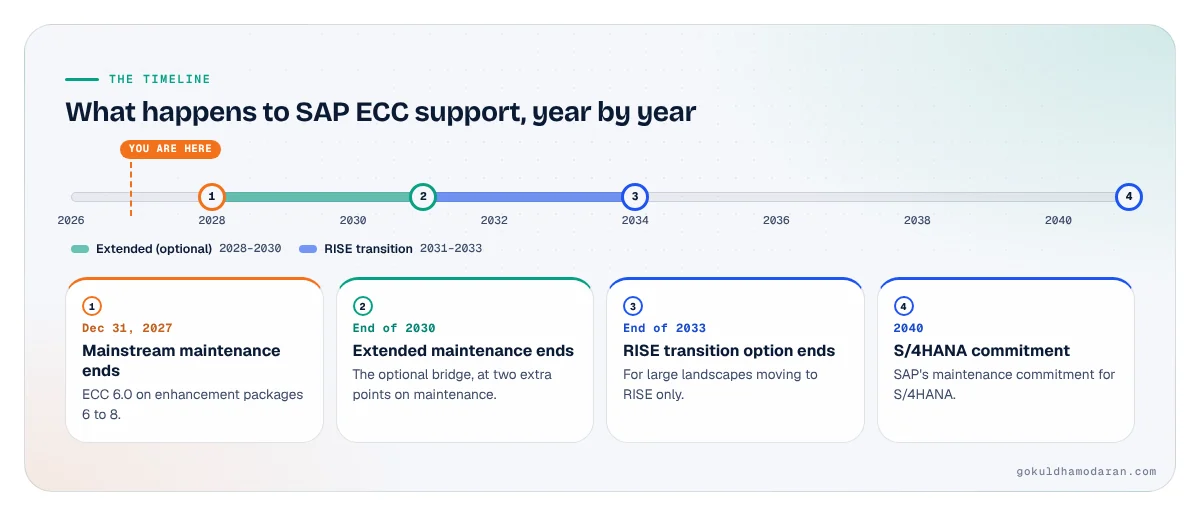
What happens to SAP ECC support, year by year
- Extended (optional) 2028–2030
- RISE transition 2031–2033
- 1Mainstream maintenance endsECC 6.0 on enhancement packages 6 to 8.
- 2Extended maintenance endsThe optional bridge, at two extra points on maintenance.
- 3RISE transition option endsFor large landscapes moving to RISE only.
- 4S/4HANA commitmentSAP's maintenance commitment for S/4HANA.
gokuldhamodaran.com
How many companies are still running ECC?
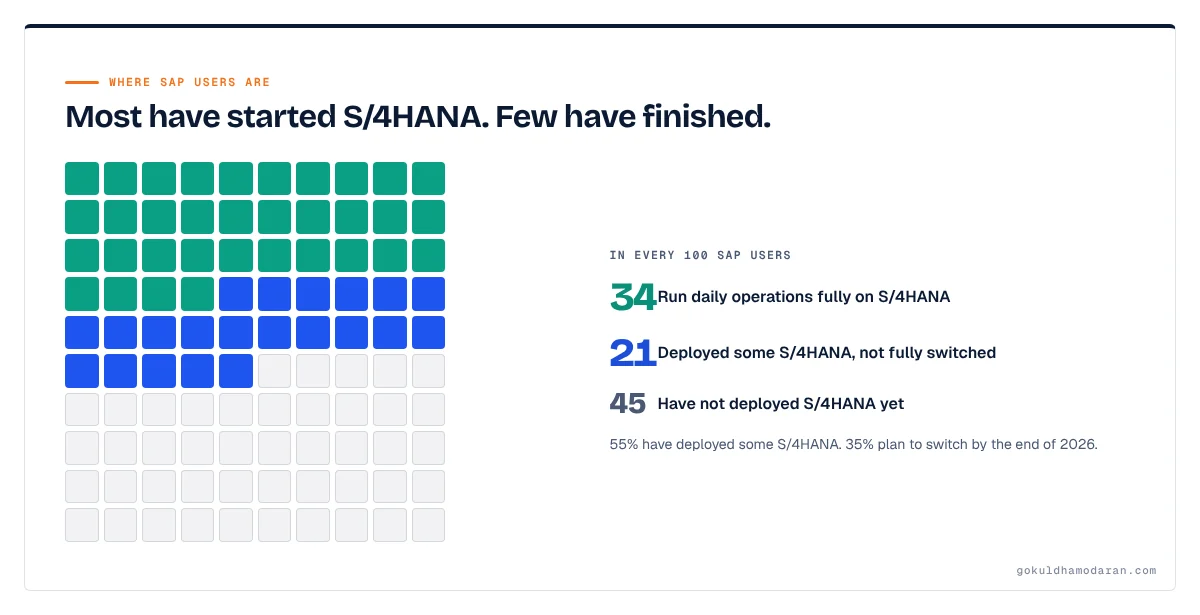
Most of the market is still mid-move. Gartner figures reported by The Register in March 2025 showed about 61% of roughly 35,000 ECC customers had not yet licensed S/4HANA at the end of 2024. SAPinsider’s 2026 benchmark of 296 SAP users found 55% have deployed some version of S/4HANA, but only 34% have fully switched daily operations to it.
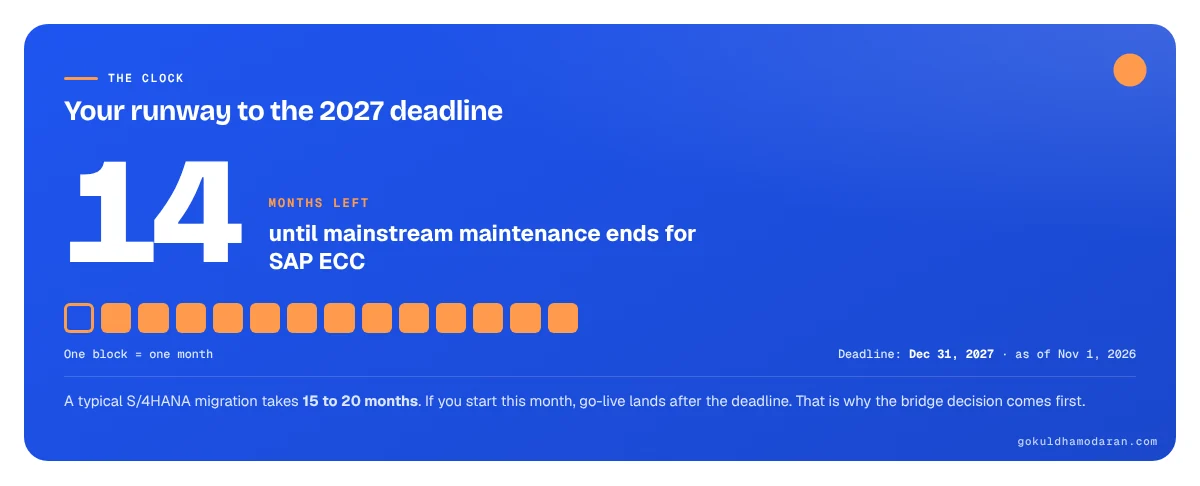
Here is why that matters for your plan. The same SAPinsider analysis puts a typical S/4HANA migration at 15 to 20 months. Start one this month and go-live lands between February and July 2028, after mainstream maintenance ends. Every company still deciding will compete for the same partners, architects and testers in 2027. If you have not started, you will almost certainly need a bridge. Pick it on purpose.
Most have started S/4HANA. Few have finished.
In every 100 SAP users
- 34Run daily operations fully on S/4HANA
- 21Deployed some S/4HANA, not fully switched
- 45Have not deployed S/4HANA yet
55% have deployed some S/4HANA. 35% plan to switch by the end of 2026.
gokuldhamodaran.com
What are your real options after 2027?
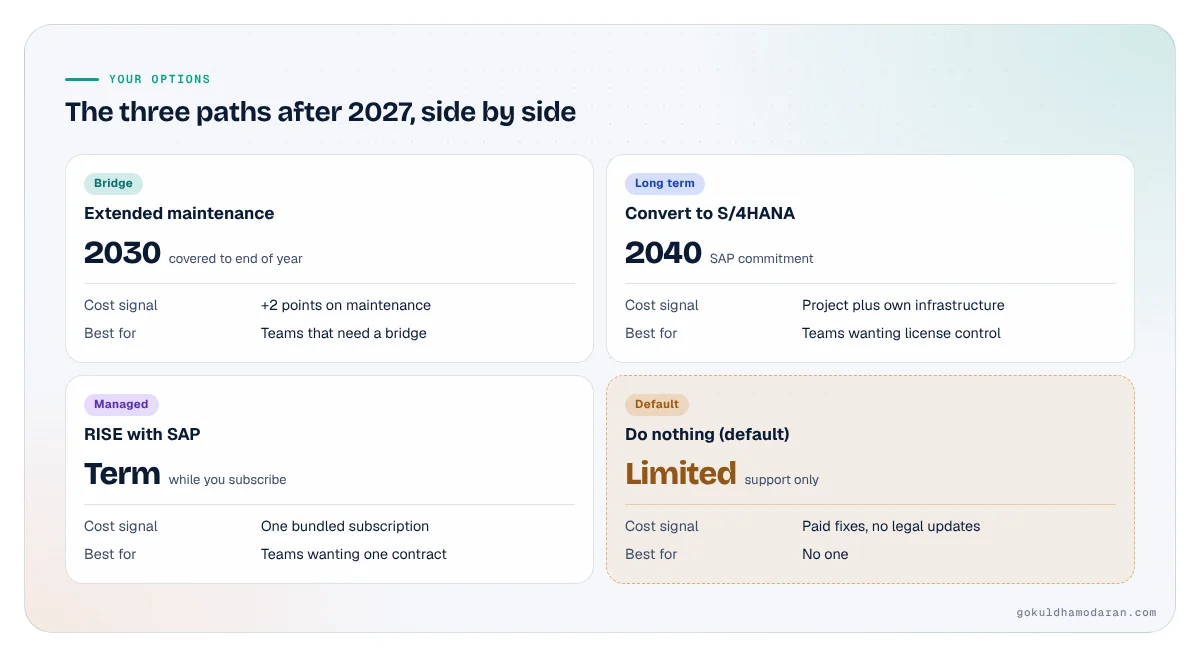
You have three real paths and one default. Pay for extended maintenance to 2030 and keep ECC for now. Convert to S/4HANA under a license you own. Or move with RISE with SAP, a subscription that bundles the software, hosting and services. The default, customer-specific maintenance, is what happens when no one decides.
Path 1: Extended maintenance to 2030
Extended maintenance keeps ECC covered from 2028 through the end of 2030 at “a premium of two percentage points” on your existing maintenance basis, per SAP. Scope is similar to mainstream maintenance, but SAP adds no new features. It covers core Business Suite 7 applications only, so check every add-on you rely on.
Path 2: Convert to S/4HANA
A conversion moves you to S/4HANA on-premise or in a hosted private setup you control. SAP has committed to maintain S/4HANA until the end of 2040. You keep license ownership and more control over timing, but you carry the infrastructure and the upgrade cycle yourself.
Path 3: RISE with SAP
RISE with SAP is SAP’s bundled subscription: cloud ERP, hosting on SAP or a hyperscaler such as AWS or Google, and transition services under a single contract. TechTarget describes it as ERP as a service. It suits teams that want one accountable vendor and predictable spend, and it is the only route to the 2031–2033 transition option covered below.
One more lever exists. Under SAP support commitments effective July 10, 2026, customers can choose a different SAP support model or a different provider for each installation, and SAP waived its reinstatement fee, per SAPinsider. That makes third-party support a real option for some systems. Weigh it against the loss of SAP legal updates before you sign.
The three paths after 2027, side by side
Extended maintenance
Convert to S/4HANA
RISE with SAP
Do nothing (default)
gokuldhamodaran.com
Is SAP extended maintenance to 2030 worth the premium?
For most companies that have not started migrating, yes. Extended maintenance is the cheapest way to buy time. Two extra points on a 22% Enterprise Support rate is roughly a 9% higher maintenance bill, as UpperEdge calculates. Compare that with rushing a 15 to 20 month project into 14 months, or running payroll and tax without legal updates.
The catch is scope and intent. UpperEdge reads the offer as built for customers in a longer conversion to S/4HANA, and non-core applications may fall to customer-specific maintenance. Treat extended maintenance as a bridge with a fixed far end, not as a new home. Set your go-live date first, then buy only the bridge you need to reach it.
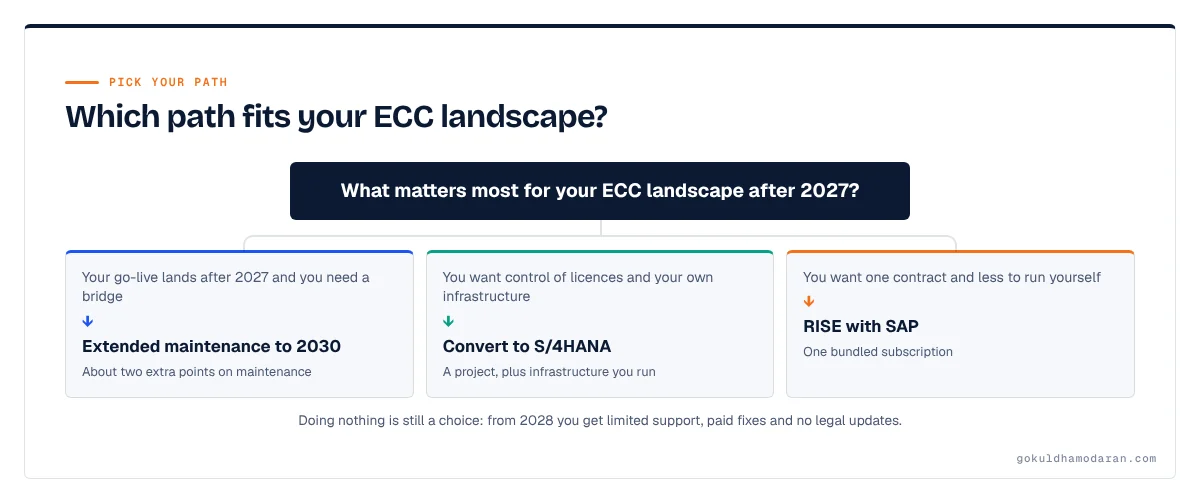
Which path fits your ECC landscape?
What matters most for your ECC landscape after 2027?
- Your go-live lands after 2027 and you need a bridgeExtended maintenance to 2030About two extra points on maintenance
- You want control of licences and your own infrastructureConvert to S/4HANAA project, plus infrastructure you run
- You want one contract and less to run yourselfRISE with SAPOne bundled subscription
Doing nothing is still a choice: from 2028 you get limited support, paid fixes and no legal updates.
gokuldhamodaran.com
What is the 2033 RISE transition option, and who gets it?
The SAP ERP, private edition, transition option is a time-bound subscription that keeps ECC supported from 2031 to 2033 for very large, complex landscapes moving through RISE with SAP. It is not an extension of the 2027 or 2030 dates. Klein said it is meant for “very few large customers.”
The prerequisites in SAP’s own update rule out most companies:
- Move to SAP ERP, private edition on SAP HANA before December 31, 2030.
- A minimum system size of 2 TB.
- The max success plan, charged on top of the price.
- A 20% uplift when switching in 2031 for customers who signed in 2026. Pricing for 2027 sign-ups is not yet disclosed.
SAP updated that page on October 13, 2026 to say subscriptions may run to December 31, 2035 with further prerequisites. If you are a large global SAP shop, ask your account team about it in writing. If you are mid-market, plan as if it does not exist.
The 14-month plan: Inventory, Decide, Contract, Execute
This is the plan I would hand a leadership team today, November 2026. It works for any of the three paths because it forces the go-live date first and the bridge second.
Your runway to the 2027 deadline
months left
until mainstream maintenance ends for SAP ECC
One block = one monthDeadline: Dec 31, 2027 · as of Nov 1, 2026
A typical S/4HANA migration takes 15 to 20 months. If you start this month, go-live lands after the deadline. That is why the bridge decision comes first.
gokuldhamodaran.com
- Inventory (November to December 2026). Confirm your enhancement package level, list custom code and add-ons, check database and OS support dates, and pull every SAP contract renewal date. Name one executive owner for the program.
- Decide (January to February 2027). Set a realistic go-live date with a partner estimate. Choose the path: extended maintenance plus conversion, RISE with SAP, or a staged mix. Get the business case signed by finance.
- Contract (March to June 2027). Sign the bridge (extended maintenance or another support model), lock partner capacity, and agree data, testing and cutover resourcing. Partner calendars tighten as 2027 goes on.
- Execute (July to December 2027). Start build, clean master data, and close compliance gaps that customer-specific maintenance would expose, such as e-invoicing and payroll changes. Review progress monthly against the go-live date, not the deadline.
Who in the buying group owns each decision?
An ECC decision is a buying group decision, not an IT ticket. In my experience on the marketing side of SAP-focused solutions, deals moved when each role got the proof it needed and stalled when one role was left out. Use this map to assign owners inside your company. If you sell into SAP customers, use it to plan your messages.
 Beyond ITThe deadline is an IT date. The impact is not.
| Decision | Owner | What they need to see |
|---|---|---|
| Path and go-live date | CIO | A partner estimate and a bridge that covers the gap |
| Business case and budget | CFO | Three-year cost of each path, including the maintenance premium |
| Contract terms | Procurement | Renewal dates, support options and the July 2026 terms |
| Process scope | Finance, supply chain and HR process owners | What changes in daily work, and when |
| Compliance risk | Tax, legal and CISO | Which legal and security updates stop under each path |
For marketers at SAP partners, this is the opening. Most competitor content sells the migration. Few pieces help the CFO compare bridges or help tax see what stops. I covered how to map and reach a full buying group in my guide to building an account-based marketing program; the same method applies here, with five roles instead of one champion.
What should you do this week?
- Find your enhancement package level. If it is below 6, mainstream maintenance already ended in 2025.
- Write down your go-live date. If no one can give one, that is your first decision.
- Book a 30-minute owners meeting. CIO, CFO, procurement and tax in one room, with the table above on screen.
Fourteen months is enough time to make a calm, well-priced decision. It is not enough time to make it next spring. For more plain-English breakdowns of SAP changes and B2B growth, join my newsletter or see my work and background.
Frequently asked questions
Will SAP ECC stop working after December 31, 2027?
No. ECC keeps running and your licenses remain valid. What ends is mainstream maintenance. Without extended maintenance, you move to customer-specific maintenance: no new legal-change updates, paid fixes for unknown issues, and no commitment to patch new high-severity security vulnerabilities.
How much does SAP extended maintenance to 2030 cost?
SAP charges a premium of two percentage points on your existing maintenance basis for core Business Suite 7 applications. On a 22% Enterprise Support rate, that works out to roughly a 9% higher annual maintenance bill. Non-core applications may not be covered, so check each add-on.
Is the 2027 SAP deadline going to be extended again?
SAP says no. CEO Christian Klein said in January 2025 that the 2027 end of mainstream maintenance will not be changed. The 2031 to 2033 transition option is a separate RISE subscription for very large landscapes, not a general extension.
How long does an S/4HANA migration take?
Benchmark research cited by SAPinsider puts a typical S/4HANA migration at 15 to 20 months. A project that starts in late 2026 would usually go live in 2028, which is why most companies that have not started will need extended maintenance or another bridge.
What is the difference between RISE with SAP and an S/4HANA conversion?
A conversion moves you to S/4HANA under a license you own, on infrastructure you run or choose. RISE with SAP is a subscription that bundles cloud ERP, hosting and transition services in one contract. RISE is also the only route to SAP's 2031 to 2033 transition option.
Sources
- SAP News: SAP extends innovation commitment for S/4HANA, provides clarity on Business Suite 7 (Feb 2020)
- SAP Community: Maintenance timelines for SAP ERP 6.0
- SAP News: Updates for SAP ERP, private edition, transition option (updated Oct 2026)
- SAPinsider: What SAP support covers after 2027 and what customers carry (Oct 2026)
- SAPinsider: ECC to S/4HANA migration status, 2026 benchmark
- The Register: SAP extends support deadline, but only via RISE (Jan 2025)
- The Register: SAP sees little progress in ECC migrations, citing Gartner (Mar 2025)
- UpperEdge: SAP extends maintenance options to 2030, but the devil is in the details
- TechTarget: RISE with SAP vs. S/4HANA Cloud

Gokul Dhamodaran
I turn what is happening at the AI frontier into what it means for enterprise systems, and I build AI products myself (Euliv Analytics, Vantage). I write Leading Indicator every Friday: the AI and enterprise tech moves that matter, and what they mean for you.
Views are my own and do not represent any employer or client. Graphics are original; sources are linked.