This is the FY2026 ranking of the top 10 Indian IT companies by revenue, from TCS to LTTS, with growth, margins and what sets each one apart. If you are weighing how AI agents change the work these firms sell, start with how AI changes software development roles.
India’s information technology industry is one of the most remarkable economic success stories of the modern era. From a modest beginning providing low-cost software services in the 1990s, the Indian IT sector has grown into a global powerhouse generating over $254 billion in annual export revenue, employing 5.4 million technology professionals, and competing with — and frequently beating — global technology giants for the world’s most complex enterprise transformation engagements.
Quick answer: The biggest IT company in India is Tata Consultancy Services (TCS), with $30.0 billion in revenue in FY2026, the year to March 31, 2026. Infosys ($20.2 billion), HCLTech ($14.7 billion), Wipro ($10.5 billion in IT services) and Tech Mahindra ($6.4 billion) complete the top five. Among the top 10, the fastest growers were Coforge (+29.2%) and Persistent Systems (+17.4%).
This ranking of the top Indian IT companies evaluates each one by global revenue, workforce scale, service specialisation, geographic reach, financial strength, and analyst positioning — giving you the most complete picture of the Indian IT landscape available.
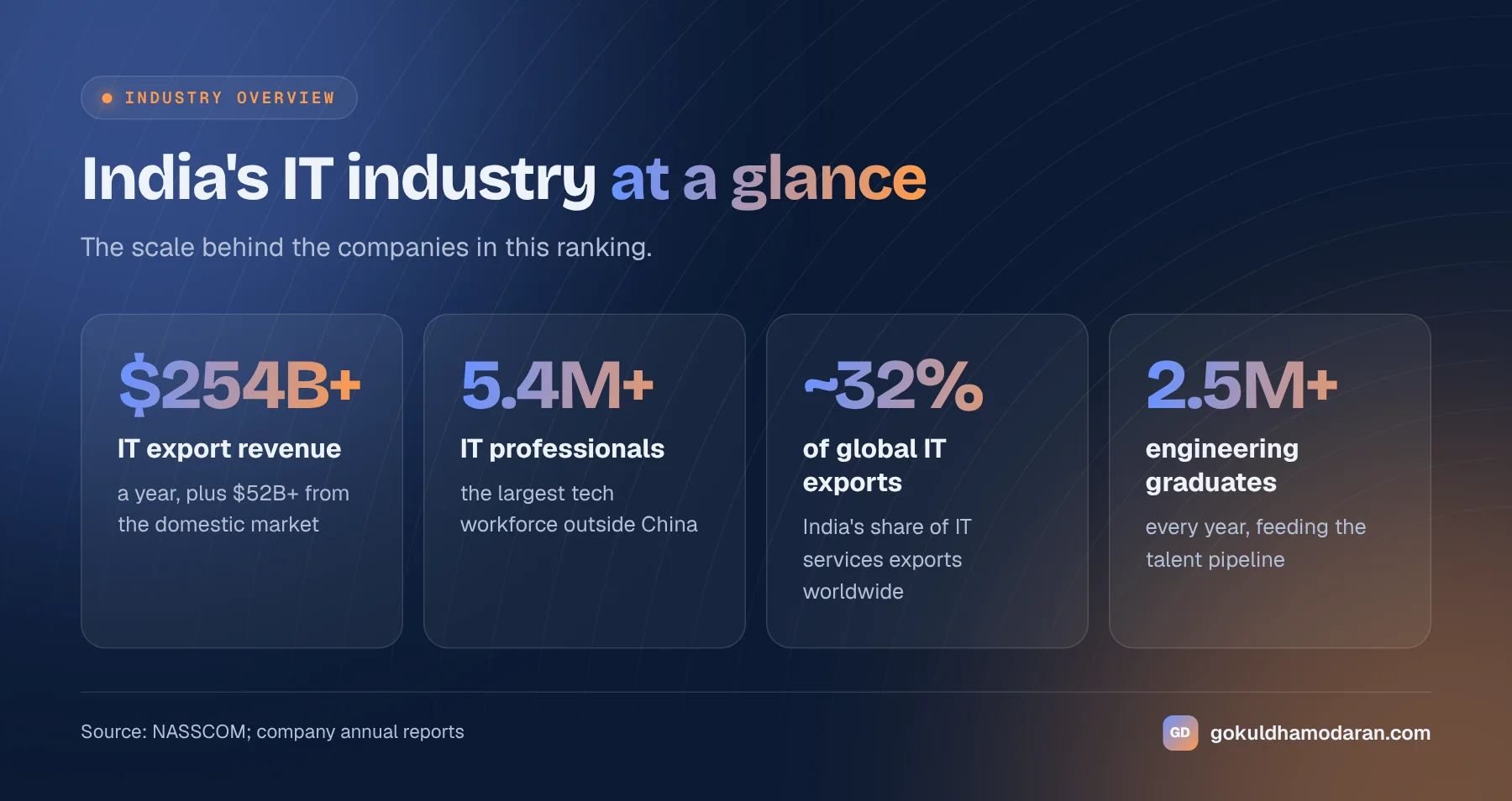
Industry Overview: India’s Top IT Companies — Key Industry Statistics (NASSCOM, Company Annual Reports)
Why Indian IT Companies Dominate Global Technology Services
The dominance of Indian IT companies in global technology services is not accidental — it is the result of four structural advantages that have compounded over three decades: an unmatched pipeline of STEM graduates, a cost-quality ratio that Western alternatives cannot replicate, English-language fluency across the talent base, and a time-zone that enables round-the-clock delivery for clients in the Americas and Europe.
| Structural Advantage | India’s Position | Global Impact |
| STEM Graduate Pipeline | India produces 2.5M+ engineering graduates annually — more than USA and Europe combined | Largest English-speaking technology talent pool in the world |
| Cost Competitiveness | Indian IT salaries are 5-8x lower than US equivalents for comparable skills | Enables 40-60% cost reduction for clients vs on-shore delivery |
| English Language Proficiency | India has the world’s second-largest English-speaking population (125M+ speakers) | Zero language barrier for US, UK, Australian, and Canadian clients |
| Time Zone Advantage | IST (UTC+5:30) enables real-time overlap with US afternoons and European mornings | Follow-the-sun delivery model gives 20-24hr development cycles |
| Process Maturity | Indian IT firms pioneered the Capability Maturity Model (CMM) — industry gold standard | Highest concentration of CMM Level 5 certified organisations globally |
| Domain Depth | 30+ years of BFSI, healthcare, retail, and manufacturing project experience | Institutional knowledge across every major industry vertical |
| Government Support | NASSCOM, SEZs (Special Economic Zones), and PLI schemes support sector growth | Favourable tax and regulatory environment for IT exports |
Table 1: Why Indian IT Companies Lead Global Technology Services — 7 Structural Advantages
Top Indian IT Companies — Revenue and Workforce
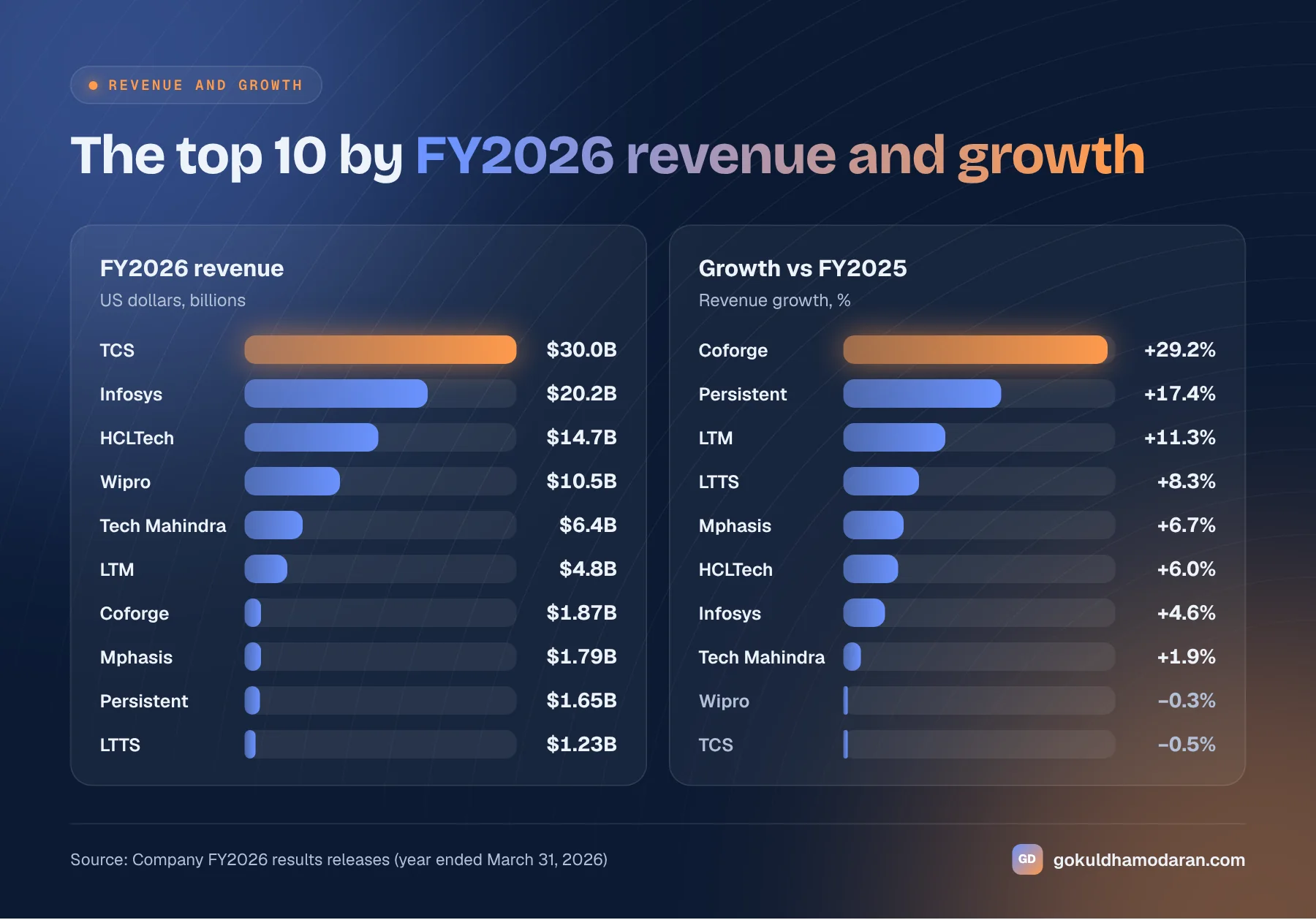
Figure 1: Top 10 Indian IT Companies — Annual Revenue (USD Billion) and Employee Count
Top 10 Indian IT Companies by Revenue (FY2026)
| Rank | Company | FY2026 revenue (USD) | Growth vs FY2025 | HQ |
| 1 | Tata Consultancy Services (TCS) | $30.0B | −0.5% | Mumbai |
| 2 | Infosys | $20.2B | +4.6% | Bengaluru |
| 3 | HCLTech | $14.7B | +6.0% | Noida |
| 4 | Wipro (IT services) | $10.5B | −0.3% | Bengaluru |
| 5 | Tech Mahindra | $6.4B | +1.9% | Pune |
| 6 | LTM (formerly LTIMindtree) | $4.8B | +11.3% | Mumbai |
| 7 | Coforge | $1.87B | +29.2% | Noida |
| 8 | Mphasis | $1.79B | +6.7% (cc) | Bengaluru |
| 9 | Persistent Systems | $1.65B | +17.4% | Pune |
| 10 | L&T Technology Services | $1.23B | +8.3% | Vadodara |
Table 2: Top 10 Indian IT companies by FY2026 revenue (year ended March 31, 2026), from each company’s results release. Growth is in reported US dollars unless marked cc (constant currency). Hexaware reports on a calendar year, so it isn’t compared here.
Revenue Growth and Market Share
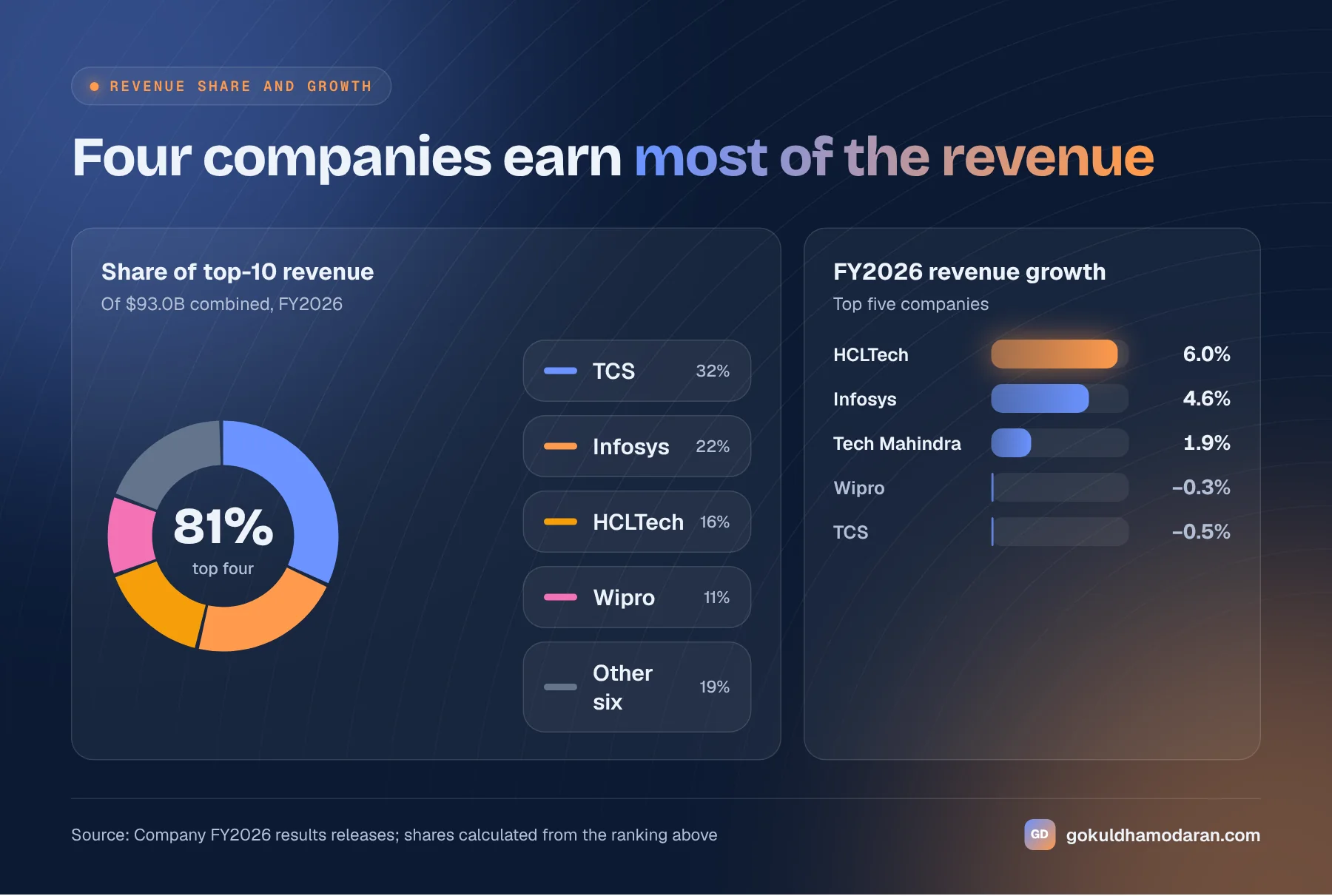
Figure 2: Top 4 Indian IT Companies — Market Share Distribution and Revenue Growth Trajectory
Deep Dive: Top 5 Indian IT Companies
The profiles below draw on each company’s FY2025 annual report. For the latest revenue ranking, see the FY2026 table above.
1. Tata Consultancy Services (TCS) — India’s IT Crown Jewel
TCS is not just India’s largest IT company — it is one of the world’s most valuable IT services organisations by market capitalisation, consistently valued above $170 billion. The company’s scale, client loyalty (it counts 57 clients generating over $100M annually), and operational efficiency set it apart in the global IT landscape.
Pros
- Largest Indian IT company by revenue ($29.1B) and employees (614K)
- Industry-leading client retention — 57 clients with $100M+ annual TCS revenue
- Consistent net profit margins of ~19-20% — among the best in sector
- Strong presence across all major industries and geographies
- TCS BaNCS, TCS iON — proprietary products adding recurring revenue
- Lowest attrition rate in the industry at ~12.5%
Cons
- Revenue growth has moderated — single-digit growth in recent quarters
- Perceived as conservative in acquisitions vs Infosys and Wipro
- Heavy dependence on North America (55%+ of revenue)
- Scale creates some organisational inertia for rapid pivots
- Premium pricing vs smaller Indian IT players
2. Infosys — The Digital Transformation Leader
Infosys has successfully repositioned from a traditional IT services company to a digital transformation leader. Its Infosys Cobalt (cloud services), Infosys Topaz (AI services), and Living Labs platform have attracted premium-rate digital engagements that consistently drive higher revenue per employee than TCS or Wipro.
Pros
- Highest revenue per employee ($59K) — reflects premium digital positioning
- Cobalt (cloud) and Topaz (AI) platforms drive premium-priced engagements
- Strongest net profit margin in tier-1 Indian IT at 21.4%
- Most diversified client base — 1,800+ active clients across all industries
- Infosys Institute thought leadership builds brand premium globally
Cons
- Smaller workforce than TCS — scale limits pursuit of very large deals
- Historical management instability has occasionally disrupted execution
- Revenue growth slower than aspirational targets in recent periods
- Less diversified geographically than TCS or Wipro
- Wage inflation pressure from talent competition with global tech giants
3. HCL Technologies — The Engineering Services Specialist
HCL Technologies has carved a distinctive position through its engineering services and software products business — a segment that commands higher margins and greater client stickiness than traditional IT outsourcing. Its Mode 3 strategy (products and platforms) generates recurring licence revenue that differentiates it from peers.
Pros
- Strong engineering services — highest specialisation in industrial/manufacturing
- HCLSoftware products division provides recurring revenue and higher margins
- Fastest-growing tier-1 Indian IT company for several consecutive years
- Strong in ADM (Application Development and Maintenance) — sticky, recurring work
- Growing cloud services practice with differentiated engineering-led approach
Cons
- Products business not yet at the revenue scale to dramatically reshape financials
- Geography concentration risk — North America and Europe dominate
- Less known brand globally vs TCS and Infosys — affects senior hiring
- Relatively newer to pure-play digital transformation vs Infosys
- Integration of acquired software assets (IBM Software) still maturing
Service Mix and Geographic Revenue
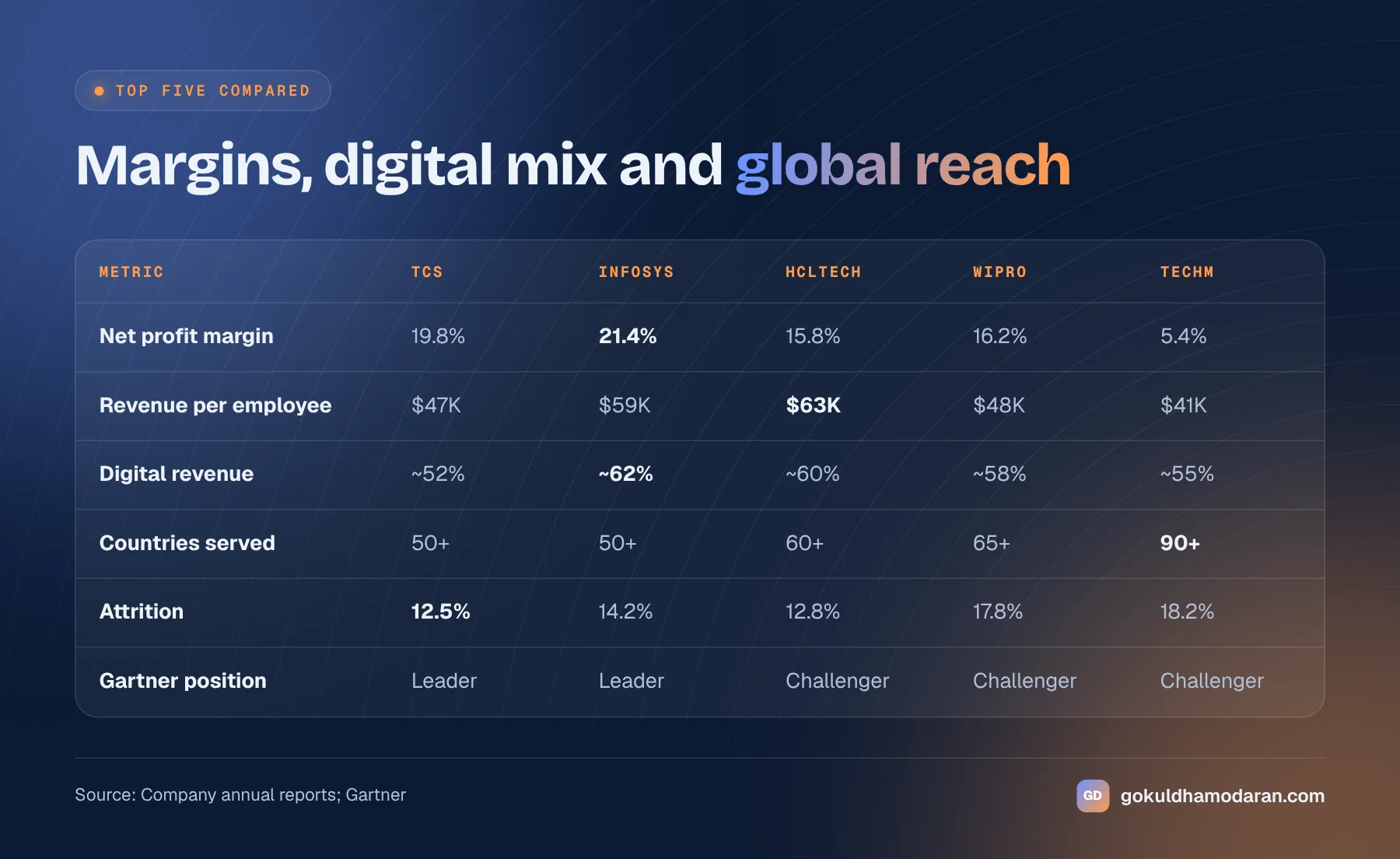
Figure 3: Indian IT Companies — Service Line Mix and Geographic Revenue Distribution (% of Revenue)
Financial Comparison: All Top 5
| Metric | TCS | Infosys | HCLTech | Wipro | Tech Mahindra |
| Revenue (USD) | $29.1B | $18.6B | $13.8B | $10.9B | $6.3B |
| Net Profit Margin | 19.8% | 21.4% | 15.8% | 16.2% | 5.4% |
| Revenue per Employee | $47K | $59K | $63K | $48K | $41K |
| YoY Revenue Growth | 4.4% | 1.4% | 5.4% | -1.0% | 4.0% |
| Attrition Rate | 12.5% | 14.2% | 12.8% | 17.8% | 18.2% |
| Digital Revenue % | ~52% | ~62% | ~60% | ~58% | ~55% |
| Market Cap (approx) | $170B+ | $75B+ | $55B+ | $25B+ | $7B+ |
| Clients (active) | 1,400+ | 1,800+ | 1,000+ | 1,200+ | 700+ |
| Countries Served | 50+ | 50+ | 60+ | 65+ | 90+ |
| Gartner Position | Leader | Leader | Challenger | Challenger | Challenger |
Table 3: Top 5 Indian IT Companies — Full Financial and Operational Comparison
The Next Tier: Rising Indian IT Champions
| Company | Revenue | Specialisation | Key Differentiator | Growth Trajectory |
| LTIMindtree | $4.3B | Data, cloud, engineering | Post-merger scale; Mindtree’s digital + LTI’s legacy strength | Strong — 15%+ organic growth in recent years |
| Mphasis | $1.6B | BFSI + cloud | Blackstone backing; AI-led mortgage and banking tech | Solid — BFSI exposure drives premium rates |
| Hexaware | $1.2B | Automation + AI delivery | Automation-first delivery model; returning to public markets | Re-emerging — IPO potential driving investment |
| Persistent Systems | $0.7B | Software engineering + ISV | Fastest-growing mid-tier; strong with software product companies | Exceptional — 30%+ revenue growth recent years |
| Coforge | $0.9B | Travel + BFSI + government | Niche vertical depth; strong partner ecosystem | Strong — vertical specialisation drives premium wins |
| KPIT Technologies | $0.5B | Automotive + mobility tech | Unique automotive software + EV focus; high growth | High — EV wave drives strong demand for KPIT |
| Sonata Software | $0.3B | Microsoft ecosystem + retail | Deep Microsoft Gold partnership; modernisation-led GTM | Growing — cloud modernisation demand strong |
Table 4: Rising Indian IT Champions — The Next Tier Companies to Watch
Indian IT Industry: Key Statistics
| Metric | Figure | Context |
| Total IT Export Revenue | $254B+ | India accounts for ~32% of global IT services exports |
| Domestic IT Revenue | $52B+ | Rapidly growing domestic market driven by digital India |
| Total IT Workforce | 5.4M+ | Largest technology workforce of any country outside China |
| IT as % of GDP | 10%+ | IT sector is a structural pillar of the Indian economy |
| Annual Engineering Graduates | 2.5M+ | More engineering graduates than USA, Europe, and China combined |
| Fortune 500 Clients | All 500 | Every Fortune 500 company is a client of at least one Indian IT firm |
| NASSCOM Members | 3,000+ | Broad ecosystem of product, services and startup companies |
| R&D Investment | $7B+/yr | Growing investment in IP and product development |
Table 5: Indian IT Industry Key Statistics — Scale, Revenue and Workforce Data
Frequently Asked Questions
Which is the largest Indian IT company?
Which Indian IT company is most profitable?
How do Indian IT companies compare to global peers like Accenture?
Are Indian IT companies good investments?
What is NASSCOM?
Which Indian IT company is best for freshers?
Which is the biggest IT company in India?
Which Indian IT company grew fastest in FY2026?
Conclusion: The Future of Indian IT on the Global Stage
Indian IT companies are no longer just cost-efficient outsourcing partners — they are strategic transformation partners for the world’s largest enterprises. The shift from labour arbitrage to intellectual capital is already underway: Infosys Topaz, TCS’s proprietary platforms, and HCL’s engineering products demonstrate that India’s IT companies are building IP, not just services.
- TCS: Safe choice for scale, reliability, and long-term enterprise partnership
- Infosys: Best for digital transformation, AI, and cloud-led engagements
- HCLTech: Top choice for engineering services and software product companies
- Wipro: Strong for consulting-led transformation and infrastructure services
- The next wave — LTIMindtree, Persistent, KPIT — offers specialised depth with high growth potential

Gokul Dhamodaran
I turn what is happening at the AI frontier into what it means for enterprise systems, and I build AI products myself (Euliv Analytics, Vantage). I write Leading Indicator every Friday: the AI and enterprise tech moves that matter, and what they mean for you.
Views are my own and do not represent any employer or client. Graphics are original; sources are linked.