The short answer
The SAP API policy for AI agents, Section 2.2.2 of SAP API Policy v.4.2026a, bars AI systems that plan and sequence their own API calls unless they use SAP-endorsed paths: A2A into Joule, the MCP Gateway in Integration Suite, or Business Data Cloud for bulk data. ODP over RFC is blocked for good after December 31, 2026.
Key takeaways
- The clause: Section 2.2.2 covers AI that plans, selects or executes sequences of API calls. Fixed-sequence RPA is out of scope.
- Not a ban: third-party agents still reach SAP, through endorsed paths only.
- Dec 31, 2026: the ODP over RFC opt-out ends. Run SAP Note 3439624 now; ODP over OData stays allowed.
- No new fees in the policy, but Digital Access still meters the documents an agent creates.
- Run the Find, Sort, Route, Price, Log audit before year end.
In April 2026, SAP published version 4.2026a of its API Policy, and one clause rewrote the rules for every AI agent that touches an SAP system. Section 2.2.2 bars API use by AI systems that “plan, select, or execute sequences of API calls,” unless they come in through architectures SAP has endorsed. On December 31, 2026, the temporary opt-out for the one interface SAP has already blocked, ODP over RFC, ends for good.
The SAP API policy for AI agents is five weeks from its first hard edge, and most teams still can’t say which of their agents it covers. I’ve planned enterprise campaigns for SAP-focused solutions across North America, Europe and APAC, and I build AI agents myself. From both seats, the policy is narrower than the panic and wider than the reassurance. This guide reads the actual text, sorts what is allowed from what is gray, and gives you a five-step audit to finish before year end.
What does the SAP API policy for AI agents actually say?
The SAP API policy for AI agents is one clause inside a short document. SAP API Policy v.4.2026a runs to four sections, and it forms part of the documentation for each SAP product, so it applies to what you already license. Here is what each section does, in plain English.
- Section 1.1, Published APIs. You may use the APIs listed on the SAP Business Accelerator Hub or named in product documentation, for the purposes that documentation describes: integration, extensions, data sync and events.
- Section 1.2, everything else. Customer and third-party apps must not call APIs that are not published, including ones labeled internal or private. The one exception: custom-developed ABAP interfaces in private cloud and on-premise systems.
- Section 2.1, limits. Rate limits, quotas and bulk extraction limits live in each product’s documentation, not in the policy itself.
- Section 2.2.2, the AI clause. Outside SAP-endorsed architectures, data services or pathways, you may not use APIs for (a) autonomous or generative AI systems that plan and sequence API calls, or (b) scraping or large-scale data extraction and replication.
- Section 3, enforcement. SAP may monitor usage and throttle, suspend or terminate access. Routing around the controls through proxies, gateways, custom code or impersonation is also prohibited.
- Section 4, legal exports. The policy does not limit data export that a law requires.
Notice what the text does not contain. It never says MCP, A2A, Joule, ODP or RFC. It names no endorsed architecture at all. Those details sit in SAP’s FAQ, its webinars and its notes, which is why most of the confusion exists.
Which AI agents does the rule cover?
The rule covers agents that decide for themselves which SAP APIs to call and in what order. SAPinsider’s September 8 explainer draws the line clearly: an AI system choosing its own sequence of calls is in scope, while deterministic automation, such as RPA that follows a predefined sequence, is not.
Is your automation an AI agent under SAP's rule?
Who decides which SAP APIs get called, and in what order?
- A fixed scriptDocumented-use rules onlyScheduled integrations, RPA
- The AI decidesUse an endorsed pathA2A, MCP Gateway or compliant MCP
- It copies data in bulkBDC or ODP over ODataNever ODP over RFC after Dec 31
Can't tell? Ask the vendor in writing and log the answer.
gokuldhamodaran.com
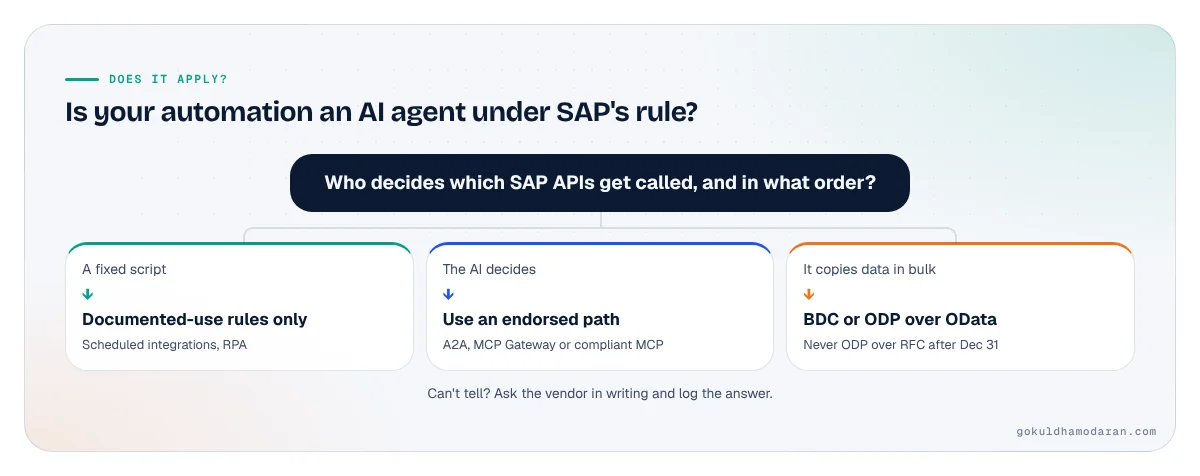
That gives you a simple first sort for every automation in your estate:
- A scheduled integration that posts invoices from a billing tool through a published API, the same calls every time: not an agent. Normal documented-use rules apply.
- An RPA bot with a fixed script: not an agent under this reading, even if a model reads the documents it processes.
- A copilot or custom agent that is told to clear the blocked invoices and picks which APIs to call: in scope. It needs an endorsed path.
Third-party AI agents are not banned. SAP said so directly in a statement to The Register on May 26: “The SAP API Policy does not restrict third-party agents from accessing SAP.” What changes is the door they use. The same SAPinsider piece notes the policy applies whether the call goes through SAP Integration Suite, API Management, third-party middleware or your own tooling.
Which paths has SAP endorsed for outside agents?
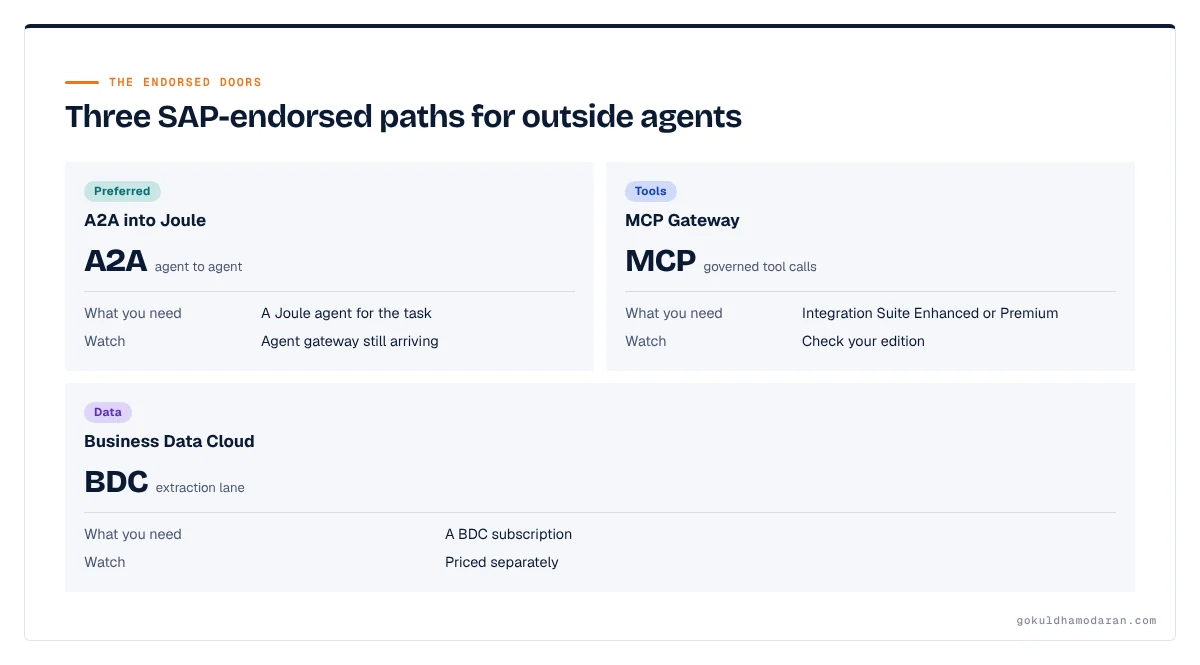
SAP has named three paths for outside agents, according to ASUG’s summary of SAP’s June 30 webinar, published July 5, 2026. Each fits a different job.
- A2A into a Joule agent. Your agent asks an SAP agent to do the work, using the Agent2Agent protocol. SAP prefers this path. ASUG reported the dedicated agent gateway was still forthcoming at the time.
- The MCP Gateway in SAP Integration Suite. Your agent calls SAP APIs as tools through Model Context Protocol, with metering and access control in between. ASUG says it ships in the Integration Suite Enhanced and Premium editions, with rollout starting July 5 on AWS and Azure and Google Cloud to follow.
- SAP Business Data Cloud for extraction. Bulk data for analytics and model training goes out through Business Data Cloud, including a documented Databricks pattern.
Third-party or custom MCP servers are allowed if they comply, but SAP gives them no support or stability guarantee. That is the real trade. You can keep your own tooling, and you carry the risk when an interface underneath it changes.
Check your Integration Suite edition before you plan around the MCP Gateway. If you run a standard edition, the endorsed tool path may mean an upgrade conversation, and that belongs in your budget for 2027. Our guide to the SAP autonomous enterprise after TechEd covers what is generally available on the Joule side and what lands in Q1 2027.
Three SAP-endorsed paths for outside agents
A2A into Joule
MCP Gateway
Business Data Cloud
gokuldhamodaran.com
What is blocked on December 31, 2026?
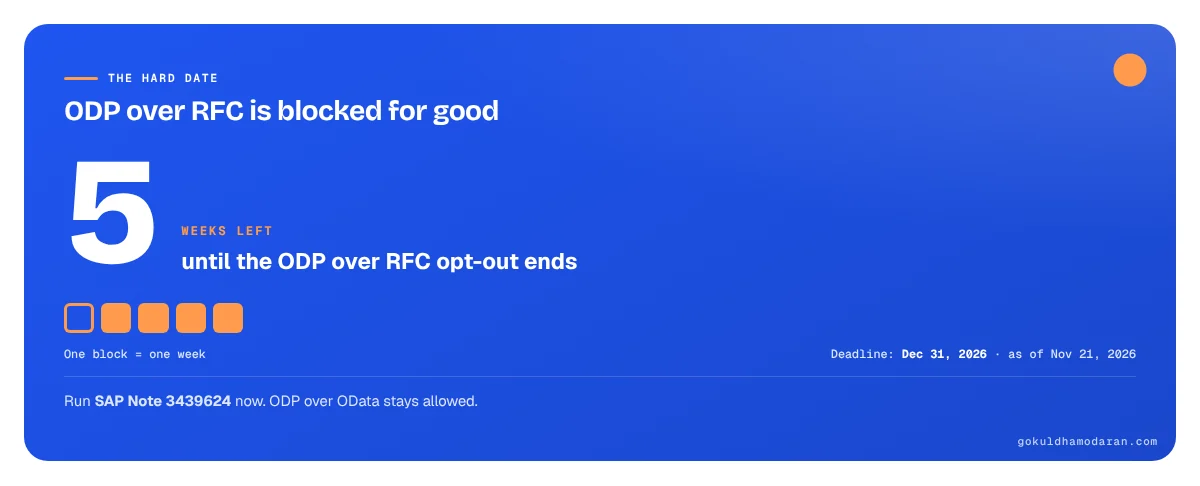
ODP over RFC is the only interface SAP has blocked so far, and its opt-out ends on December 31, 2026. ASUG reports a security patch shipped on June 9, 2026 that stops noncompliant ODP calls over RFC. Affected customers could suspend the restriction while they migrate, but only through year end. After that, the block is permanent.
ODP over RFC is blocked for good
weeks left
until the ODP over RFC opt-out ends
One block = one weekDeadline: Dec 31, 2026 · as of Nov 21, 2026
Run SAP Note 3439624 now. ODP over OData stays allowed.
gokuldhamodaran.com
This hits a familiar pattern: third-party data pipelines and replication tools that pulled SAP extractors through the Operational Data Provisioning framework over RFC. If one of those feeds your warehouse, your lakehouse or the dataset behind an AI model, it stops when the opt-out does.
- Find out if you’re affected: SAP Note 3439624 provides the self-assessment, per ASUG. Forrester also cites SAP Note 3255746 as the enforcement note.
- The safe harbor: ODP over OData remains valid and unrestricted, and ASUG says SAP has no plan at this time to restrict it.
- The longer-term route: Business Data Cloud, if your extraction is large-scale replication rather than a scoped feed.
My read: this is the one part of the SAP API policy 2026 changes with a hard date, so it goes first. Everything else is a governance question you can work through in 2027. This one breaks a pipeline on January 1.
What is still gray?
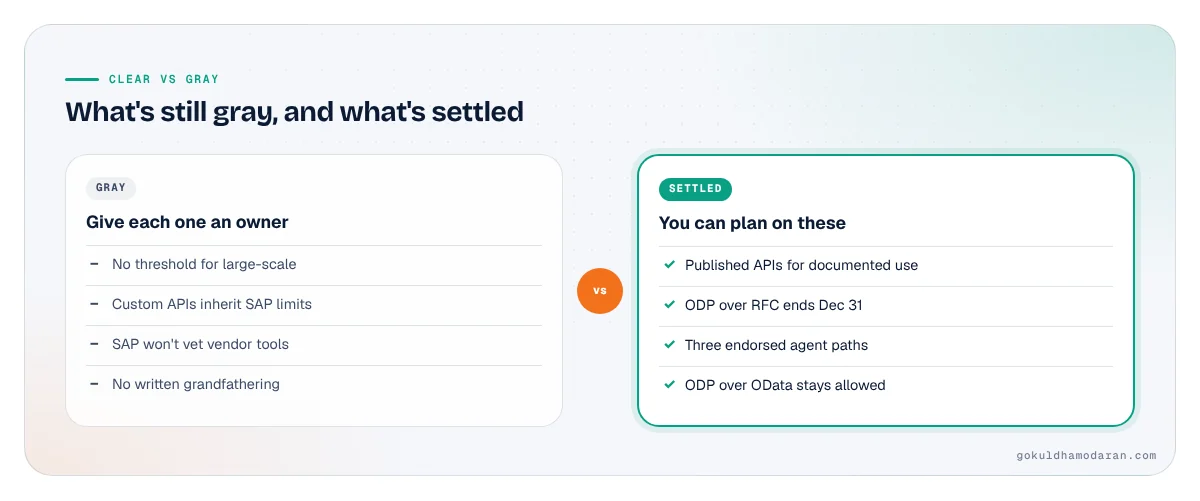
Four questions have no firm answer yet, and you should treat each as a risk with an owner rather than wait for clarity.
What's still gray, and what's settled
Give each one an owner
- No threshold for large-scale
- Custom APIs inherit SAP limits
- SAP won't vet vendor tools
- No written grandfathering
You can plan on these
- Published APIs for documented use
- ODP over RFC ends Dec 31
- Three endorsed agent paths
- ODP over OData stays allowed
gokuldhamodaran.com
- How much is large-scale? Section 2.2.2(b) prohibits large-scale extraction outside endorsed paths, but sets no threshold. Forrester lists this among the questions SAP has not answered.
- Custom APIs. SAPinsider says customer-namespace interfaces remain permitted: custom ABAP, OData services, CDS views and RFC modules. ASUG adds the catch: custom APIs inherit whatever limits attach to the SAP APIs beneath them, and they cannot become a back door for an unendorsed agent.
- Third-party products. SAP will not assess vendor tools for compliance, ASUG reports. Your vendor has to tell you, in writing, which path its agent uses.
- Grandfathering. ASUG says existing integrations get monitoring and outreach before any hard enforcement, and SAPinsider says SAP will not retroactively invalidate undocumented integrations simply as an enforcement action. Neither is a written exemption.
The tooling to check is also still arriving. ABAP Test Cockpit and its Cloud Readiness Check can scan custom code for dependencies on non-published APIs, but ASUG reported that automatic flagging of prohibited APIs was still in preparation. Clean core levels A through D and Z or Y namespace code continue unaffected.
Does the policy change Digital Access fees?
The policy itself adds no new fees. In its May 26 statement, SAP said the policy introduces no new pricing for access via endorsed architectures, and SAPinsider reports SAP saying it does not change current license grants or entitlements. That is the contract question. The cost question is different.
Digital Access is SAP’s document-based model for licensing indirect use, where systems and bots create documents such as sales orders and invoices in SAP. Thomas Wieberneit’s analysis on CustomerThink puts the split neatly: the API policy controls the path an agent takes, and Digital Access meters the documents it creates. An agent that creates 10,000 invoice documents generates Digital Access usage whichever door it came through.
So the endorsed path does not make an agent free. It makes it allowed. The bill depends on what the agent does once it is inside, and an agent that loops or retries can create documents faster than any human team.
- Ask your account team how agent-created documents count under your current Digital Access terms.
- Estimate monthly document volume per agent before go-live, not after.
- Price the endorsed path too: Integration Suite edition, Business Data Cloud and Joule usage after any free period.
Forrester’s advice for 2026 renewals is direct: add post-promotion price ceilings and get written carve-outs before signing multiyear third-party AI deals that depend on SAP data. Check the details with your legal team and your licensing advisor.
The five-step audit to run before year end
You have about five weeks before the ODP over RFC opt-out ends. That is enough time for a focused audit if you start with the pipelines and leave the policy debate for January. I call it the perimeter audit: Find, Sort, Route, Price, Log.
Find, Sort, Route, Price, Log
- 01FindList every agent, bot and pipeline on SAP. Run Note 3439624.
- 02SortFixed script, AI-planned calls or bulk extraction.
- 03RouteMove each to A2A, MCP, BDC or ODP over OData.
- 04PriceDocuments per agent, plus editions. 2027 terms in writing.
- 05LogAn owner, an identity and an audit trail per agent.
gokuldhamodaran.com
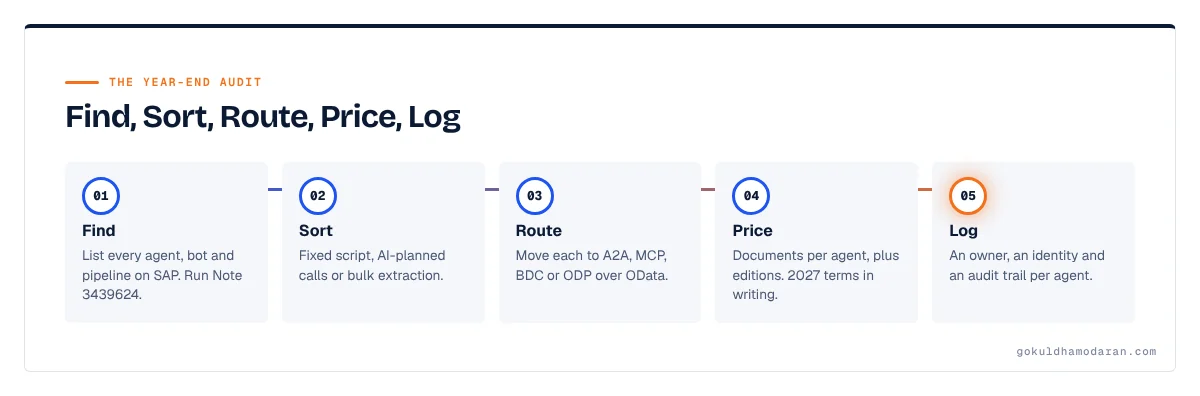
- Find. List every agent, pipeline, bot and integration that touches SAP. Include vendor tools and anything a business team set up on its own. Run SAP Note 3439624 for ODP over RFC exposure this week.
- Sort. Tag each one: fixed sequence (documented-use rules only), AI-planned calls (needs an endorsed path), or bulk extraction (needs Business Data Cloud or ODP over OData). Check every endpoint is a published API, as Section 1.2 requires.
- Route. Move each AI-planned agent to A2A, the MCP Gateway or a compliant MCP server. Move each ODP over RFC pipeline to ODP over OData or Business Data Cloud before December 31.
- Price. Estimate documents per agent per month for Digital Access, plus the Integration Suite edition and data volumes the new path needs. Get 2027 terms in writing before your renewal.
- Log. Give every agent an owner, an identity and an audit trail. If SAP throttles a call under Section 3, someone needs to know which agent made it and why.
If a vendor can’t tell you which path its agent uses, that tool goes on the risk list with a named owner and a date. That single rule will do more for you than any amount of reading the FAQ.
Ownership is where most agent programs break anyway. Our piece on why agentic AI projects fail shows how often the missing piece is an owner, not a model.
What this means for your 2027 SAP roadmap
The SAP API policy for AI agents is best read as an architecture decision SAP made for you. The analysts disagree on the motive. Gartner’s Christian Hestermann told The Register that SAP is closing the door to third-party agentic environments. SAP’s CEO Christian Klein told investors customers and partners had nothing to worry about, and said mass calls would be throttled. Both can be true at once: the doors are open, and SAP owns them.
 2027 roadmapThe doors are open. SAP owns them.
For an enterprise architect, that settles three things for 2027:
- Agent architecture goes through a gateway. Whatever you build, plan for a governed layer between agents and SAP, whether SAP’s or one that meets the same rules.
- Data strategy picks a lane. Analytics and model training on SAP data run through Business Data Cloud or ODP over OData, not legacy extractors.
- Clean core stops being optional. Custom code that leans on unpublished APIs is now both an upgrade risk and a policy risk.
If you are still on ECC, this lands on top of your migration timeline. Our guide to SAP ECC end of maintenance in 2027 covers those dates, and our piece on AI agents in ERP has a test for telling a production agent from a demo.
My read: the policy is a perimeter, not a wall. Teams that map their agents now will spend January building. Teams that wait will spend it finding out which pipeline stopped.
Frequently asked questions
Does the SAP API policy ban third-party AI agents?
No. SAP told The Register on May 26, 2026 that the policy does not restrict third-party agents from accessing SAP. It restricts how they get in. Agents that plan their own sequence of API calls must use an SAP-endorsed path, such as A2A into a Joule agent, the MCP Gateway in SAP Integration Suite, or Business Data Cloud for bulk data.
Is RPA covered by the SAP API policy's AI clause?
Usually not. SAPinsider's September 2026 explainer says deterministic automation, such as RPA that follows a predefined sequence of API calls, is outside the AI clause. The clause targets systems that decide for themselves which APIs to call and in what order. RPA still has to use published APIs for their documented purpose and respect rate limits.
What replaces ODP over RFC after December 31, 2026?
ODP over OData remains valid and unrestricted, according to ASUG's July 2026 summary of SAP's webinar, and SAP has no plan at this time to restrict it. For large-scale replication into a lakehouse or analytics platform, SAP points customers to SAP Business Data Cloud. Run SAP Note 3439624 first to see which pipelines use ODP over RFC today.
Can I still build custom APIs in SAP for my agents?
Yes, with limits. The policy keeps an exception for custom-developed ABAP interfaces in private cloud and on-premise systems, and SAPinsider says customer-namespace OData services, CDS views and RFC modules remain permitted. ASUG adds that custom APIs inherit the limits of the SAP APIs beneath them and cannot become a route around the AI clause.
Do I need SAP Integration Suite to use the MCP Gateway?
Yes. ASUG reports the MCP Gateway ships as part of the SAP Integration Suite Enhanced and Premium editions, with rollout that began on July 5, 2026 on AWS and Azure. Integration Suite itself is not mandatory under the policy, but a custom or third-party MCP server carries no SAP support or stability guarantee.
Sources
- SAP: SAP API Policy v.4.2026a (PDF)
- ASUG: SAP API Policy overview, API availability, agentic AI architectures and impacts on existing integrations (Jul 5, 2026)
- SAPinsider: SAP API Policy, what customers need to know about integrations and AI agents (Sep 8, 2026)
- Forrester: SAP is attempting to become the gatekeeper of enterprise AI (May 20, 2026)
- The Register: SAP's AI strategy, come for the openness, stay because you have to (May 19, 2026, updated May 26)
- The Register: AI clause in new SAP API policy has partners worried over lock-in (Apr 29, 2026)
- CustomerThink: SAP draws a perimeter around agentic AI (2026)

Gokul Dhamodaran
I turn what is happening at the AI frontier into what it means for enterprise systems, and I build AI products myself (Euliv Analytics, Vantage). I write Leading Indicator every Friday: the AI and enterprise tech moves that matter, and what they mean for you.
Views are my own and do not represent any employer or client. Graphics are original; sources are linked.