The short answer
To study in USA from India for Fall 2027, plan about 12 months ahead: shortlist programs, take an English test (and the GRE if required), apply by winter, get your I-20, pay the $350 SEVIS fee, then book your F-1 visa. Budget roughly $37,000 to $51,000 (₹34.6 to ₹47.3 lakh) a year at public universities.
Key takeaways
- Start 12 months out. Fall 2027 means tests now and applications by winter.
- Two public universities list $37,327 and about $51,000 a year for international graduate students (₹34.6 to ₹47.3 lakh).
- A three-year Indian degree works at some schools only: check each program's policy first.
- The F-1 visa can be issued up to 365 days before your start date; you can enter only 30 days before.
- Never pay anyone to see a room. No money before you've seen it and signed.
The first room I rented in the US cost about $475 to $550 a month with utilities. A semester later I paid about $400, in a better place, with friends I met there. Almost every big decision in this journey works like that: the first plan is rarely the cheapest one, and the people who plan early get the better choices.
This roadmap shows how to study in USA from India for the Fall 2027 intake, step by step, with official sources. Rupee figures use ₹92.8 per US dollar (FBIL reference rate, Nov 23, 2026); rates move, so check before you budget. Updated November 2026.
How many Indian students study in the USA now?
India sent 339,435 students to the US in 2025-26, the most of any country for the third year in a row, according to the IIE Open Doors 2026 data reported by India Weekly on Nov 16, 2026. That total is down 6.5% and includes students on OPT work training.
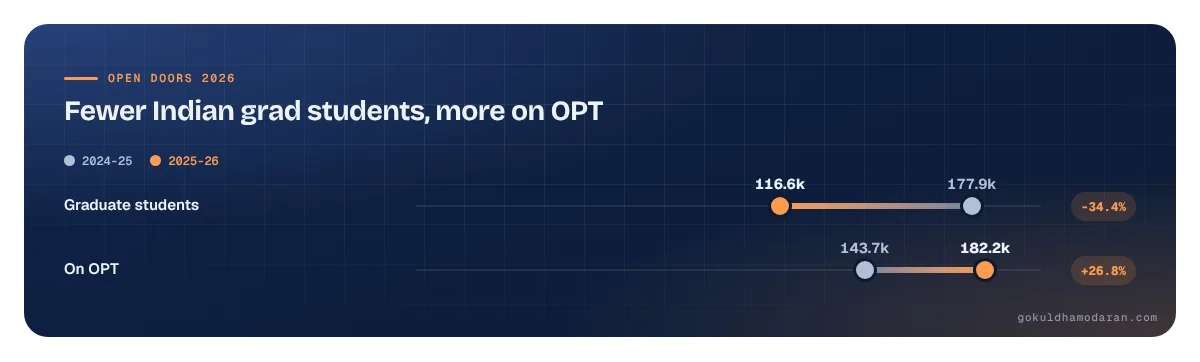
The split matters more. Indian graduate students fell 34.4%, to 116,609, while Indians on OPT rose 26.8% to 182,201. Fewer started a master’s last year, so strong 2027 applicants face a less crowded field.
Fewer Indian grad students, more on OPT
2024-252025-26
- Graduate students177.9k116.6k-34.4%
- On OPT143.7k182.2k+26.8%
gokuldhamodaran.com
Study in USA for Indian students makes most sense when you know your program, can fund year one and your degree qualifies. The next guide, is studying in the USA worth it for Indian students, does that math in full.
The 7-step roadmap to study in USA from India
Every path to an MS in USA from India follows this order.
From India to a US campus in five stages
- 01EligibilityDegree, marks, 3-year rule
- 02TestsEnglish test, GRE if asked
- 03Shortlist6 to 10 programs you can fund
- 04ApplySOP, letters, transcripts
- 05Visa and landI-20, SEVIS, F-1, housing
gokuldhamodaran.com
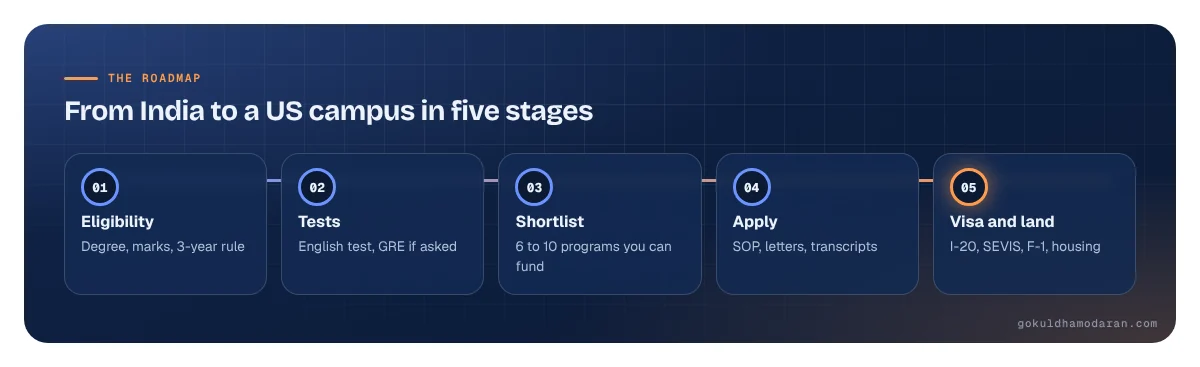
- Check eligibility. Confirm your degree, marks and backlogs meet each program’s rules. See eligibility for MS in USA.
- Take your tests. One English test, plus the GRE if your program asks for it.
- Shortlist by budget. Pick 6 to 10 programs you can fund.
- Apply. Statement of purpose, recommendations, transcripts and fees, program by program.
- Fund it. Assistantships, scholarships, an education loan and family savings.
- Get your I-20 and visa. The school issues the I-20, then you pay SEVIS and apply for the F-1.
- Prepare to land. Housing, a bank account, packing and your first 30 days.
Step one is the one people rush, so start there.
Can you study in the USA with a three-year Indian degree?
Sometimes, and only where the program says yes. WES treats some three-year Indian bachelor’s degrees as equal to a US bachelor’s when the degree is Division I and the college holds a NAAC grade of A or better. Each US school still sets its own rule.
Illinois Tech is a clear example. Its policy accepts three-year degrees for some master’s programs, such as those in its business school, but its Computer Science program wants a master’s in the same field as well. Read every program’s policy before you pay a fee.
Which tests do you need, and what do they cost in India?
Most programs want one English test; some also want the GRE. Official fees, checked November 2026:
| Test | Fee | In rupees | Official source |
|---|---|---|---|
| TOEFL iBT | about $170 | ₹15,729 | ETS India |
| IELTS Academic | about $205 | ₹19,000 | IELTS IDP India |
| Duolingo English Test | $70 | about ₹6,500 | Duolingo English Test |
| GRE General Test | $249 | about ₹23,100 | ETS |
Not every university takes all three English tests, so check the admissions page first. The TOEFL vs IELTS vs Duolingo guide and the GRE requirement guide go deeper. Tests sorted, the next question is money.
What is the cost of studying in USA from India?
The cost of studying in USA from India is about $37,000 to $51,000 a year at the two public universities below, before any funding. That is roughly ₹34.6 to ₹47.3 lakh a year, or ₹69 to ₹95 lakh for a two-year master’s. Private universities often cost more.
What a year costs at two public universities
University at Buffalo
Kansas State
gokuldhamodaran.com
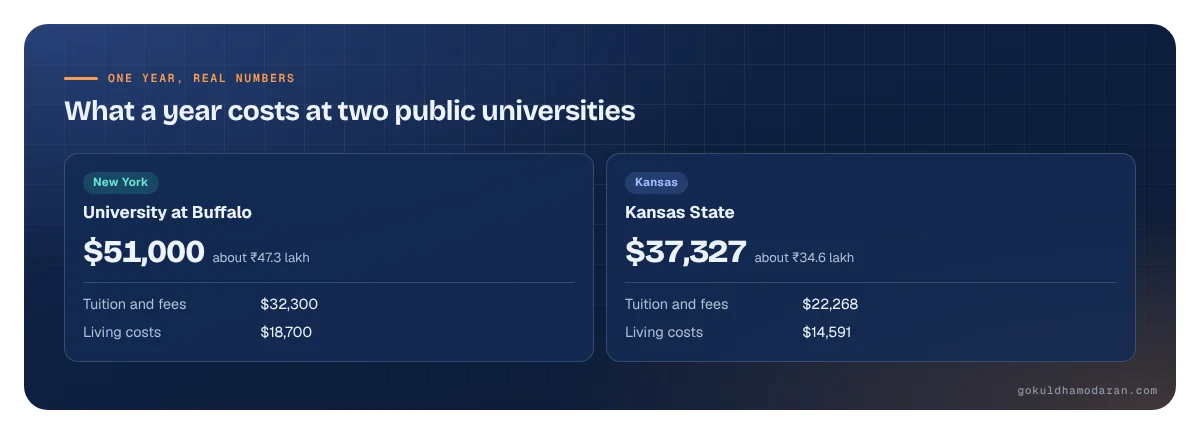
- University at Buffalo (2026-27): $32,300 tuition and fees plus $18,700 living costs for a graduate student, about $51,000 (₹47.3 lakh) for nine months, per its estimated expenses page.
- Kansas State University (updated April 2026): $37,327 (₹34.6 lakh) for its Manhattan campus, including $14,591 living costs, per its cost estimate.
These two universities are examples for reference only. There are many more US universities, and costs vary by school and city, so check each school’s own cost page.
Rent is the line you control most. My rent dropped about $100 a month once I moved in with people I’d met, and a shared room and bathroom often saves $300 to $400 a month over a private one. Funding is the other lever: Buffalo lists $24,200 in tuition and fees for students with an assistantship, against $32,300 without. See how to get a graduate assistantship.
When should you start for the Fall 2027 intake?
Start about 12 months before classes. For an August 2027 start, that means tests this winter and applications soon after, because many programs close fall admissions early in the year. Your program’s own page has the real deadline.
Your 12-month plan for Fall 2027
- 1Tests doneEnglish test, GRE if needed
- 2Applications inMost fall rounds close
- 3Admits and I-20Pick your school
- 4SEVIS and visa$350 fee, interview
- 5FlyUp to 30 days early
gokuldhamodaran.com
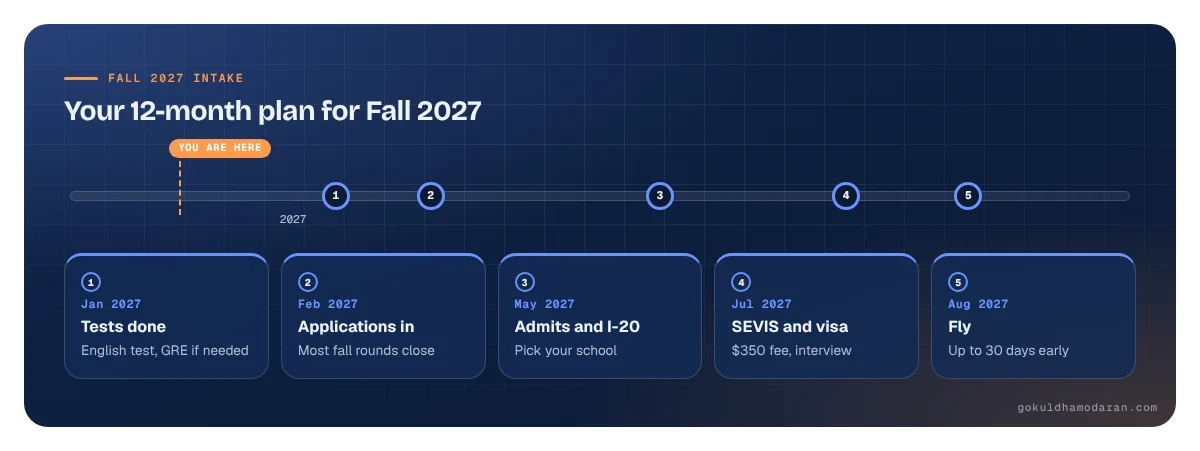
- Nov 2026 to Jan 2027: tests, shortlist and documents.
- Dec 2026 to Feb 2027: applications.
- Mar to May 2027: admits, funding offers and your I-20.
- May to Jul 2027: SEVIS fee, visa interview, housing.
- Late Jul to Aug 2027: fly, at most 30 days before your start date.
The when to start preparing guide has the full calendar. Once an admit arrives, the visa clock starts.
How does the F-1 visa process work for Indian students?
The F-1 visa process has a fixed order, set out on Study in the States: get admitted to an SEVP-certified school, receive your Form I-20, pay the I-901 SEVIS fee, apply for the visa at a US embassy or consulate, then arrive and receive your I-94 record.
- SEVIS fee: $350 (about ₹32,500) for F-1 students, as listed by the University of Chicago.
- Visa application fee: $185 (about ₹17,200) for F students on the State Department’s appointment system.
- Timing: student visas can be issued up to 365 days before your start date, but you cannot enter more than 30 days early, as MIT’s international office explains.
Fees change, so confirm them before you pay. Our F-1 visa process guide covers documents and booking. This is general information, not immigration advice.
What should you sort out before you fly?
Housing first. Most students find rooms and subleases on Facebook Marketplace and student groups, then sign a lease, or a sublease when they take over someone’s lease. My advice: take a short-term place first, then move in with people you meet once you know the area.
One firm rule. Never pay any amount to see a room, get the address or book a visit. Anyone asking for money before you’ve seen the place and signed is running a scam.
This week, open three programs’ admissions pages and check their degree rule and English tests. Step one, done.
Up next in this series
This is the roadmap. Each next guide takes one step and goes deep: exact documents, real costs, common mistakes.
- Is a US master’s worth it for Indian students in 2027? Costs against outcomes.
- When to start preparing: month by month.
- Best US universities for an MS in CS (2027), ranked by value.
- Eligibility: three-year degrees, GPA and backlogs.
A new one goes up daily in the Study Abroad Guide.
Frequently asked questions
How much does it cost to study in the USA from India?
At two public universities, a year costs about $37,000 to $51,000 (₹34.6 to ₹47.3 lakh) for an international graduate student, including living costs. Kansas State lists $37,327 and Buffalo about $51,000 for 2026-27. A two-year master's is roughly ₹69 to ₹95 lakh before assistantships or scholarships.
Can I do an MS in the USA after a three-year degree?
Yes, at some programs. WES treats some three-year Indian degrees as equal to a US bachelor's when they are Division I from a NAAC A-grade college, but each university decides. Illinois Tech, for example, accepts them for certain master's programs only. Check every program's policy before applying.
When should I apply for the Fall 2027 intake?
Plan your tests for November 2026 to January 2027 and send applications between December and February, since many programs close fall admissions early in the year. Admits and I-20s usually follow in spring, leaving May to July for the visa. Always use the deadline on your program's own page.
How early can I get an F-1 visa?
A US student visa for a new student can be issued up to 365 days before the program start date on your I-20. You still cannot enter the United States more than 30 days before that date. Pay the $350 SEVIS fee before your visa interview.
Sources
- Open Doors 2026 data release, Institute of International Education
- Indian students in US fall 6.5% to 339,435: Open Doors report, India Weekly (Nov 16, 2026)
- FBIL reference rates
- 3-year Indian bachelor's degree, WES
- Three-year Indian degrees, Illinois Tech graduate admission
- TOEFL iBT fees, ETS India
- IELTS test fee, IELTS IDP India
- GRE General Test fees, ETS
- How much does the DET cost? Cialfo (Jul 2026)
- Estimated expenses 2026-2027, University at Buffalo
- International student estimated cost of attendance, Kansas State University
- F-1 postsecondary students guide, Study in the States (DHS)
- SEVIS I-901 fee, University of Chicago
- Visa fees, US visa appointment service (State Department)
- F and M student visas can be issued a year in advance, MIT ISchO
- Study in the USA, IDP India

Gokul Dhamodaran
I turn what is happening at the AI frontier into what it means for enterprise systems, and I build AI products myself (Euliv Analytics, Vantage). I write Leading Indicator every Friday: the AI and enterprise tech moves that matter, and what they mean for you.
Views are my own and do not represent any employer or client. Graphics are original; sources are linked.