The short answer
AI's impact on software development roles is mostly reshaping, not removal. Agents absorb repeatable tasks such as first-draft code, scripted tests and status reports, while demand grows for judgment work: framing outcomes, writing evaluations, securing agent access and running agents in production. Every role still has a job; the job moves to a different ADLC stage.
Key takeaways
- AI reshapes far more jobs than it removes: BCG puts 50–55% of US jobs in the reshaped group.
- Sort tasks, not titles: absorb, assist or keep.
- Every SDLC role gets one ADLC stage to own: QA owns the evals, analysts own the framing, SRE owns operations.
- Bank the freed hours before cutting anything. They fund the agent backlog.
- Juniors aren't the cost to cut. They're the eval writers you'll need.
The AI impact on software development roles is no longer a forecast. Gartner says generative AI will require 80% of the engineering workforce to upskill through 2027. Stanford researchers found that employment for 22- to 25-year-olds in the most AI-exposed jobs, software developers among them, fell about 16% relative to less-exposed groups by October 2025.
That second number is why people are nervous. But most of the work in a software company isn’t disappearing. It’s moving: from writing every line to defining what good looks like, proving it and running agents safely. This guide maps that move for nine roles, shows which stage of the agentic development lifecycle each role should own, and gives leaders a 90-day plan to redeploy people instead of cutting them.
Will AI replace software developers?
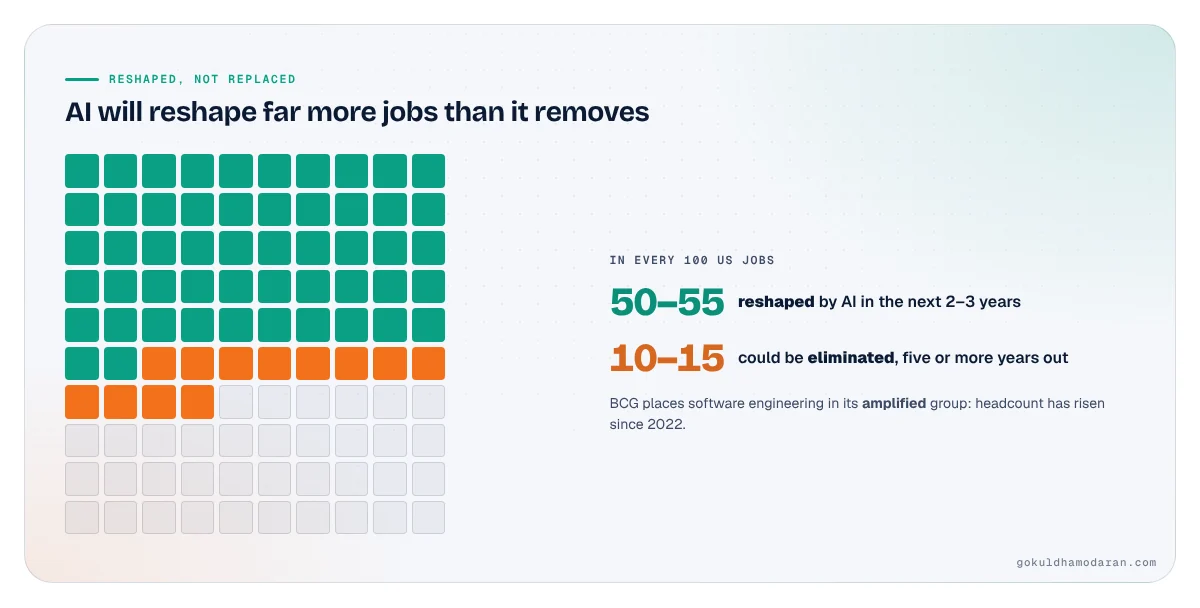
Mostly no, but it will change what they spend the day on, and it is already shrinking some entry-level work. BCG estimates that 50% to 55% of US jobs will be reshaped by AI within two to three years, while 10% to 15% could be eliminated five or more years out. BCG places software engineering in its “amplified” group and notes that engineering headcount has risen steadily since 2022.
Both sides of the debate have evidence. Gartner expects organizations to need more skilled engineers, not fewer, as demand for AI-powered software grows. In the World Economic Forum’s employer survey, 77% of employers plan to upskill their people, yet 41% also plan to reduce staff where AI can do the work. The honest answer is that AI changes every role, and each company decides whether that change becomes a redeployment or a layoff.
AI will reshape far more jobs than it removes
In every 100 US jobs
- 50–55reshaped by AI in the next 2–3 years
- 10–15could be eliminated, five or more years out
BCG places software engineering in its amplified group: headcount has risen since 2022.
gokuldhamodaran.com
What changes when SDLC teams move to ADLC?
In SDLC, the scarce skill was producing working code. In the agentic development lifecycle (ADLC), first drafts of code get cheap. The scarce skills become framing the outcome, building the test set that defines “right”, giving agents the least access they need, and watching them after release. Work shifts toward definition at the start and toward operations at the end.
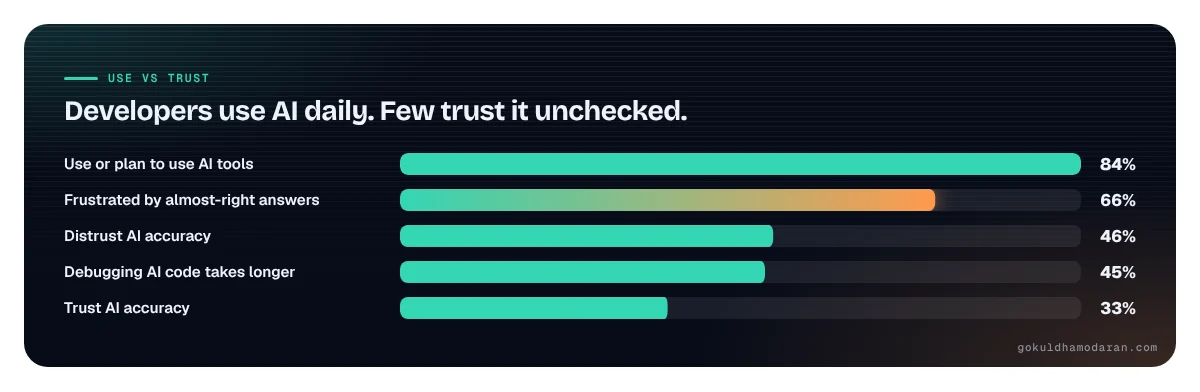
The data shows why. The Stack Overflow 2025 Developer Survey of more than 49,000 developers found that 84% use or plan to use AI tools, but 46% distrust the accuracy of the output and 66% are frustrated by answers that are almost right. Google’s 2025 DORA report calls AI an amplifier: it speeds up strong teams and exposes the weaknesses of fragmented ones.
Speed is also hard to judge from the inside. METR’s early-2025 trial found experienced open-source developers took 19% longer with AI while believing they were faster. Its 2026 follow-up points to modest speedups but calls its own data weak evidence. So someone has to check the work, define good and own the risk. Those are jobs, and your current team is best placed to do them.
AI impact on software development roles: the 9-role map
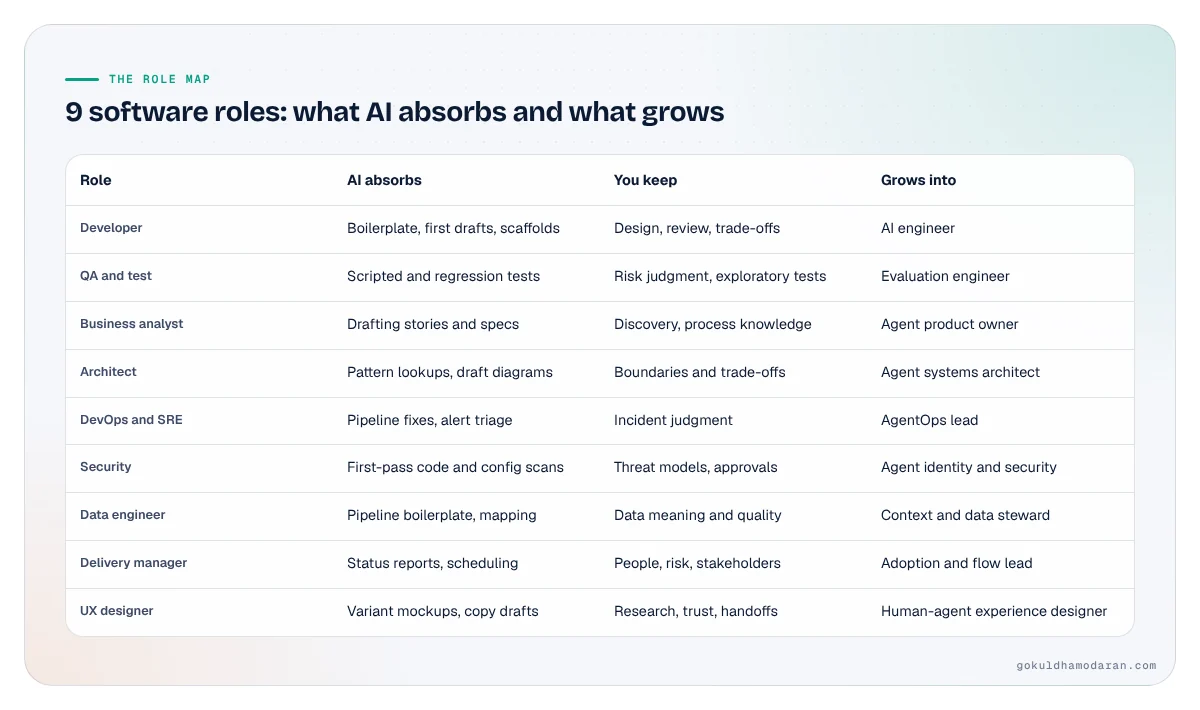
Here is the AI impact on software development roles, one role at a time. Use this map as the starting point for every role on a software team. For each role it shows what agents absorb first, what stays human, the title the role grows into, and one move to make this month.
9 software roles: what AI absorbs and what grows
| Role | AI absorbs | You keep | Grows into |
|---|---|---|---|
| Developer | Boilerplate, first drafts, scaffolds | Design, review, trade-offs | AI engineer |
| QA and test | Scripted and regression tests | Risk judgment, exploratory tests | Evaluation engineer |
| Business analyst | Drafting stories and specs | Discovery, process knowledge | Agent product owner |
| Architect | Pattern lookups, draft diagrams | Boundaries and trade-offs | Agent systems architect |
| DevOps and SRE | Pipeline fixes, alert triage | Incident judgment | AgentOps lead |
| Security | First-pass code and config scans | Threat models, approvals | Agent identity and security |
| Data engineer | Pipeline boilerplate, mapping | Data meaning and quality | Context and data steward |
| Delivery manager | Status reports, scheduling | People, risk, stakeholders | Adoption and flow lead |
| UX designer | Variant mockups, copy drafts | Research, trust, handoffs | Human-agent experience designer |
Developer
QA and test
Business analyst
Architect
DevOps and SRE
Security
Data engineer
Delivery manager
UX designer
gokuldhamodaran.com
Developer → AI engineer
Agents absorb boilerplate, first drafts, refactors and test scaffolds. You keep design, code review and the trade-offs no prompt can see. You grow into an AI engineer, the role Gartner describes as a blend of software engineering, data science and AI/ML skills. You give agents context, constraints and evals, then judge what comes back. First move: write the repo rules and worked examples your coding agent reads before every task.
QA and test engineer → evaluation engineer
Agents absorb scripted test cases and regression runs. You keep risk judgment and exploratory testing. You grow into the owner of the golden dataset: you calibrate LLM-as-judge scoring against human reviewers and run red-team sessions. In ADLC the evaluation is the specification, which makes QA one of the most important roles, not the first one to cut. First move: collect 50 real cases with known right answers for one agent.
Business analyst → agent product owner
Agents absorb drafting user stories, specs and meeting notes. You keep discovery: knowing how the process really runs and who signs off. You grow into an agent product owner who writes the one-sentence outcome, sets the autonomy level (“the agent drafts; a person approves anything that moves money”) and turns acceptance criteria into eval cases. First move: rewrite one feature’s acceptance criteria as ten test examples.
Architect → agent systems architect
Agents absorb pattern lookups and first-draft diagrams. You keep system boundaries and the trade-offs between them. You grow into the person who decides which tools an agent may call, how it is identified, how every run is traced and where a person must approve. First move: draw the permission map for one agent: every tool and data source, marked read or write.
DevOps and SRE → AgentOps lead
Agents absorb routine pipeline fixes and first-pass alert triage. You keep incident judgment and reliability calls. You grow into running agents in production: release rings, rollback, a kill switch, drift alerts and cost per correct outcome. A model update becomes a release you test, not a background patch. First move: add tracing to one agent and read a full week of its runs.
Security engineer → agent identity and security
Agents absorb first-pass code and configuration scanning. You keep threat modeling and approvals. You grow into giving every agent its own identity with least privilege, testing for prompt injection and checking AI-written code for invented dependencies. Researchers at USENIX Security 2025 found hallucinated package names in at least 5.2% of code from commercial models. First move: list every credential your agents use today, and who issued it.
Data engineer → context and data steward
Agents absorb pipeline boilerplate and field mapping. You keep the meaning of the data and its quality. You grow into the owner of what agents are grounded on: which sources are approved, how fresh they are and who may see what. A good model with bad context gives confident wrong answers. First move: tag the three sources your first agent reads with an owner and a freshness date.
Project and delivery manager → adoption and flow lead
Agents absorb status reports, scheduling and minutes. You keep people, risk and stakeholders. You grow into leading the human side of the change: who reviews what, where freed hours are reinvested and how the weekly numbers are read out. First move: add “hours freed by agents” as a line in your weekly report.
UX designer → human-agent experience designer
Agents absorb variant mockups and copy drafts. You keep user research and the craft of trust. You grow into designing approvals, explanations, undo and the handoffs between people and agents. First move: design the approval screen for one agent action that moves money or data.
Which ADLC stage should each role own?
Every role should own one ADLC stage. Ownership turns a vague “upskill on AI” plan into a job description. The loop below maps the nine roles onto the seven stages. Design and Prove are highlighted because that is where most teams have no owner today.
Every role owns a stage of the ADLC loop
- 01Frame · analyst, product ownerOutcome, owner and autonomy level.
- 02Ground · data, securityApproved sources and least-privilege access.
- 03Design · architect, QAArchitecture and the eval plan, written first.
- 04Prove · QA, domain expertsGolden dataset, baseline, go or no-go.
- 05Build · developersEvery change runs the evals.
- 06Release · DevOpsRings, rollback and a kill switch.
- 07Operate · SRE, delivery leadTraces, drift and cost per correct outcome.
gokuldhamodaran.com
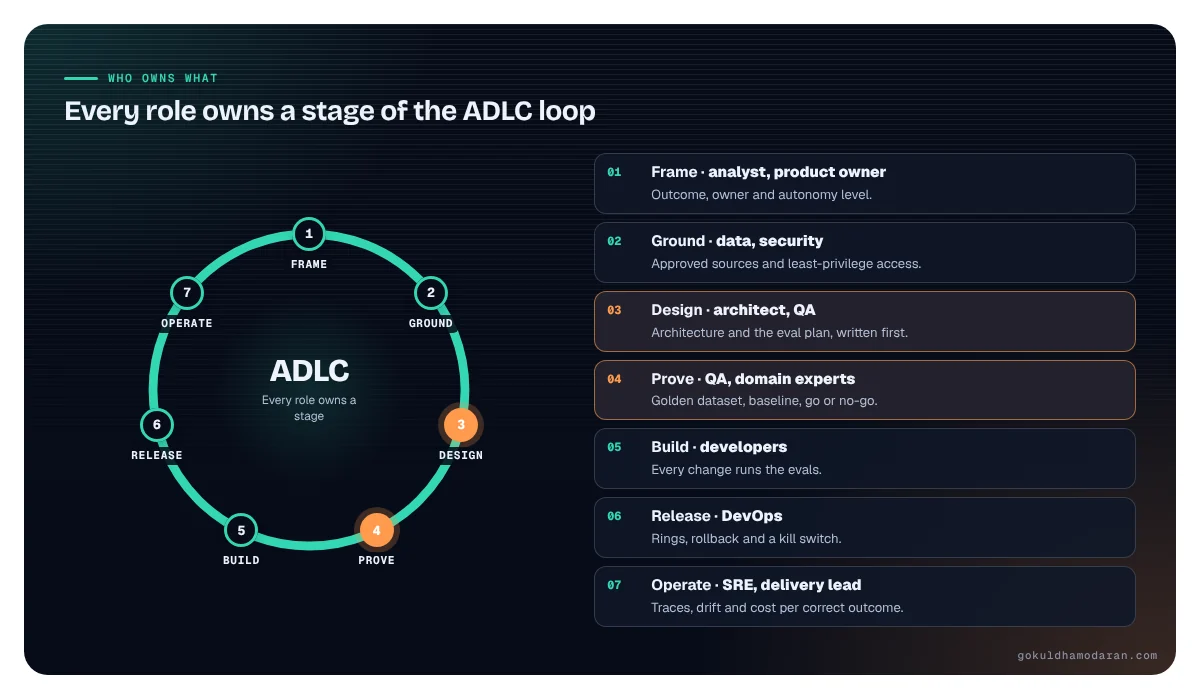
Two stages need pairs. Ground needs the data engineer and security together, because the context an agent reads and the permissions it holds are one decision. Operate needs SRE and the delivery lead, because an agent in production is both a system to monitor and a change people have to accept.
How do you decide which tasks AI should take?
Sort tasks, not titles. List each person’s most frequent tasks and ask two questions: does the task repeat with a clear right answer, and how costly is a mistake? Repeatable and cheap to get wrong: absorb it. Repeatable but costly: assist, where the agent drafts and a person approves. Needs judgment, trust or a new decision: keep it, and invest there.
Absorb, assist or keep: sort tasks, not titles
What kind of task is it?
- Repeats often, clear right answer, mistakes are cheapAbsorbThe agent does it. You review a weekly sample.
- Repeats often, but a mistake is costlyAssistThe agent drafts. A person approves before it ships.
- Needs judgment, trust or a new decisionKeepYour growth zone. Invest here.
Absorbed tasks free hours. Decide where those hours go before anyone decides headcount.
gokuldhamodaran.com
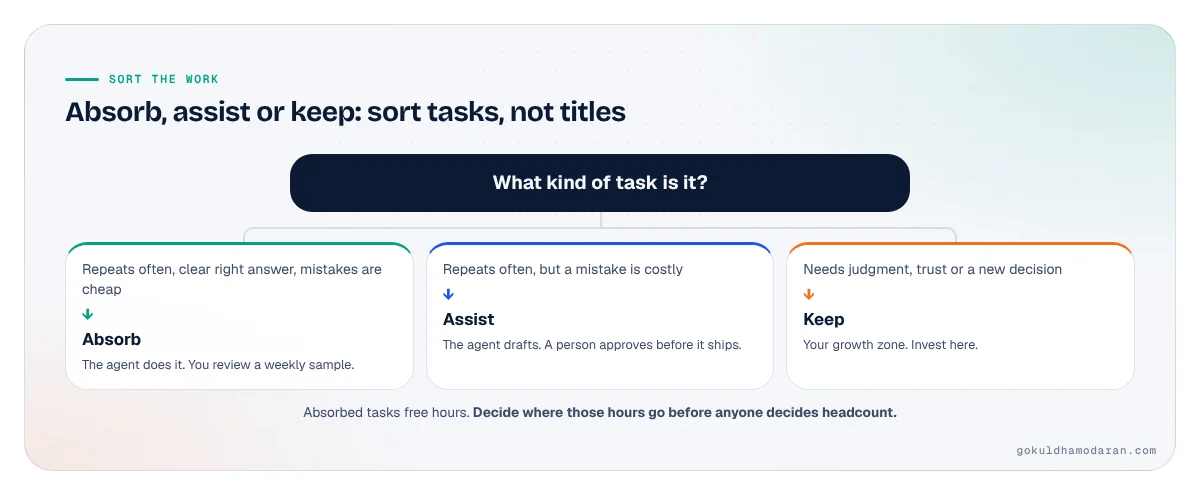
Expect every role to have tasks in all three buckets. If a whole role lands in “absorb”, the map is too coarse: split the tasks further. The keep column is the most useful output, because it is the growth plan for that person.
How can companies adopt ADLC without layoffs?
Treat freed hours as a budget before treating them as a saving. The first agents rarely remove whole jobs; they remove slices of many jobs. Those slices only become savings if someone decides to cut. They become growth if you decide in advance where the hours go.
- Map tasks, not titles. Every role sorts its work into absorb, assist and keep.
- Bank the freed hours. Log them every week and decide what they fund: the agent backlog, the eval sets, the work that never got staffed.
- Fill new roles from inside first. Evaluation engineers from QA, agent product owners from analysts, AgentOps from SRE. They already know your systems and your customers.
- Give each role a stage. Use the loop above so nobody’s job description is “use AI more”.
- Protect learning time. Put hours in the calendar, not just licenses in the budget.
- Report outcomes, not headcount. Cost per correct outcome, cycle time and escaped defects tell leadership more than seats saved.
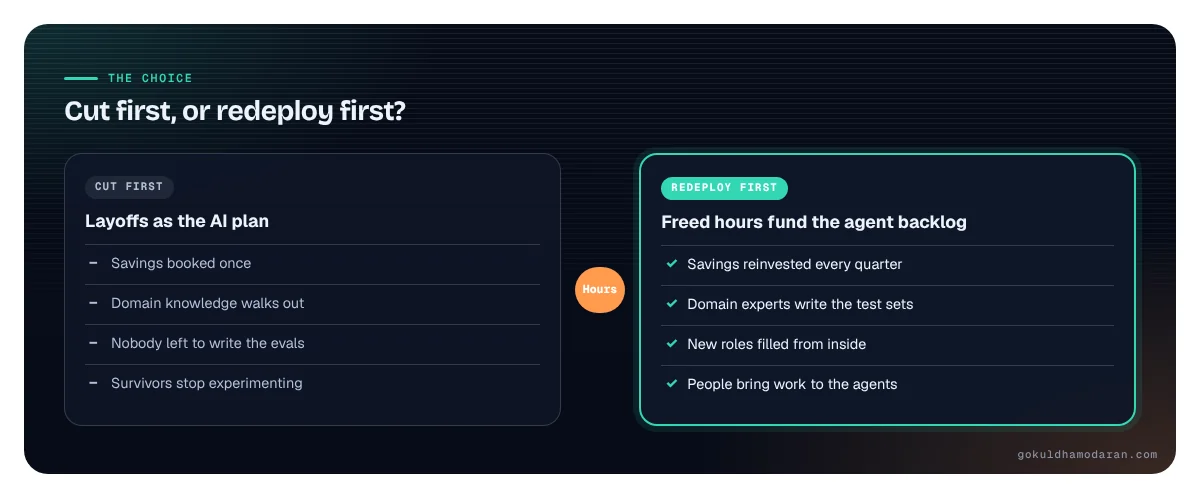
IBM shows both sides of the choice. CEO Arvind Krishna said in May 2025 that AI had taken over work from several hundred HR employees, yet IBM’s total employment went up because the savings funded more programmers and salespeople. The cut happened, and so did the reinvestment. Leaders get to choose the ratio.
Cut first, or redeploy first?
Layoffs as the AI plan
- Savings booked once
- Domain knowledge walks out
- Nobody left to write the evals
- Survivors stop experimenting
Freed hours fund the agent backlog
- Savings reinvested every quarter
- Domain experts write the test sets
- New roles filled from inside
- People bring work to the agents
gokuldhamodaran.com
What happens to junior developers?
Junior roles carry the most risk, and the Stanford data shows it. The mistake is to stop hiring juniors altogether: in two years there will be no mid-level people who know your systems. A better path is to make juniors the apprentices of ADLC. They write eval cases, review agent traces and fix what agents get almost right, with a senior checking their judgment. That builds the exact skills Gartner says most engineers will need.
New hybrid roles are also appearing fast. Bloomberry’s analysis of job postings found forward deployed engineer listings rose 1,165% year over year in 2025: engineers who build AI systems alongside the people who use them. The pattern is part builder, part translator, and it is open to developers, analysts and solution consultants alike.
Which skills matter most for the future of software engineering jobs?
The skills that matter most are the ones agents can’t supply for themselves: a clear definition of good, judgment about risk and the trust of the people who use the result. Across all nine roles, six skills keep coming up.
- Outcome framing. Writing what the agent is for, who owns it and what it may do alone, in one sentence anyone can test.
- Evaluation design. Building golden datasets, setting baselines and reading scores as rates, not pass or fail.
- Context engineering. Giving agents the right specs, examples, rules and data, and nothing they shouldn’t see.
- Agent identity and permissions. Least privilege, approval points and an audit trail for every action.
- Operating in production. Tracing, drift alerts, rollback and cost per correct outcome.
- Explaining results. Turning agent numbers into a decision a business owner can make.
None of these are new job families. They are the next version of skills your testers, analysts, engineers and operators already use, which is why the AI impact on software development roles is best handled by retraining the people you have.
A 90-day plan to redeploy, not remove
Redeploy, don't remove: a 90-day team plan
- 01Days 1–30 · Map the workSort every role's tasks: absorb, assist, keep. Log hours freed.
- 02Days 31–60 · Pilot new rolesQA builds evals, the analyst frames, SRE runs AgentOps on one agent.
- 03Days 61–90 · Reinvest and reportFreed hours fund the backlog. Report outcomes, not headcount.
gokuldhamodaran.com
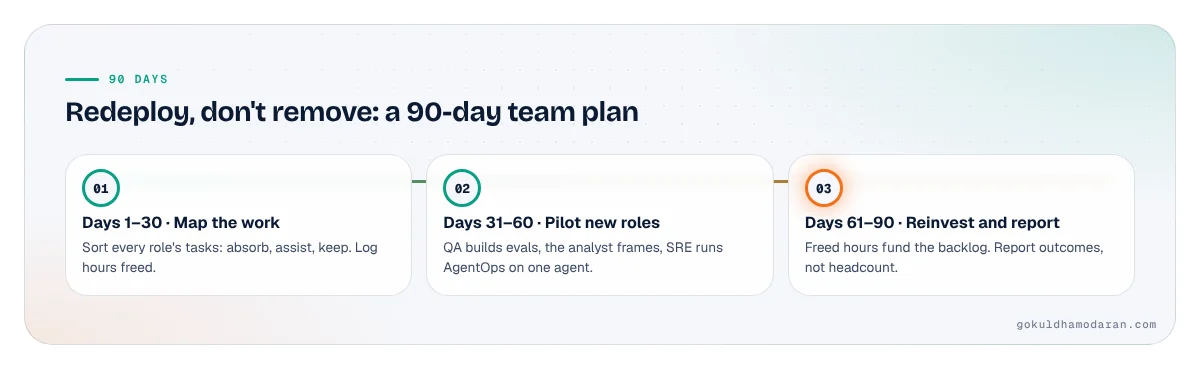
- Days 1–30, map the work. Every role sorts its tasks into absorb, assist and keep, and each person picks the ADLC stage they will own. Start logging hours freed.
- Days 31–60, pilot the new roles. On one live agent, QA builds the eval set, the analyst frames the outcome and SRE runs it with tracing and a kill switch.
- Days 61–90, reinvest and report. Freed hours fund the agent backlog. Report outcomes to leadership, and name the next two roles to move.
For each person the plan is simpler: pick your stage, learn its three core skills, and bring one piece of proof to the day-90 review. That might be an eval set, a permission map, a traced agent or a tested approval screen.
The bottom line
AI doesn’t delete the software team. It takes over the repetitive slices of each job and creates work nobody is staffed for yet: defining good, proving it, securing agents and running them. Companies that move their people into that work keep the knowledge they will need, and turn the AI impact on software development roles into an advantage. Companies that cut first will end up hiring for it later, without the context their old team had.
My read: I build AI agents myself, and the hard part is rarely the code. It is writing down what a right answer looks like. That is the job of your QA lead, your analyst and your domain experts. Keep them, and give them the new title. For more like this every week, join the Leading Indicator newsletter, read the full ADLC guide or see more guides on the site.
Frequently asked questions
Will AI replace QA testers?
AI absorbs scripted test writing and regression runs, but agents create a bigger testing job: defining what a right answer is. In the agentic development lifecycle, QA grows into evaluation engineering, owning golden datasets, calibrating LLM-as-judge scoring and running red-team sessions. Teams that cut QA first often find nobody can grade their agents.
What new roles do AI agents create in software teams?
The clearest new roles are AI engineer, evaluation engineer, agent product owner, AgentOps lead, agent identity and security, and context or data steward. Hybrid customer-facing roles are growing too: Bloomberry found forward deployed engineer postings rose 1,165% year over year in 2025. Most of these roles are best filled from inside.
How should a business analyst prepare for AI agents?
Move from writing stories to framing outcomes. Practice writing the one-sentence brief, the autonomy level and acceptance criteria as test examples with known right answers. That is the Frame stage of ADLC, and it makes the analyst the agent product owner: the person who decides what the agent may do alone and how success is measured.
Can companies adopt AI agents without layoffs?
Yes, if they plan for it. Early agents remove slices of many jobs, not whole jobs, so the freed hours can fund the agent backlog, eval sets and new roles filled from inside. Leaders should log freed hours, decide in advance what they fund, protect learning time and report outcomes instead of seats saved.
Sources
- Gartner: Generative AI will require 80% of engineering workforce to upskill through 2027 (Oct 3, 2024)
- Stanford Digital Economy Lab: Canaries, interest rates and timing (Feb 9, 2026)
- BCG: AI Will Reshape More Jobs Than It Replaces (2026)
- World Economic Forum: Future of Jobs Report 2025 press release (Jan 8, 2025)
- Stack Overflow Developer Survey 2025: AI
- Google: How are developers using AI? Inside the 2025 DORA report (Sep 23, 2025)
- METR: Measuring the impact of early-2025 AI on experienced open-source developer productivity (Jul 10, 2025)
- METR: We are changing our developer productivity experiment design (Feb 24, 2026)
- Entrepreneur: IBM CEO says AI replaced hundreds of HR workers, total employment went up (May 8, 2025)
- Bloomberry: I analyzed 1,000 forward deployed engineer jobs (Jan 2026)
- USENIX Security 2025: Package hallucinations by code-generating LLMs

Gokul Dhamodaran
I turn what is happening at the AI frontier into what it means for enterprise systems, and I build AI products myself (Euliv Analytics, Vantage). I write Leading Indicator every Friday: the AI and enterprise tech moves that matter, and what they mean for you.
Views are my own and do not represent any employer or client. Graphics are original; sources are linked.